Saturday, January 31, 2009

Sadie is one year old and in a sense, so am I


Every day Sadie is perfect. But every day she is a little more herself than she was the day before. Futurity is part of her perfection: language, verticality. We call this growing up.

A sentence I want to write: The better we think we know ourselves, the less we know of what we're capable of. This sentence may not be true; I need to invent a character to say it.

From the Wikipedia entry for Wallace Stevens: "The poet should find the words that will speak to the delicatest ear of its modern listeners, echoing what it wants to hear but cannot articulate for itself." So listeners are like children.

I am pretty much already whom I'm going to be. My futurity's at least half exhausted. Nel mezzo del cammin di nostra vita. But I can't actually know this. At any moment I might make the journey to hell, purgatory, or heaven, and not necessarily in that order.

Pointing at what she wants: something on the table, something on the ceiling, something out the window. Whining when she doesn't get it, inarticulate, disjointed.

The seeing hand. "Let me see that" means give. The talking hand (not "talk to the hand"). Crying, both hands outstretched.

A child should not mean, but be.

Her aunt gave her a wooden box with red cylinders, blue cubes, and green pyramids, and a removable lid with circle, square, and triangular openings. The idea is to put the round peg in the round hole. Sadie just takes the lid off and tosses it aside, then drops the shapes into the box, like Alexander cutting the knot.

Emily visited a Montessori school: the toddlers working quietly and diligently at their play stations, or rather playing diligently at their work stations. Then they all gathered at a table for a snack. My friend Alex says the firm boundaries established there make the child freer within themselves, later in life. It's what I tell my students about the lipograms and homophonic translations I ask them to do, though I don't say "child within."

Embarrassing how often, when trying to teach a difficult concept such as Bakhtin's authoritative speech, I resort to the example of The Matrix. "The Matrix is all around you. You can feel it when you go to work... when you go to church... when you pay your taxes." Too bad about the sequels.

Her fierceness and will, a rage boiling up from within. But language, so far, stands apart from that will. Instead it's syllabic joy: in "hat" (anything she puts on her head), in "apple" (rarely in reference to the fruit), in "duck" (not necessarily a bird that quacks). But: "up" is shifting from phoneme to morpheme, from plaything to entreaty and command.

Tonight we're meeting friends to celebrate a year of parenthood, without the object of that parenthood (we're getting a babysitter). A year in a strange country where the lights have changed. A year in which I seem to have become more porous, more easily seized by emotion. Can't think of a child's suffering now, even a fictional child, without suffering myself—is this profound or sentimental?

A year of learning to trust touch. I was recently asked, How do you hold a baby? First of all you support the head. Then you yield to the hand that seems to support you—a stark, impersonal strength that parents know. That drops you when it's done with you and leaves you breathless in front of the TV.

Standing at a nearly imperceptible distance from writing. As Sadie stands a hairsbreadth from speaking.

One strange and wonderful year down the rabbit hole, everyone seeming to fall at the same rate, but Sadie's already clutching that bottle, that cake. EAT ME. DRINK ME. Telescoping somewhere else, beyond us.

Now in the not-yet.

Tuesday, January 13, 2009

A Poem by Allen Grossman

Pretty well expresses my feelings about Israel right now. From his new book, Descartes' Loneliness:

City of David

Jerusalem is a grave of poets. Name
two who are buried there:
the poet Dennis Silk is buried there.
He lived with a dressmaker's dummy,
in a cave, on the Hill of Evil
Counsel due south of Zion Mount.
She bore him children
after her kind.—In any case, whatever
she gave birth to did not live.
Famous Amichai, also a poet,
is buried there. From his apartment on
the eastern slope you can see
a gate of the City, called David's Gate.
In '48, on a beach at Tel Aviv,
the poet Amichai held a dying soldier
in his arms. The soldier whispered—:
"Shelley." And then he died.
Poets built Jerusalem. Therefore,
poets have a duty to destroy
Jerusalem. If I forget thee,
the world will be better off.
The tree a cat can get up into,
a cat can get down from by itself.

Saturday, January 10, 2009

Once Again, It's Time to Apply for a Plonsker

A what? Read this, all you prose writers under forty, and get cracking.

Thursday, January 08, 2009

Poem for the Inaugural Poem

Since public speech is dead, they say, since poetry is only
a private, even perverse affair nowadays, since in spite of this you and you alone
will rise to the occasion, let me rise to the occasion of you!
In Frost’s wake, after Maya Angelou’s multicultural mellifluities and Miller Williams’ stalwart
soporifics, it shall be you—brainchild
of Elizabeth Alexander, as worthy a poet as any, plucked from obscurity
to be returned to obscurity, Friend of Barack, who was himself so plucked
and now bestrides the puny stage available and makes it larger by his largeness
and gives voice to those whose voices are already a bit too loud (I’m looking at you, Rick Warren,
and the Pope too, why not, the unlovely dumbass, he says homosexuality poses as great a threat to the planet
as global warming) and who speaks himself so reasonably in his plucked, scuffed baritone,
enameled mellow speech like Johnny Hartman's in the studio dark
answering Coltrane’s horn as he, Barack Obama, answers Martin’s
and maybe Malcolm’s, well we can dream we all saw that New Yorker cover
and exchanged terrorist fist bumps and fantasized a bit
about his First Lady, who let’s face it is totally packing and totally hot—
and while this poem is rolling, now, inexorably toward the real poem
let us also pay tribute to Malia and Sasha and to the whole damn handsome family
who in a single moving day will renovate so much that is now just trash and spangles—
mission accomplished, Barack, getting elected was enough
and while banks and Detroit go under and the still-President’s dodging shoes
why do I yet wish to linger in the path of the electric door
letting it shut and shut again on my foot until it gets painful
to think of you, inaugural poem, unfurling on January 20th,
getting lots of things wrong or just unmemorably and inevitably disappointing
and stalling like an opening act that’s in over its head
but stalling’s what I want so I hope you’re really long
I hope you go on for hours and days, I hope the crowd will be well provided
with hot dogs and tents and porta potties while you spiel and spiel and spiel
like an elegy for a newborn like a Jimmy Stewart filibuster
that you’ll resemble, inaugural poem, growing hoarse and sweaty and exhausted
as the crowd begins to rumble wanting history to begin
but I’m prepared to wait I’m prepared to wait it out
for who could bear it if poetry were to really be reborn
untimely now as rhetoric like the losers told him they’re just words
words we could lift to our shoulders and carry triumphant as soldiers
to the Black White House we’re all secretly hoping you’ll give us
and preach it sing out testify amen brothers sisters speak in tongues
give us back our public ecstasy give us back the beside ourselves
give us back to nobler thoughts and gives us back to waking reason
give us the snake to handle it’s alright now we’re experienced
for history is a temptation after these nightmare years
these satanic treadmill years blackened with the smoke of bodies
flag-covered coffins and factories, flagged detention centers and lapels,
flagged schools and postoffices—simply to buy a stamp was to feel shame—
and now you’re here, inaugural poem, I and everyone can scarcely believe it—
let us down gently as you’re meant to, deliver an awkward common speech
salted with unmemorable metaphors but maybe a single metrical line
that will give us back the gift outright that lies soiled from neglect
some trace memory of untrustworthy eloquence for a moment we can trust
will open wide the door to what no one scarcely imagined
shouldn’t you shut up and just say what everyone is thinking
over and over till the taste of it is swelling in every mouth
President, our
President, black
President, our black President—
so call him to preside
over what’s best and worst in us, masses yearning to breathe free,
masses yearning to be masses, many-purposed but a living ear
to hear you fall at last to silence. And let our President speak.

************

The lineation here's a mess—Whitman could never have used Blogger—but beyond my meager technical abilities to correct. I read this poem at the MLA off-site reading (maskless). It was going to appear in a chapbook of poems for the inauguration that will be published by DePaul University, but they objected to the line about the Pope and I decided to leave it in, so that means leaving the poem out of the anthology. My first time being censored, that I can recall, and a fitting moment of ambivalence.

Wednesday, January 07, 2009

Gaza

It should go without saying that I'm horrified and disgusted by Israel's assault on the helpless civilians of Gaza. Unfortunately, it doesn't. So, in case it matters to someone, even one person, I'll say it here.

Unlike most of my extended family, I was not raised with any special feeling for Israel—partly a byproduct of my liberal parents' distance from Judaism as a religion (I grew up attending a Unitarian fellowship, making us "Jewnitarians"). My sense of Jewishness was firmly diasporic, and—for better or worse—largely informed by the experience of the Holocaust, which my maternal grandparents had both improbably survived (as had my mother, born in 1942 and hidden by relatives in the Budapest ghetto till war's end). The stories I absorbed from her, from my grandfather, and the gruesome books that my mother collected on the subject, formed the kernel of my notion of Jews as victims of power. Jews as wielders of power were difficult to envision, but if I did envision them, I imagined that they would be called to a higher standard of ethical conduct both by the Torah itself and by the historical experience of near-extinction at the hands of oppressors. It's stomach-wrenching to see that experience being used, instead, to justify the oppression of others through routinized racism, the creation of new ghettos, and plain old-fashioned banditry.

Again and again I hear the argument: you'd do the same if rockets were being fired at you. Obama, who like every other American politician panders to, if not Israel itself than to the debased American discourse about Israel, said it himself. It's profoundly disappointing to see the people I must claim as my own, whom if they are to mean anything as a Jewish people must hold themselves to the highest standards of justice and equality, justifying their actions with an argument that amounts to "anyone would do the same in our place." It's a meaningless argument that makes the special cultural heritage and historic burden of Jewishness just as meaningless.

My tribalism, such as it is, is primarily invested in communities of choice: poets, intellectuals, D&D fanatics. But I would make myself part of another tribe, however small and splintered: secular Jews with a nevertheless religious feeling for the meaning of a chosen people—chosen not to prevail over enemies, or to take land based on Biblical claims, but rather chosen to be choosers of the more difficult, less expedient, most just path, whatever the situation. I am therefore not a Zionist, though I'm not an anti-Zionist either—a Diasporist, who rather thinks that Philip Roth got it right in his amazing metafiction Operation Shylock: A Confession. That's the Jewishness I'm committed to: suffering questions, and not punishing those who question us. The Jewishness of Marx and Emma Goldman and Rosa Luxemburg; the Jewishness of Kafka and Benjamin; the Jewishness of Rosenzweig and Roth and Leonard Bernstein.

My identity aside, powerlessly, imperatively, I say simply: stop. Stop the war. Stop making widows. Stop making orphans. Stop making fresh hatred. Stop today. Stop now.

Stop.

Tuesday, January 06, 2009

Lillian Ruth Rasof Corey, 1922 - 2009

Pictured at left, a couple of weeks ago, with her friend Helene in the background and Sadie Gray in front.

Goodbye, Grandma. You taught us all a lot about love.

Thursday, January 01, 2009

Poets in San Francisco

First, some images, in more or less reverse chronological order:

Fog rolling in.


Michael Palmer reading Ernest Jones's "Songs of the Low" and other poems from the new Volume III of the Poems for the Millenium anthology, edited by Jerome Rothenberg and Jeffrey C. Robinson, and devoted to "Romantic and Postromantic Poetry."

Leslie Scalapino reading STC's "Kubla Khan" at the same event.


Carmen Gimenez-Smith and Richard Greenfield at dinner after the reading.


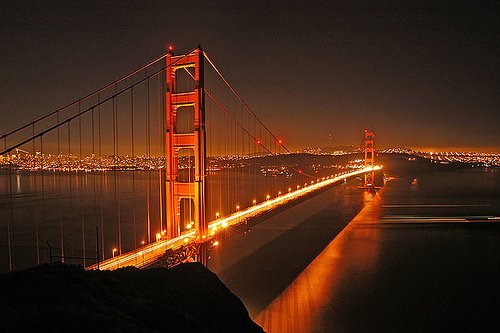
Obligatory shot of the Golden Gate Bridge


Brian Teare, right, and his partner Robert.


Angular view of the Contemporary Jewish Museum, downtown.


The Transamerica Pyramid and the Zoetrope building.


Me in a tree at Muir Woods.


My sister Vanessa and her neighbor's dog Einstein.


Shadows of Vanessa and me at Land's End.


This trip was just about everything I'd hoped for: five days devoted to poetry in one of the most beautiful cities on earth. I did nothing whatever MLA related, though I did participate in the off-site reading at the Yerba Buena center on Sunday night (there's a story to be told about the poem I read but I'll save that for another post). But I went to all my favorite bookstores (the ones that still exist, that is; but I didn't make it to the East Bay to mourn for Cody's in any case) and bought a pile of things I have no time to read, and I hung out with my favorite people, and perhaps most significantly did a manuscript workshop on Saturday night with Richard Greenfield and Brian Teare and Catherine Meng (we also went over Cat's remarkable new manuscript, bits of which have appeared here and there, most recently in Fence: it's a book partly inspired by Lost and the questions of collective subjectivity and narrativity that that show's capable of raising in its finer moments). In the workshop, I was persuaded of a couple of things:
- The Odysseyan superstructure that I'd constructed this past summer as a means of freshening and re-opening the poems was actually a cumbersome distraction from the poems, which don't need its help.

- The title, Severance Songs, has to go. Brian doesn't like "severance" because he doesn't think the poems are about that; Richard doesn't like the unreconstructed romanticism of "songs." Cat doesn't mind the title, but she does agree the book needs a new frame, and Homer isn't the guy to provide it.

- The individual poems may or may not need titles so their density doesn't overwhelm the reader, a real risk in a whole book of formally similar poems. (More formal variation or ventilation of some of the poems may also be required.)
The problem of the new title really stumped me all day Sunday as I wandered about the city. I've used the old one for so long, and published many or even most of the poems with reference to it, including the chapbook-sized chunk that appeared in Conjunctions in 2004. The title has, at least in my own mind, taken on some of the attributes of a brand, which I'm leery of discarding. On the other hand, it's obvious that the poems need a new frame, a new handle, which will provide unobstructed (or unobstructive) access to them. At the same time, I need to honor the poems as they were written and the original impulses behind them, not thrash about in search of a "high concept" that will erase the slowness of their accumulation.

Because they were written day by day, more or less in response to events in my life while living in Ithaca, I considered using a term like journal, diary, notebook, or daybook in the new title. But this would suggest a casualness that the poems, in their post-Stevensian density, simply don't reflect. Then I thought of using the word "sonnets," since the sonnet form is the most unifying principle of the book. None of the poems use end rhyme in any systematic way, but they're all about fourteen lines long and play with the argumentative structure of the sonnet; more significantly, the pursuit of an impossible ideal is the most consistent theme in the poems as a whole. But to use sonnets in the title would imply a sequentiality and completeness that's as false as the retrofitted Odysseyan superstructre. This is a serial poem, if it's anything, with the open-endedness and anti-narrativity that implies.

Browsing in Green Apple Books with Brian the next day, I mused to Brian that maybe I should simply name the book after the place in which I wrote it. Ithaca is out, obviously, and Ithaca, New York is specific in the wrong way. What about Southern Tier, I asked him. Then he reminded me that the Fingerlakes Region, and western New York in general, has another, more remarkable name that it acquired in the mid-nineteenth century: the burned-over district.

This immediately appealed to me. First of all, it plays with the idea of the poem as field or territory, and the ventilation of the poems is my attempt to deterritorialize the "little room" of the sonnet. Then of course there's the term's actual reference to the region I lived as a place so prone to spiritual uplift and transformation on a massive scale (in the Second Great Awakening) that it was spoken of as a place in which all the spiritual timber had already been used up. The Oneida colony, Joseph Smith and his golden tablets, the Shakers, and other such Transcendentalists avant la lettre all made their most significant spiritual discoveries in western New York. Finally, while on the one hand the term suggests devastation—a spiritual commons turned stale, flat and unprofitable from overuse—it also suggests renewal, as in slash-and-burn agriculture. All this seems to apply to what the poems actually are and do, in a way that the Odysseus model simply doesn't.

So, that's the new title of my revised manuscript: Burned-over District. I think that turns the corner and takes the poems into a new epoch, which is a movement I really need. Not just so that the book itself might see the light of day, but so I can begin to close the door on this project and start seeing what new things arise. I'm grateful, above all, for my poetry companions Richard, Brian, and Cat, part of my Montana cohort and, as I said that night, invaluable "continuity girls": the people who have known you and your work long enough to remind you of who and what you're really about. I've been struggling with my own love of beautiful language—a kind of Oedipal struggle with Stevens, who's the poet that first enabled my own writing at a tender age, and who's in my DNA now for better and for worse. My comrades gave me permission, and the book permission, simply to be myself. There's no greater gift.

Wednesday, December 10, 2008

Gudding, Bolaño, and the Limits of Literature

Last week I had the pleasure of having Gabe Gudding up to Lake Forest to talk to my Modern Poetry students and give a reading. I'd recommend him to any teacher and any class anywhere. One of my students marveled afterward about how unpretentious he is. Both in conversation and in the reading he was a quiet, yet commanding presence, the best imaginable soft advocate for his own work. At least three of my students wrote or are writing pieces inspired by him and Rhode Island Notebook in the wake of his visit, and it's some of the best writing they've done all semester.

But I come not to praise Gabe but to bury him, or rather to contemplate his own flirtation with the limits of poetry. We were all struck by his admission in the class that he often doesn't like or feels embarrassed by his old work—something most writers can surely relate to—but during the Q&A after the reading he went further and told us that he doesn't read much poetry any more and doesn't really like or trust it. "I want poetry to be useful," he said, and said he was moving away from beautiful language and metaphors (things he clearly loves and which come naturally to him as the leaves to a tree) toward simply presenting the things he finds in the world—an Objectivist-inluenced stance. The example of the new style that he presented was an section from his horological essay, "Praise to the Swiss Federation," a portion of which was excerpted in Harper's. I took this piece for a poem in the spirit of Christopher Smart, but Gabe calls it an essay, and as such evidence of his move away from poetry and, it would perhaps not be too much to say, an expression of his unease with the literary as such.


Given my obsession with Roberto Bolañno, it was natural for me to connect Gabe's unease with the central quality of Bolaño's greatness, as asserted by the clever boys at n plus one, following up their own Benjamin Kunkel's review of The Savage Detectives that first appeared in the London Review of Books. There Kunkel wrote, "Here is a writer, then, who writes as if literature were all that mattered, and at the same time writes in a distinctly unliterary way." The collectively authored n plus one piece goes further, comparing Bolaño or at least his similarly sudden canonization to W.G. Sebald (have they been reading my blog?) and saying of both authors, "neither fiction writer writes as if he believes in fiction. Our canonization of these writers implies a sense, even a conviction, that you can't be a really important novelist anymore unless you can't really write novels" (italics original).

We have overshot, then, the hermeneutics of suspicion that characterized "theory" in the 1970s to arrive at a poetics of suspicion: only literature that puts the very premises of the literary into question can now summon the aesthetic impact we associate with great literature. This may represent the most complete assimilation by authors of the skeptical stance that diffused itself in the last universally acknowledged great wave of postmodern fiction (Pynchon, Delillo, Coover) and poetry (Ashbery, Ashbery, Ashbery). Now it's not merely literary strategies that are picked apart and turned around through unreliable narrators, disordered chronologies, the blurring of fact and fiction, extreme parataxis, etc. It's the literary itself, the summoning and deployment of aesthetic effects, summarized in the phrase "beautiful language." It's like the avant-garde attack on art as an institution, but the spirit is less merry prankster than Beckettian: I can't go on writing, I'll go on writing. Which tone makes me wonder if this new anti-literary strategy isn't just modernism through the back door, since it's modernism's aura of mournful remembrance that most superficially distinguishes it from the products of postmodernism.

The only problem with this thesis is that it isn't really true. Sebald's work first shocked readers with its apparently artless photographs and endless paragraphs, but in recollection the work is nearly limpid, its melancholy polished to a high gleam. If Sebald's writing drew sighs of longing from its American readers, that had less to do with a sense of liberation from the literary than it provided a frisson of contact with a culture and history and tragedy that seemed far weightier and more substantial than ours during the decade of his American emergence. He seems less strange and more realistic in post-9/11 America, with his endless search for lost people, lost time, lost atmospheres. As for Bolaño, I suspect the artless, "lurid and flat" storytelling we accuse him of now will become not the surface to be broken by the diving reader in search of deeper, more duende-like qualities; instead, it will eventually be seen as the very thing that attracts us and which marks his writing as literary: that is, language hijacked on the road to representation by the very starkness and strangeness of the real that infiltrates and suffuses the work of Sebald and Bolaño alike. Or to put it another way, this is writing that doesn't pretend to understand the strangeness of life but lets it unfold, never shaped in any form save by storytellers who don't disguise both their interest in and their lack of control over the outcome. Sebald did this monologically; Bolaño's major innovation is his dialogism, as seen in the innumerable narrators of The Savage Detectives. None of them has a handle on the truth, but collectively they present us with the restless search for truth, for a truth that can account for the fate of the novel's antiheroes on every level: social, economic, juridical, literary, geographical. From what I've read of 2666 he pursues a similarly dark and heteroglossic investigation, one with far more chilling consequences in its irresolution.

Which takes me back to Gabe, whose Rhode Island Notebook already shows signs of the anti-literary, hyper-literary stance he now wants to take toward poetry. In its seemingly artless, scatological, essayistic progress, the book picks up and discards language both lyrical and mundane, sometimes sadistically so, reckoning experience through that simplest and most flexible of narratives: there and back again, anabasis-katabasis. So when Gabe talks about wanting to somehow move beyond poetry, yet in poetry, I want to send him one of those old Publishers Clearing House envelopes that says YOU MAY ALREADY BE A WINNER. And I wonder what his model may have to teach me in my own moment of revulsion (too strong: recoiling? re-collection?) against my own literary DNA, my own restless distrust of the beautiful language I seem so badly to need.

Tuesday, December 02, 2008

Flowers in My Hair


Caught in the feedback loop of silence. Wanting to write—there's no more futile emotion. You have to want to write something. And I am writing, here and there, but it never seems like the thing. But wanting it to be "the thing" is what defeats me.

There are two books I want to read between semesters: Robert Bolaño's 2666 and Lewis Hyde's The Gift. Bolaño draws me in much the same way W.G. Sebald did years ago, though he entirely lacks Sebald's lyricism (in spite of being a poet) and studied sense of guilt (except in the fictional sense, as in the sensational, abject guiltiness of Father Urrutia in By Night in Chile. As for Hyde, his book is a vade mecum that others have tried to push on me in the past, but I always avoided it, knowing little about the author and suspecting, because of the title and the way it's marketed, that it's basically a glorified self-help book. Just look at that little heart! But from what I've heard, it really is a masterpiece and a boon to the thinking of any poet who seeks escape from markets (especially the market in recognition that is the subject of Adam Kirsch's latest dismal screed in the same November issue of Poetry that gave me my first taste of the poetry of Robert Bolaño [typically, though he always thought of himself first and foremost as a poet, only his fiction has made it over into English]).

But I mention Kirsch because of his essay, with its anatomy of the scorn that has been heaped on the head of Keith Gessen, author of a novel that both chronicles the literary ambitions of young men and is the ourouborian document of Gessen's own ambition—much misplaced, it seems, in these unliterary times. Why didn't he just do a virtuosic job of lip-syncing something on YouTube? But then, why don't I? Because I have this faith in literature which is yet killing my ability to produce any. The desire to speak from the mountaintop—to go big—to take on one's era—shames and paralyzes. We must think small, instead, but cannily: to assume that our petty obsessions are the keys to something greater. Joyce's silence, exile, and cunning must meet with Emerson's core belief: "To believe your own thought, to believe that what is true for you in your private heart is true for all men, — that is genius." And that is how I recognized the genius of Bolaño, who writes frankly and astonishing about the pettiest of worlds—the world of poets—and ends up going very big indeed, stalking nothing less than the wounded utopian specter that haunts the Americas, manifesting in the present tense as farce (in the government and persona of a Hugo Chavez), as cynicism (it's hard not to feel hopeless at Obama's apparent transformation into Clinton III—but did he really promise us anything different?), or most starkly as murder (the countless unsolved murders of young women in Juarez that are the major subject and backdrop of 2666).

The very little I've seen of Hyde is a tonic for all this. I couldn't find The Gift in the Evanston Public Library, but I did glance at his introduction to the collection of Thoreau essays he edited, in which he talks about Thoreau (and I think Emerson) as a master of the prophetic voice: that which stands upon the hilltop above the valleys of venal life and proclaims—not the future, but truths which must be eventually be fresh again because they are eternal. Up to this point Hyde seemed a talented hagiographer. But then came this astonishing passage:
A Thoreauvian prophetic essay leads us on a redemptive journey... but there is a redemption of the valley as well, one that comes from abandoning all hope of getting it together. If you need to come apart, you do not need to listen to the prophetic voice. Stop trying to be a hero. There is a time to fall to pieces, to identify with the confusion of your life as it is, confined absolutely to the present November sunset and your present apartment. (Emphasis added.)
This is exactly what I needed to hear, exactly the cure for the itch of objectless ambition, or more simply the desire to "get it together": to seamlessly synthesize a life that, in its multiple spheres—writing, new fatherhood, marriage, teaching—resists all my efforts to be glued into a whole. If I can take Hyde's advice and be an upended Thoreau, who goes not into the woods but deeper into his own messy life, maybe I'll find my way back to the writing that matters to me, without letting everything else go any more to pieces than it already is.

As a step in this direction, which may superficially resemble the urge to get it together, I'm taking a holiday to San Francisco at the end of this month, roughly coinciding with MLA, though I have no plans to attend the conference itself. Instead, I'm going to meet up with the poet-friends who will be converging there, to talk poetry and read manuscripts and browse Green Apple and Moe's Books like in the old days, and reconnect with that hauntingly beautiful cityscape, and just be a poet for a few days, letting the ties that bind me unravel a little bit without worrying about reraveling them later—they'll do that themselves, god knows. My beautiful wife is willing to let me go for a little while, though it will be painful to miss even six days of little Sadie Gray's growth. (She's dabbling now in language: show her a picture of a dog or say "dog" to her and she makes a little "uff-uff" sound, almost reflexively, her bright and shining eyes as yet displaying nothing like consciousness, present-tense eyes like those of dogs themselves.)


And so I have no plans either to get this blog together. Let it hang out as it will, a post per month or per day or per year. Let it and the pace of expectations adapt to my life and not the other way around for a change.

Monday, November 10, 2008

Troublesome and Lamentable

In one of the odder choices of entertainment that I could have made post-election, I went downtown this past Wednesday to see Sean Graney's ferocious production of the play I wrote my master's thesis on, The Troublesome Reign and Lamentable Death of Edward II, King of England, with the Tragical Fall of Proud Mortimer. I've seen one other production of the play in San Francisco, a more conventional staging that emphasized its homoeroticism at the expense of other qualities, and in fairly blatant ways (the first scene finds Piers Gaveston cavorting on a gigantic bed with half-a-dozen other naked men). Graney's production emphasizes the sheer dreadfulness of the story: a weak, vain king's passion for a French commoner destroys him and everyone around him. But he tells the story with a kind of black joie de vivre: a spirit emphasized by the gleeful intensity of the actors with whom the audience interacts very closely, for the play is done "promenade" style. That is, most of the audience is right there on the "stage" with the actors, and we moved or are moved about to follow the action from corner to corner. The mood was set from the very beginning, as a kind of club beat pounded while audience and actors shmoozed under the lazy eyes of King Edward, watching from his throne:
At one end of the floor, where stage center would be in a more conventionally blocked piece, was the arresting image of a heap of broken images—sorry, chairs:
Most ominous was the grisly bathroom to the audience's left as we entered the space: the room into which, one after the other, the play's principal characters are led to be executed (with of course the singular and "fundamental" exception of the gruesome onstage murder of the king himself—the murdered played, as was the case in the San Francisco production, by the same actor who had been Edward's lover earlier):Out of the mob of actors and audience order of a sort does emerge once the play gets going. Graney cuts a lot of Marlowe's text, inserts a number of anachronisms, and unbalances the balance suggested by Marlowe's long title: in spite of his childishness and spitefulness, our sympathies are engaged by the fey, hapless Edward much more than they are by the thuggish, homophobic Mortimer. One ought to feel, I think, a bit more strongly how Edward's distraction has put the entire kingdom at risk: Mortimer ought to emerge as a thug, driven to unspeakable evil by noble motives, if the play's design of darkness is to properly appall. But it was cracking good theater nonetheless. One element I liked was how, after each character's death, he re-emerged bloody from the bloody bathroom to be led offstage by a hideous masked Death ringing a bell. At the play's conclusion, young Edward III mourns his father and one of his attendants is a figure wearing a similar mask, though smaller and daintier. As the last line rings out, this figure whips off his mask to reveal the face of the murdered king. And so Edward II's identity with death is made clear.

Here's hoping that the coincidence of this tale of mischief, mayhem, and misrule has nothing whatsoever to do with the atmosphere of our new administration. So far things seem to be going smoothly with our new, rockstar President-elect. The sense of relief I feel about the presidency's being assumed by a genuine grown-up—an intellectual, even—grows and grows. It remains to be seen just how progressive he will be, but I continue to be stunned by the sensation of having a leader I don't have to be ashamed of. A few poets have already begun to muse about what Obama's rise means for American poetry: some seem to conclude it means—drumroll, please—the death of irony. Others have come to the same conclusion in a decidedly tongue-in-cheek fashion. I'm beginning to assimilate various thoughts about it.

In the must-read insider's account of the two campaigns in the latest Newsweek, the writer remarks on how after World War II, Democrats and Republicans fought as hard as they ever had, but they both had the shared experience of war in their backgrounds, which bred a certain degree of respect, or at least recognition. We don't have that. Instead, we have echo-chambers, crystallized now in the very, very large chamber of Obama's supporters (whose sudden disconnection from the feeding tube of electoral news has become an instant joke) and the somewhat smaller chamber of Republican dead-enders now busy telling each other that McCain lost because he wasn't conservative enough. Now there's talk of bipartisanship, about which I have very mixed feelings. On the one hand, I don't understand how we can even begin to talk about sharing power with the people who have been so cynical about power and government: whose skill (up to now) in winning elections was inversely proportional to their basic competence, even in pursuing their own fucked-up goals (c.f. Iraq). On the other hand, to turn around and pretend that a massive swath of the population which continues to be conservative—"Real America"—is actually faker than fake, means to buy into a similar kind of cynicism. Count me one of those stirred by Obama's 2004 claim that "there is not a red America or a blue America but the United States of America!" But joining hands with the people who've done so much to make the very word "America" into a dubious object doesn't sit well either.

I find myself thinking, of all people, of Giambattista Vico, whose New Science I'm being reintroduced to as I finally start to read a book I've long delayed reading, Robert Pogue Harrison's Forests: The Shadow of Civilization. Harrison and Vico together both seem like practitioners of what Isaac Asimov called "psychohistory," studying the past in order to predict the future. Harrison takes the title of his first chapter, "First the Forests," from Vico's analysis of the progress of human civilization: "First the forests, after that the huts, then the villages, next the cities, and finally the academies." But in Harrison's reading, this account of progress and synthesis is really an account of disintegration and decline. His reading of Vico reminds me of nothing so much as Adorno and Horkheimer's analysis of the dialectic of enlightenment, by which that which disintegrates myth—critical reason—becomes itself a myth that must itself distintegrate. It's the nutshell version of postmodernism. Breathtakingly, Harrison shows how Vico presents humanity emerging from the forest, only to recreate a "forest" of isolated individuals within the bounds of the city as myths and traditions fall apart to be replaced by naked self-interest. Vico:
But if the peoples are rotting in that ultimate civil disease [skepticism] and cannot agree on a monarch from within, and are not conquered and preserved by better nations from without, then providence for their extreme ill has its extreme remedy at hand. For such peoples, like so many beasts, have fallen into the custom of each man thinking only of his own private interests and have reached the extreme of delicacy, or better of pride, in which like wild animals they bristle and lash out at the slightest displeasure.
Does this not describe our culture as it is, or as it was on the verge of becoming, before we agreed on a monarch from within (deeply within, I take it, as Obama's multiracial appeal makes him truly resemble an image of America as it is and shall be, more than any visage featured on any currency)? Are we not, in our respective blogospheres, at the extreme of delicacy and pride, reacting disproportionately to every stimulus that penetrates the bubble? It doesn't seem like too much to say that, had McCain prevailed, Vico's account of the ironic society could and should have been printed as the most accurate front-page news of our condition. It remains to be seen whether Obama is the symbol of a counter-impulse for a new, progressive mythology, or if his election will amount to too little, too late.

Is the poet's task now, then, to consolidate the new myth? Are we to become court poets singing the praises of our new king? I wonder. The New York Times has poems about the election from John Ashbery, August Kleinzahler, Joshua Mehigan, Mary Jo Bang, and J.D. McClatchy. Only McClatchy's poem is free of irony, and in fact it stages a little morality play about hope versus cynicism. It is also of course the least interesting poem, language's little perversities having been ironed out by its firm-handed message. So again I wonder: where does politics leave poetry, now that poetry, or at least oratory, has re-entered politics?

Perhaps more free than ever before. Certainly not less relevant to public discourse, because there's nowhere for a needle to go beneath E. But poetry still wants to be public, still wants to tease out myths, still needs to believe it's stitching something together more perdurable than the animal media and the quick, unsatisfying his of connection it offers.

The hopefullest time I can recall as an adult. A time which will no doubt pass too quickly: the troublesome and lamentable will no doubt return. For now I take comfort in Whitman's remark about the President: that he takes off his hat to the people, not they to him. That there is some hope in hope's endurance.

Wednesday, November 05, 2008

Hallelujah


Free at last. Free
at last. Thank God Almighty
we are free at last.

Tuesday, November 04, 2008

One Vote

From Emily's phone.

My turn comes later.

Sunday, November 02, 2008

Nothing Up My Sleeve, or, Teaching the Extraverts


There are two kinds of people: those who divide the world into two kinds of people and those who don't. Clearly I'm the first kind, though I try to remain skeptical and self-conscious about my own tendency to do so, and so is the artist referred to universally on the Lake Forest College campus simply as "Archambeau." He has a fascinating recent blog post titled Roberto Bolaño and the Extravert Muse that uses the Jungian categories of "intravert" and "extravert" to characterize artists and their relationship to their work (or maybe more precisely, their muses). As Bob points out, these categories roughly correspond to Schiller's "sentimental" and "naive" modes of poetry, and one could actually easily come up with one of those x/y columns like the ones that I remember use to lay out the vulgar distinction between modernism and postmodernism. So:

intravert
sentimental
Apollonian
cooked
craft
deliberation
meaning creates music
the 18th Century
traditional form
Auden
extravert
naive
Dionysian
raw
inspiration
vision
music creates meaning
the 19th Century
open form
Spicer
One could easily make too much of this. But like all such divisions, as a quick graph it has some utility, and just now what concerns me is the problem it suggests (Bob touches on this too) for the teacher of creative writing. It's relatively easy to teach the first column, and in fact the notion of poetry as teachable derives from that zone. What's seemingly impossible to teach is the second column, and that more romantic notion of what a poet is inspires the saying, "Poets are born, not made," and lead all sorts of people to doubt and calumnify the value of creative writing programs. The best we may be able to do, as Bob suggests, is to offer students Noulipo-type constraints which will produce a poem of the second column using the methodology of the first.

The alternative that I've seen put into practice most often relies on sheer charisma: the students sit at the feet of a poet-guru who may or may not be able to articulate the rules of craft, but whose value as a teacher relies largely on simple proximity. The poet-guru is a role model for how to be Dionysus in a world run by cut-rate Apollos: a lady of first permission, to paraphrase Duncan. Jorie Graham is such a teacher, and a wildly effective one (you can see it in her hair), but it's a pedagogical mode that is itself unteachable. And in a way, to be an extravert teacher doesn't at all address the problem of being an effective teacher of an exravert student. The very framework of the academic creative writing classroom and workshop is intraverted, and the charisma of the extravert teacher may actually do more to loosen up her intravert students than it is likely to foster a sense of permission among those already basically alienated by the workshop structure. What I've seen more often is high- or low-speed collisions between teachers and students of the same extraverted ilk, resulting as often in confusion and bitterness as it does in a sense of discipleship (itself a problematic outcome).

The extraverted students of mine that I can identify are few in number; I think it takes a sense of self unusual in an undergraduate to share writing that one can't or won't explain (most of my creative writing students are ready and eager to explain their work: "No, see, what I meant here was..."). They come to me sometimes expressing frustration with their workshop group, whose response to their original, striking, but messy work is generally one of bafflement. I try to offer them my encouragement and appreciation for what they do, which is after all the poetry I'm most inclined to think of as "the real thing." If they're receptive, I also try to verse them in the intraverted language that can be so helpful to a poet when it comes to presenting his or her work, but is even more important as a shield: the worst thing that can happen to such a poet is if someone steals or vandalizes or changes the channel on the radio from which he receives his Martian transmissions. I point this out more often in my modern poetry lit class: how necessary it is for many poets to be tricksters, to come up with a convincing stream of patter to distract the critics from their essentially ecstatic practices. The alternative for many has been drugs and alcohol, which is of course in the long run as fatal to one's self as to one's art. If Hart Crane had come up with some decent patter for Yvor Winters, he might have lived longer.

When I've taken the Jung-inspired Myers-Briggs personality test, I come up as an INFP: an Introverted Intuitive Feeling Perceiver. But it's always a close thing: my scores hover around the fifty-percent mark in three of the four categories and if I just answered a few questions differently it's conceivable I'd turn out an ENTJ—an Extroverted Feeling Thinking Judger. That suggests a degree of ambidexterity, or maybe a comfort zone that's broad enough to be fungible. Because I can talk the intraverted, craft-y, Apollonian talk as a teacher and critic and inveterate categorizer; but when I write poetry, I don't feel at all the sense of Arnoldian mastery and control that I imagine the true intravert poet does. The words lead me on, and only retroactively can I construct the narrative that might help me present that work for an audience of listeners or editors. I'm not lying when I explain my poems, but I don't feel like I'm being true to my process either, because the meaning of my work, to me, only becomes hazily apparent when I read it.

Only to friends and intimates am I comfortable admitting that I don't know what something I wrote is about—yet. For everyone else, I've got the necessary patter. Nothing in my hand, nothing in my other hand, nothing up my sleeve. Asking myself at every moment of the act: is this my card?

ADDENDUM - 11/3/08

A remarkably relevant paragraph from Adam Gopnik's essay "Last of the Metrozoids," which my creative writing students are reading in Heather Sellers' The Practice of Creative Writing. Can't help but see its relevance for our political moment as well:
It is said sometimes that the great teachers and mentors, the rabbis and gurus, achieve their ends by inducting the disciple into a kind of secret circle of knowledge and belief, make of their charisma a kind of gift. The more I think about it, though, the more I suspect that the best teachers—and, for that mater, the truly long-term winning coaches, the Walshes and Woodens and Weavers—do something else. They don't mystify the work and offer themselves as a model of rabbinical authority, a practice that nearly always lapses into a history of acolytes and excommunications. The real teachers and coaches may offer a charismatic model—they probably have to—but then they insist that all the magic they have to offer is a commitment to repetition and perseverance. The great oracles may enthrall, but the really great teachers demystify. They make particle physics into a series of diagrams that anyone can follow, football into a series of steps that anyone can master, and art into a series of slides that anyone can see. A guru gives us himself and then his system; a teacher gives us his subject, and then ourselves.

Friday, October 31, 2008

Barack Obama for President

The urgency of electing this man—with his curiosity, his compassion, his steadiness, and his pragmatism tempered by idealism (not the other way around)—seems to me blindingly obvious yet worth saying and repeating. Only fear of his otherness, which the Republicans are pushing hard, would seem capable of derailing him now. I hope it won't happen. I've read all the polls, I've heard many anecdotes, and I think it won't happen. Barack Obama is our next president. But will he win a powerful enough mandate to counter the vitriol, hatred, and cries of illegitimacy that will be coming from the radical right-wing margin that dictates the agenda of the so-called mainstream? If you thought the wingnuts were at their nuttiest during the Clinton years, you ain't seen nothing yet.

So let's vote for him in vast and overwhelming numbers. Let's see all the new voters that the pundits are so skeptical about actually show up at the polls. Let's suspend for just a moment our natural skepticism and believe, not in Obama the man, but in what he's come to represent. Not so much a new politics, for I don't recognize the "Obambi" figure that Roger D. Hodge laments in his extraordinarily cynical "Notebook" piece in the latest issue of Harper's. Obama's thrown plenty of elbows: this has been the most efficient, ruthless, anti-Roveian campaign a Democrat could wish for. I hope and expect that Obama will play the game that needs to be played—not a post-politics (as another Harper's piece suspects and fears) but a politics that effectively mobilizes the majority of the people to act in and fight for their own best interests: a well-managed economy that is also a green economy; a foreign policy that wins friends, influence, and partners; health-care as a human right; peace. Will Obama bring about these things? Almost certainly not. But he might be the tipping point which helps all those thousands of people who've turned out to see and hear him realize their own power, contra Hodge, and take new responsibility for their own destinies.

Michael Schaivo has said all this more eloquently than I, so go read him and forward that to your friends and relatives on the fence. And go vote.

Tuesday, October 21, 2008

Touch

An unhealthy obsession with political blogs, plus keeping up with three classes and spending time with my family, has left poetry (and this blog) in the dust. This worries me a little. It's not that I think the world thirsts for my opinions, but rather that the blog has been my primary means of engaging with poetry for so very long. And if neglecting the blog had somehow led to my writing or reading more poetry that would be an acceptable bargain, but it hasn't. Instead the only poetry I read is the poetry I teach: very good stuff (Whitman this week and Dickinson next week in my nineteenth-century class; Ginsberg this week and Gwendolyn Brooks next week in my modern poetry class), but by no means new to me. Which doesn't mean I won't make discoveries reading Song of Myself for the umpteenth time, but my role as a teacher does tend to confine me to reading for the clearest through-line that I can offer my students, as opposed to getting caught up in eccentric eddies as I would be if reading for my own pleasure and advancement.

On the other hand, engaging in the contemporary for the contemporary's sake may be the most rapid path to irrelevance. Getting the news from poems doesn't mean reading the latest poems as though they were the newspaper (or Juan Cole or Talking Points Memo). Having for a while been most engaged by the poetry of news, or the pomo poetry of poets striking tragical-comical-pastoral poses amid the potpourri of capitalism, I now feel my inclination drifting toward a more Romantic stance. Which leaves plenty of room for political engagement and critique, but doesn't depend on a shielded persona, either. The contemporary poets who've been my most steadfast mental companions are those who—I hate to resort to workshop-speak, but it seems inevitable—stake themselves in and on their poems. Julianna Spahr, Lisa Jarnot, Jennifer Moxley, Claudia Rankine, Lisa Robertson, Alice Notley. It's not too much to say that these women are some of my heroes for writing smart, thorny, sometimes luxurious and sometimes threadbare verse in which I feel the presence of a living person who situates her whole mind and body in a world I recognize anew through her vision. They bare their injuries to the reader, but not to feed her prurience a la the Confessional poets; they're simply unwilling to play the fundamentally adolescent game summed up in the warning phrase, "Be cool."

It's strangely difficult to think of contemporary male poets who do this, whose work isn't suborned in some way by the need to shield their egos. (Heterosexual male poets, I should say: I would classify the work of my friend Brian Teare, for example, with that of the women neo-Romantics I've mentioned.) Older poets come to mind, Allen Grossman chief among them, but not those of my own generation or younger. Because of that I've come to prefer those male poets who are very far from cool—whose vulnerability is made transparent by their self-aggrandizement—a mode I associate with the likes of D.H. Lawrence and Ted Berrigan. But it's hard to write that stuff without veering off into camp, which is another defense, another version of "the cool." Gabe Gudding comes very close to what I have in mind. So does Dan Bouchard, and my other great poetry friend, Richard Greenfield.

This is all very personal: I've never been cool, and now that I'm a father I feel warmer than ever, repelled by even the mildly ironic carapaces of the professoriate I'm now a part of. And the temptation of being accepted as "one of the cool kids"—a running buddy of the Flarfists or post-Language poets or any clique you'd care to name—has lost much of its hold over my imagination. Which is not to say I reject the possibilities of the group or wish to retreat to some naive atomized model of the lone poet. Most of the poets I've mentioned have been part of some group or other at one time in their careers—we all need comrades. It's more that I want to take up the other strands of relationship in my life and have those networks be of at least as much importance in my work as other poets and writers. The point of writing for me, always, is to put an end to isolation.

That also means ending the isolation of the body. I want to get closer to the physical in my writing, both in terms of sound and image, and in terms of content. The body in poetry seems either to lyricize into the ether or else present the sick plummet into matter and mortality. There has to be another way simply to breathe and move and touch in poetry. Maybe I should try rhyming again.

In between, for now.

Saturday, October 04, 2008

The Race


In the latest New York Times article on the election, this paragraph appears:
“Senator Obama has more money than God, the most favorable political climate imaginable — a three-week Wall Street meltdown and financial crisis — and with all that, the most margin he can get is four points?” said Bill McInturff, one of Mr. McCain’s pollsters. “That does speak to the questions there are about lack of experience, his candidacy, and other things that make people say, ‘Gosh, is he really ready?’ ”
This is, I believe, a fundamental error on the McCain campaign's part. I think Obama passed the experience threshold after the first debate, if he hadn't done so already. The reason that he doesn't have a double-digit lead—though some polls give him close to one—has nothing to do with McInturff's argument. It's because of his name and because he's black.

I think that this means that the viciously negative campaign the McCain campaign says it's going to run in the next month is a waste of their dwindling resources and time, because nothing they say about Obama's supposed associations with radicals or his lack of experience or his "dangerous" willingness to use diplomacy is going to be scarier to the American people than the scary stuff that's already on the surface—stuff they are apparently willing to overlook to the tune of a 5.9% advantage to Obama according to the Real Clear Politics average of the current national polls. That doesn't mean we don't live in a racist country, only that our fear of the unknown is now less great than our fear of a known quantity: the bankrupt (in every sense!) Republican leadership of the past decade.

Obama's rope-a-dope strategy seems to be paying off big right now. I can only hope—in spite of the lack of evidence, in spite of his apparent "pragmatism"—that he has a similarly cool strategy for installing and pursuing a genuinely progressive agenda as President. We may, however, have substituted progress on the level of identity politics for the kind of progress that would really move large numbers of people at home and abroad toward justice and equality.

Thursday, October 02, 2008

Birthday Baby Blogging

My birthday, not hers. I've gotten two mealtime snapshots to sustain me through a long workday:

Yay, food!

The biggest eyes.

***

We spent the week in Modern Poetry reading excerpts from The Cantos. The students were surprisingly game for it all. I think it helps that I confess my own ambivalence every time, so that they neither feel they must celebrate his genius nor denounce his nastiness but can instead actually respond to what's there. Next week: Gertrude Stein.

Tomorrow Lake Forest's Homecoming Weekend begins. I'll be taking part in an Alumni College event in which alumni get to feel like they're students once again. My chair, Rick Mallette, and I will discuss Frost's "Design." A spooky old chestnut of a poem. He's going to do an old-fashioned close reading, and I'm going to try and get all ecocritical about it.

And next week I come out as a poet to the rest of the faculty: we have a lunchtime series here where people present on their work or research to other faculty members. After some deliberation as to whether to talk about scholarship or my own poetry, I chose the latter. This is the squib I came up with to publicize the event:
Severance Songs: The Odyssey at Home

A reading from and talk about Joshua’s recently completed manuscript of poems, Severance Songs. Begun in the wake of September 11 and continued through the Iraq War, these poems ask whether it’s possible to live a right life in a wrong world. Or to put things in terms of the book’s enabling counter-myth: what if Odysseus had never gone to Troy? How do you find Ithaca if you’ve never left it? How do we take responsibility for a world we never made? And if we do not, who will? War, pastoral, humor, and love move in these poems toward his tentative conclusion: in severance there is yet a bond.
I do hope I can find a home for this book someday soon; I believe it has some of my best work in it, and it's come to seem like the most complete gesture that I've made poetically in the past decade.

Homeward bound now for birthday cake (if I'm lucky) and Palin's making a complete ass of herself in the VP debate (if we're all lucky).

Wednesday, September 24, 2008

Life? Or Blogging?

There's probably no more tiresome sort of blog post than the apology for not blogging, but that's what circumstances have reduced me to. These days, I find teaching and family life absorb nearly all of my energy, and what little is left over goes either toward other projects (writing reviews, talks I'm giving at Lake Forest in the coming weeks) or leisure reading (last week's spare moments were consumed by a copy of Woodward and Bernstein's The Final Days that I found in a box on the street—anticipatory schadenfreude on my part). Current literary events, like the sad and sudden passing of David Foster Wallace, are passing me by. I'm not even reading blogs much anymore, a new trend as disturbing as it might be healthy.

If I did have time to blog, I'd blog about the Modern Poetry course I'm teaching, which has been a very exciting adventure. I have some very bright students in that class (including Brother Tom, who's auditing) who have never before encountered the likes of Ezra Pound, T.S. Eliot, Wallace Stevens, or William Carlos Williams (the story so far). One beneficial effect for me has been to reread these writers as a clever undergraduate might—I find myself concerned with what these poets might mean, whereas normally when I read poetry I just permit myself to be ravished by surface effects and sociohistoric echoes. So I have to construct a narrative for each poet's work to guide the class, while letting the range and scope of it suggest to the students the necessary provisionality of such a narrative.

I'd also probably blog—it's a mercy I do not—about the presidential campaign. Despite his being by any world measure a center-right candidate, despite the likelihood of his turning into neoliberalism with a (multicultural) human face, I badly want Obama to win, and to win big. I have a daughter—have her while she is mine—and that puts me a lot closer to Polonius and his desire to keep the ship of state afloat than it does to Hamlet's revolution. If McCain and Palin get in—satyrs to Obama's Hyperion?—I will fear not for the decline of the American empire (that would be just fine, I long to live in a "normal country"), but its convulsive self-destruction. Which is to say, my little family will likely be stumping for Obama in Kenosha, Wis., this weekend. And I'll be checking the latest polls every spare second between now and November 4, hoping for current financial crisis-driven trends to continue to boost the guy who does indeed offer hope, however slender a reed that might be.

Going back underground, for a time.

Friday, September 12, 2008

Endoskeleton


I emerge from start-of-semester-induced silence blinking into the bloglight. I've got an enviable Tuesday-Thursday teaching schedule this semester, with Wednesday devoted to grading and committees, giving me a four-day weekend to spend with wife and daughter and do my own work (and, okay, a bunch of grading). But my abbreviated workweek is extraordinarily intense, and that combined with the vagaries of a seven-month-old's sleep schedule has left me with little or no extra energy that isn't being consumed by class preparation, futzing with my Olson article, reshuffling manuscripts, and fretting about the election.

Saddening news of the passing of Reginald Shepherd yesterday. We never met, but I had a stimulating and occasionally contentious online relationship with him for years. His apparent esteem for my work and opinions did a lot to help me feel that I had something valuable to contribute to the discourse surrounding American poetry, for which I'll always be grateful. He unfailingly addressed me as "Joshua" no matter how often I signed my e-mails "Josh," and I came to welcome the grace notes of his formality. I'll miss hearing what I imagined his voice sounded like: a bass-baritone with a rare glinting laugh attached.

Over at Exoskeleton, in between posting about his own election anxieties, Johannes Göransson has been taking issue with some of my blogpinions. I seem to be something of a bête noir of his, for manifesting insufficient political sensitivities. Now I read his blog with some regularity, but I still want to say: Johannes, by all means pick bones with me, but link to the posts you argue with, eh? Otherwise I may not find out you've been criticizing me until weeks after the fact.

Most recently, Johannes expressed irritation with the "tribes" model that Scott McCloud adapted for talking about comics, and which I've found useful for thinking about poetry—my own most of all. He objects, if I read him aright, to what he sees as my belief that political poetry (i.e., iconoclasm) is less artistic than the other kinds (such as formalism). For Johannes, all poetry, indeed I'd say all artistic production, is political, a point that any longtime reader of this blog knows I agree with. But he seems to think that when I describe a certain kind of political poetry as "angry" or "feces-throwing" that I'm denigrating its artistic value. Far from it! He seems entirely to have missed my genuine sense of envy when confronted by the work of poets and writers whose self-identification, if offered McCloud's model, would certainly fall heavily on the Iconoclast/Animist side of the street—the real shit-stirrers, people like Kent Johnson and caconrad and some of the Flarfists and some of the "gurlesque" writers (and Johannes himself). Hurling feces is entirely appropriate behavior from an artist who feels him or herself to be in a cage, and the art of attracting spectators in that situation, who risk being themselves beshitted but are nonetheless drawn to that implicating spectacle, is a very fine art indeed.

As I'd want to make use of it, the four tribes model is in no way prescriptive, but descriptive, and of less use in categorizing art than in assisting in an artist's own fuller self-perception and positioning. It's a means of situating oneself in the field, and of assessing one's own inclinations and fears. It's true that, unlike Silliman's quietude/post-avant bifurcation, it's not a historicizing model, which may be a weakness. But I'd argue that a model that can be used historically (to talk about what Iconoclasm might have meant to the second-gen New York School poets, for example) is more useful than a model that purports to do all the critical work for you, so that nothing remains to you but sorting the poets you encounter into this category or that.

Finally, the question was raised as to whether I read comics. Yes I do, but much less than I used to, because they're so darned expensive and because comic book store owners, in my experience, are paranoid about people lingering over their wares, insisting that you buy something if you spend more than a couple of minutes with any one title. This forces me into the arms of Barnes & Noble, where you can sit and read for hours, but the selection is much more limited. It's true I've mostly read Anglo-American comics, and my favorites aren't particularly outré—Harvey Pekar, Alan Moore, Art Spiegelman, more recently Alison Bechdel. But I do enjoy the work of Jason (I got a big kick out of his book The Left Bank Gang, which reimagines the American expatriate writers of the 1920s—Hemingway, Fitzgerald, Pound, etc.—as both comic book artists and criminals), I watched a lot of anime in college, and I also used to read Heavy Metal which introduced me to French artists like Moebius. So I been around.

Friday, August 29, 2008

When Four Tribes Go to War


Ron has linked to a blog entry by Damien G. Walter on Scott McCloud's theory of the four tribes of artists in his book Making Comics. Longtime readers may recall my excitement about McCloud's classifications in this post that I wrote two years ago. I only call attention to it now because of the spiffy graphic, which I may print out and give to my creative writing students late in the semester, after they've had a chance to build up a small body of work and some confidence, just to promote discussion.

My own natural orientation tends toward Formalist/Classicist, the two "headiest" tribes, but I often look with longing at the greener grass of the Animists and Iconoclasts, grubbing and hooting and blazing with passion and hurling their own feces at the looky-loos. Flarf has attracted so much attention, I think, for being a counterintuitive blending of the Formalist and Iconoclast positions, whereas most of the Language and post-Language writers tend to be either strongly Formalist or strongly Iconoclast without much mixing (Michael Palmer versus Bruce Andrews, say, or Lyn Hejinian versus Alice Notley). The good old School of Quietude writers form an occasionally fractious alliance between Classicists and Animists; for a long time they had many people persuaded that their dyad was the only game in town. One could go on mapping poets and movements this way, but as a cognitive model it's probably most useful for obtaining a better self-understanding.

For a writer like me, uneasily perched between "emerging" and "mid-career," McCloud's tribes help me explain a little better to myself my own dissatisfactions with my writing, and will maybe even serve as fingerposts pointing toward new goals, new processes.

Popular Posts

Followers