Sunday, July 21, 2013

Return


A personal epoch shift began when I read Bolaño (specifically Last Evenings on Earth, The Savage Detectives, and By Night in Chile) and discovered a dual doorway (poetry as subject for fiction; narrative as vehicle for poetry) outside what had come to seem my suffocating and provincial identification with U.S. poetry. Now I read Latin American and European literature (mostly fiction) and my American poetry reading is mostly rereading (Olson, Duncan, Ashbery, Notley), and I feel myself inoculated against the anxious white male melancholy of Edmundson, et al. So much of what I read is preoccupied with the literary as such, proposes literature as adventure (which includes risk, which includes destruction). I am out of step with the contemporary: I don't watch many films any more, I don't listen to pop, the last TV show I cared about was Lost. I love and live by the written word, am traversed by it. Every minute I spend alone that I don't spend reading or writing seems lost. I am literary to my bones, a twentieth-century animal. That's how it is.

Next year will be a banner year for me, publications-wise. In May 2014, Spuyten Duyvil will publish my first novel, Beautiful Soul. In September or October of that year, Omnidawn Publishing will bring out my fourth full-length collection, The Barons and Other Poems. It may be time to emerge from the privacy of not-blogging. That might seem a strange thing to say, since I post pretty regularly on Facebook or Twitter. But this blog has been my public "face" for ten years. I can delete it, or I can show myself and see what appears. A return (like the key on an old typewriter), not the return.

You want the new. You want controversy and the leaping of flames. I want to write my way out, to write my way in. The past has never felt more alive.


Thursday, August 16, 2012

Blogging The Arcadia Project


For the next several months I expect to be blogging regularly at http://arcadiaproject.net. Check out my first post: "Heavy Weather, or: Why Postmodern?"

Wednesday, August 08, 2012

An Interview

An interview with me conducted by Stephen Ross in which I talk about The Barons, The Arcadia Project, Robert Duncan, and diverse other subjects has been published over at Wave Composition.

Wednesday, July 25, 2012

On Not Being a Winner


Yesterday I received the best possible news about my manuscript The Barons and Other Poems: Omnidawn Publishing has accepted the book for publication and will bring it out in Fall 2014. This is thrilling news for a number of reasons. One is that Omnidawn is one of the most exciting, relevant, and hard-working presses that the contemporary publishing scene has to offer. Rusty Morrison and Ken Keegan have built an astonishing list in its decade or so of existence: their authors include Cal Bedient, Norma Cole, Gillian Conoley, Richard Greenfield, Lyn Hejinian, Paul Hoover, Devin Johnston, Myung Mi Kim, Hank Lazer, Laura Moriarty, Craig Santos Perez, Bin Ramke, Aaron Shurin, Keith & Rosmarie Waldrop, and Tyrone Williams, all people whose work I respect and in some cases revere. They have demonstrated a level of commitment to their authors that is unparalleled, working tirelessly and of course without compensation to edit, design, and promote their books. But most of all, I’m excited to be publishing The Barons and Other Poems with Omnidawn because for the first time since my chapbook Hope & AnchorI’ll be working with a publisher directly, without having to win a contest first.

I won’t pretend to be outraged by the contest model that has been so good to me: I’ve won four of ‘em, after all. No one likes to pay reading fees, but for the most part I haven’t minded subsidizing presses whose work I respect. Omnidawn has three poetry contests, without which I’m sure the press would not be able to produce books in anywhere near the same quantity or quality. This time, I neither entered nor won a contest: there will be no prize money, nor can my book be touted as a prize winner. This is a good thing. It means that the person who fell in love with my book, who believes it to be worth devoting a considerable quantity of time, energy, and money, will be devoting herself personally to its success. It’s far better, in my view, than having an outside judge pass along a winning manuscript to an editor who, however dedicated, won’t own the process in the way she would if she had chosen the book herself.

It’s not my intention here to disparage my former editors: far from it. No editor has worked harder on my behalf than Jim Schley at TupeloPress did when he was in charge of shepherding Severance Songs through the publication process: he even functioned, wonder of wonders, as an editor, making suggestions and recommending cuts and rearrangements that helped to make it a better book. That’s shockingly rare in the poetry world; I suspect it’s become rare in the world of fiction and trade books too.  I look forward to a similar back-and-forth with my Omnidawn editors. But I feel somehow that the exchange we have is going to be more profound, more fundamentally collaborative, and cut more closely to the bone of what I’m trying to accomplish with this particular book.

The Barons and Other Poems is my most ambitious book yet, in part because it’s a collection (as the title implies) and not a “concept” book or a “project” in the way of my other books (and of so many other poetry books published today--the vast majority, I'd say). It’s open. I have a longstanding interest in open form in the narrow sense, and you can see evidence of that in almost everything I’ve written, even the sonnets of Severance Songs. But this is the first time that I feel I’ve produced a truly open work in the sense that each poem makes a gesture, hazards something, contradicts itself or what’s gone before, without ever, as Mallarmé said, abolishing chance—the possibility of things going (always already being) disastrously wrong. The fault is in our stars and in ourselves. There’s an intrinsic roughness and shagginess to this work. I feel so lucky to have found a publisher who will respect that, and may seek even to enhance it, and to complete the book’s gesture which I have come to understand can only happen when a book is properly designed AND distributed AND promoted—talked about—believed in—by its publisher.

I am sure there will be disagreements and disappointments, but I am equally sure that this is happening at the right time, with the right publisher, and the right book.

And not least of all with this news comes a sense of liberation: the ability to close the door on one body of work and to open the door onto something unprecedented and unpredictable. Will it look like poetry, or fiction, or something else?

Tuesday, July 10, 2012

My Romanticism


A few posts ago, I defined Romanticism in a rough-and-ready, ahistorical fashion, "as a stance that assumes the mutual dependence of self and world, or if you prefer, freedom and determination." My colleague Bob Archambeau, who is a scholar of Romanticism and far more qualified than I to opine on the subject, asked me rather reasonably what I meant by that. So I will try and explain, in my pragmatically poetics-minded way, what Romanticism means to and for me as a writer in the early 21st century.

The broadest and most persuasive recent definition of Romanticism I know comes from Michael Löwy and Robert Sayre's book Romanticism Against the Tide of Modernity The title efficiently boils down the book's thesis: Romanticism is a broad, multinational weltanschauung that emerges in the late 18th century as a reaction against the Enlightenment, bourgeois capitalism, and industrialization. To paint with an even broader historical brush, I would say that with the emergence of modernity we see the dramatic rise in significance of "the world" and the worldly, in the face of the retreat of the divine as sole arbiter of value. Against forces that assert the primacy of "the world"--of the social, of rational systems--Romanticism rises as a sometimes contradictory wave in support of individuality, which seeks to restore the divine as a counterweight to the social (but in so doing reinforcing and exaggerating the fatal separation between divinity and world: Romantics flee organized religion and toward the cultic, toward individuals and small charismatic groups). Therefore, the 21st-century Romanticism or post-Romanticism that attracts me is a secularized Romanticism, which takes as its territory the wounded dialectic of self and world: wounded because that third thing, the divine, is present only in its absence, conditioning the territories of self and world.

As intellectual history this is pretty sketchy, but it gets across some of my sense of what Romanticism is, or what function it might serve, for our post-Language era of poetry: a reassertion of subjectivity that is not naive or reactionary, that has learned from the efforts of Language poetry to represent and negotiate with larger social systems. But there is another sense of it that I take from Robert Duncan, best encapsulated in Ezra Pound's phrase "the spirit of romance." Pound's book of that title tills the ground of the Troubadours, reaching back for a sense of Romance that is medieval, pre-Renaissance, which locates the ground of reality in myth and dream. In The H.D. Book Duncan writes that "The images of the poem, then, were not impressions translated from the given reality of the poet into words but were evocations of a dream greater than reality, a New World coming into existence in the opus of the poem itself" (97-98). What Duncan calls "the stuff of a poetic reality" is what I think of as the material of the Event: the Event as shaping act of the imagination creates and conjures Truth and the Subject, calling them forward from a background whose tangible immutability no longer goes unquestioned. The divine--the only truth-actor in the pre-modern dispensation--reappears as secular truth-action, materialized in the fidelity of the poet to her materials, which are the unevenly distributed products of her selfhood, of history, of tradition, and of her environment.

For a while now I have been interested in another more specific but related category of the poetic, the visionary. Poetic seeing in the visionary sense is something completely other than mimesis, even the mimesis of imagism: I would go so far as to call it a counter-mimesis, to relate it to the idea of the counter-factual. A poet like Blake creates, via or on the way to achieving fidelity to his (quite literal) visions, a "New World" in his poem. Such new worlds may be seen as offering an escape from what passes for Blake's reality (dark Satanic mills, etc.), but I think that visionary images are always dialectical: like a negative mimesis they comment on the qualities missing from the given world (the way Adorno says all lyric poems do) but they also conjure, in their process or adventure, the spirit of Romance or the spirit of Reality with a capital R: the revolutionary spirit from which all real changes, all real truths, emerge. The visionary poem rehearses creation. And I think the visionary, in that spirit, is what our historical moment may be calling for.

Tuesday, July 03, 2012

Force Multiplier, or the Subject of Poetry


My thinking about "the multiple" as a category for poetic thought began when I first began reading Alain Badiou back in 2009, then took a detour through Bruno Latour and the fashionable new philosophical field of object-oriented ontology (OOO to its fans), and lately has arrived at a rereading of Hannah Arendt, via Robin Blaser (whose wonderful essays in The Fire I seem at last ready to read and whose care for what he calls "particles" make him an orienting figure in the new poetics I am exploring).

The notion of the multiple grounds Badiou's ontology: there's a pretty decent summary on his Wikipedia page. But what's really interesting and urgent about Badiou's philosophy is the rupture he describes between ontology and subjectivity: the possibility of action or what Badiou calls "the Event." In my reading or misreading of Badiou, we live in a universe of "indifferent multiplicities," one of which might be given a name like "Politics"--precisely because the most authentic political possibilities are what get excluded from (and thus in mathematical terms "dominate") the set "Politics." The person, the subject, is itself multiple, is in fact non-existent, just a vector or trace assigned to multiple multiplicities and mapped or contained in the iron cage of Foucauldian power/knowledge. But crucially, a subject can emerge: one of the indifferent multiplicities of the universe gets named by the subject, who affirms his fidelity in that act of naming: I choose YOU, out of all the others, as my beloved, and so realize myself as a lover, and my relation to all others in the universe and myself is forever changed. What's attractive about this philosophy is the phenomenon of the Event as rupture, as eruption of Truth, and the importance it reassigns to the subject. Through her fidelity to the Event in love, science, politics, or art, the subject creates herself, and recreates the world.

The poems that have meant the most to me, writing or reading them, have been Events: I feel myself addressed, interpolated, on a level other than rational, and become, for a moment, more. And in that moment of departure from my everyday self, I am conscious of that self as multiple, as a constellation of objects that might be given such names as citizen, professor, father, etc. But the poem calls me away from all that, for a moment: I make a choice, I stake myself on the poem, and when the experience of the poem is over I am somewhere different from where I started, called to responsibility in Robert Duncan's sense: "Responsiblity is to keep / the ability to respond." Which response, more often than not, has for me taken the form of a new poem.

Object-oriented ontology seems to be nearly the opposite of Badiou's, for as a form of realism it affirms the reality of objects in the universe irrespective of human perceptions or relations to them. Its strongest move, from a poetic standpoint (and from the standpoint of someone preoccupied in particular with environmental writing and with the scene of negotiation between self and system) is to decenter the human so that ontology is no longer constructed in terms of self-object (i.e., correlationism) but as object-object. At the same time, there is a Badiouan dimension to OOO in its suggestion of the possibility that ALL objects, not only human beings, can create relations with other objects, and therefore all have the potential of being or behaving like subjects. Imagine what it might look like, the fidelity to an Event manifested by a butterfly, a skyscraper, the Rotary Club, or any other object/entity. Now most of the OOO-folks I've read, like Graham Harman, seem more interested in establishing the independence of objects from relation, tout court: that is, they are not simply interested in separating the reality of objects from human perception's distortion effect, but in disintegrating "relation" altogether. Objects exist, without ontological priority from one to the next, and apparently to maintain this thesis one must bracket the possibility of mediation. But I'm more tantalized by this prospect of an unlimited field of Events: a universe of objects (including objects introjected by the self) that might at any moment manifest as subjects through fidelity to an Event, which itself a sort of relationless relation since the Event is fundamentally creative.

This expansive new field of relations has interesting political implications, one major description of which has been offered by Latour in his idea of the "new Constitution" (in Politics of Nature), which will supplant the "modern Constitution" that tried to purify the boundaries between human and non-human but instead results in the proliferation of hybrids and "quasi-objects." In the new Constitution proposed by Latour, the old barriers come down and the discourses of politics and science (human and nonhuman, subjects and objects) become complementary, so that the Collective is not only redefined (as more inclusive) but is subject to constant redefinition (and ever-more inclusive). Put another way, our responsibility under the new Constitution is constantly expanding as we recognize the capacity of others (nonhuman and even conceptual others, as well as human others) to respond to us and to their environments.

I have wandered rather far from poetry. But my evolving sense of the importance of the multiple, of the breakdown in subjectivity which is also paradoxically an expansion of its limits, helps me to understand how poetry might meet the crisis that almost seems to produce poetry now. That is, the crisis of the public sphere (this is where Arendt comes in): the public sphere that poets have abandoned in droves (the abandonment has of course been mutual), cultivating instead a kind of self-conscious pariah discourse, in which both self and other are neutralized as actors, becoming objects that relate to each other un-Event-fully, suspended in a solution of uncrystallized subjectivity (the largely found language of the postmodern poem) that registers an affect of nostalgia or hostility or bemusement.

What's missing in contemporary American poetry is that sense of responsibility to what affects all of us (Duncan insisted, always, on the universality of experience), which is NOT the same as "political" poetry, nor is it achieved through the insertion of political content. The "poetry world" is a pariah world, really a condition of worldlessness. That's inevitable to some degree because poetic discourse will always be anathema to the rational discursivity that cannot help but affirm what exists while denying the possibility of anything truly new. But poetry is or ought to create the conditions under which an Event might occur; ought to address and be addressed by new human and nonhuman others; ought to indicate rather than abdicate the possibility of public speech, that is, of action. Ought to model what becoming a subject is; ought to terrify us, too, with the uncanny possibility of subjectivity's universality (which is anchored, always, in the particular and historical). I is an other, that's just a starting place: the others are all I's.

There is a spirit in all things, for poets to conjure. A conjuring that happens in obedience and in listening, to words, which are also objects, which make silence speak.


Now come, my Ariel! bring a corollary,
Rather than want a spirit: appear and pertly!
No tongue! all eyes! be silent.

Friday, June 29, 2012

Poetics of the Multiple

Midway through my life's journey comes a long moment of reflection and redefinition regarding poetics (this comes in place of the conversations I might have were I able to attend the Orono conference this weekend). The past several years have been devoted to a number of poetry-related projects: to The Arcadia Project (look for it this August), to assorted Black Mountain poets (my article "Robert Duncan's Visionary Ecology" will appear in issue 40 of Paideuma), and to the newer poems of my manuscript The Barons (which I'm trying to publish outside the contest system for a change; contests have been good to me but I long for a more authentic relation between writer and editor). A great deal of activity, but the novel has been a giant distraction from all that: a distraction that I craved, wanting and needing without quite being conscious of it a kind of breathing space or sabbath not from poetry exactly but from "being a poet," defining and defined by my esoteric art. Now that the novel is done, and wending its slow way into the hands of potential publishers, I am wondering what to do with all the fresh air the novel has left in its wake for considering poetry and its centrality to my life, and the possibility of writing it again.

If the novel opened up an interval in poetry for me, the door to that interval was opened or closed by my completion of my most recent manuscript of poems, The Barons, some poems from which, along with an interview, appear in the latest issue of Spoon River Poetry Review. My previous books were all "projects"; The Barons is a collection in the old-fashioned sense, really a collection of collections, that together constitute a sort of narrative of my activity in poetry since 2004, when most of the poems in Severance Songs were completed. It's a book that engages more directly than the others with my diminished faith in Romanticism: it even scorns and heaps abuse on Romanticism without ever giving up on it entirely.

The drama of the book from a poetics standpoint comes in seeking alternatives to what Jennifer Moore has called "the aesthetics of failure" that she associates with poets like Matt Hart and Tao Lin, which others have begun to refer to as "the new sincerity" (itself hardly a new term or idea). For these poets, Moore claims, "this deliberate embrace of failure is worked out through an explicit departure from an allegedly exhausted aesthetic and a movement toward a renewed emphasis on emotion."

Meanwhile from another direction you have the conceptualists pursuing, as Vanessa Place and Rob Fitterman have put it, "strategies of failure" (Place tries to one-up Beckett in this interview: "fail again, fail worse"). And then in one of the liveliest quarters of the post-post-avant you have the aesthetic of the Montevidayans with their devotion to the political grotesque, to body-centered excess that pursues not "failure," exactly, but an aggressive interrogation of the political-social structures that undergird the very notion of "success," embracing poetry specifically (along with video nasties and other modes of marginalized spectacle) precisely for its weakness, its oddity, its place as a kind of malfunctioning prosthetic that calls attention to a profound and irremediable lack.

These three major aesthetics of failure, so predominant in poetry now, are just the latest reactions to (Joyelle McSweeney would say a zombie version of) a barred Romanticism, which I will simply and probably ahistorically define as a stance that assumes the mutual dependence of self and world, or if you prefer, freedom and determination. To continue to speak broadly and crudely, for a long time in American postwar poetry the self bestrode the world like a colossus, in sincere or grotesque manifestations (sincerely grotesque in the case of a Confessionalist like Sylvia Plath). Then as the tide of French theory began to slop against these shores we saw a new predominance of the world in the most interesting poetry, though "the world" appears in different guises: as heavily theorized social text for the Language poets, as gossip and theater for the New York School and its epigones. Now I would say that the self has been fully and completely invaded by the world/the other (on a DNA level, as a prism for the Spectacle, etc.), having been systematically deranged not by and for poetry but by the mediation of systems whose surfaces have never been more accessible (thanks to the Internet) even as their levers (who the boss?) and nodal points (the "tubes" of the real) have never been more obscure. The self wants to make a comeback, but it can only do so through some mode of abjection and surrender. What concerns me, for poetry, is that what's being surrendered in at least the first two versions of failure before us is poetry itself, or more specifically, two of its three major dimensions. 

These three dimensions, of course, are described by Ezra Pound as melopoeia (the music of language), phanopoeia (the casting of images on the reader's mind), and logopoeia ("the dance of the intellect among words"). In essence, the new sincerity and conceptualism have abandoned where they haven't mocked the first two elements and try to persist almost entirely in the third. It is, quite literally, thin stuff: deliberately impoverished, emaciated, Musselman-poetry. Here is a reasonably typical example, from Dorothea Lasky:


Toast to my friend or why Friendship is the best kind of Love  


Laura, Laura I am sad for you
But more than you I am sad for me 
And when I make a toast to you 
I make a toast to me, my friend. 
Here on the front porches of our lives, 
I toast to you, with goblet raised. 
And the house of our lives too, glittering 
With decay. And the fatish ghost 
Of losing and the sun and moon 
Being the same thing outside our house, O! 
That in decay we could find that losing 
Is truly beautiful. I love you and what's so wrong 
With that? Life is before us, so let us live! 
In friendship we are one together and in friendship 
I am all soul. No that’s wrong, too. 
What is a soul all aflame? 
If it’s a bird in snow, 
Then that’s what I am.

In my view this poem practices a sort of deliberate badness, a vacancy in terms of music and image, that by surrendering aesthetic power while telegraphing a naked longing for Romantic plenitude ("a soul all aflame") asks the reader to, in effect, lend it that plenitude, which it cannot itself repay. It's a subprime poem. Tao Lin goes even farther in this direction:


Poems that look weird 


One time I wrote a poem that looked really weird 
It looked like a scrabble board would 
If I were playing against you and losing by three hundred or something 
Because I'd just mix up all the tiles then, and 
You'd be angry but you'd laugh and that would be fun 


This other time you had The Paris Review anthology 
And you were looking for a poem about boats to show me 
And I pointed at a poem that looked weird 
And I said, I hate it when they do that 
And you said, I don't, I think it's pretty 


Another time I was thinking about you 
And I was thinking that you think that weird poems are pretty 
And I think that you are pretty 
I was thinking that there was something there, in that thought 
Some sort of connection that was completely free of bullshit, finally

That last line is where the "new sincerity" comes in: a mistrust of music and eloquence coupled with an ingenuous faith in a weirdly hypostasized "poetry" ("poems that look weird") will somehow cut through the bullshit and establish "connection." It's just conceptualism by another name, since conceptualism almost always relies on some manifestation of the faux-naif voice that colors these poems. It's just that, with a conceptualist poem, the no-bullshit connection on offer is with the world, not the self: a connection that promises to cut through prevailing ideologies and meet the reader (or "thinker," as Place prefers) on the ethically queasy ground s/he already occupies (viz. any performance of Place's ongoing grisly project "Statements of Fact").

The Montevidayans are the most attractive to me of the three modes under discussion, for the simple reason that theirs remains primarily an aesthetic in the primary sense of that word: a mode of feeling. There is nothing unmusical about a poem like McSweeney's "King Prion," especially if you are lucky enough to hear her perform those marvelous "Hoooooooos," a kind of non-linguistic vocalization that clears the ground for the ecstatic, abyssal somersaults performed by each poem (or "possession," as her husband Johannes Göransson prefers to term it). In terms of subject matter, too, the Montevidayans have internalized more successfully than any other tendency I can think of that weird prismatic fracturing, that dissolved boundary between self and world (a boundary named the body), which I think represents the most acute representation and critique of the Romantic legacy for our time.

Install the Flash plugin to watch this video.

Go to minute 33 to hear Joyelle read from "King Prion."

Yet I do not count myself in their number because I think theirs remains a primarily image-based poetics, as partly demonstrated by the group's ongoing fascination with film. (I should make it plain here that I am not speaking as a critic or as someone who seeks to be definitive: this is personal: I am groping toward the poetics that is mine: any prescriptions straying into this text are for myself alone.) Instead I am drawn back again and again to the poets of the 1960s associated with Black Mountain and San Francisco: Duncan, Spicer, Blaser, Olson (to a lesser extent Levertov, to a much lesser extent Creeley). Because that is the moment, I think, when the emphasis shifted, when the self was no longer an adequate platform for Romantic poetics but the world had not yet been theorized so lucidly (or as glibly) as it would be in the wake of "theory." The esoteric dimension in a poet like Duncan, which I once found so frustrating, now fascinates because it represents the attempt of a poet both fully intellectualized and fully alive to the ear to find a means of negotiating the boundary between self and world, means alive to the sensory-perceptual but not sufficing in them.

I want a poetics that takes self and world seriously, even as it struggles against hierarchy: the self is just one more object (or constellation of objects) in the sea of the world, yes--and yet. I am unwilling to surrender a fundamental pragmatism if not a humanism: a desire that poetry be placed at the root of life's flourishing: my life, other lives. The Barons, in its five sections, marks waypoints on the path toward such a poetics, as it slowly sheds the lightly ironized Transcendentalism I learned from Wallace Stevens and sets aside my equally naive, grad student's faith in cognitive mapping and ideology critique. It rediscovers narrative as a kind of alternative furthering of the goals of lyric poetry, since narrative of structural necessity believes in a sort of progress. There are also here hints, I think, of an intensified rather than deflected struggle with the confinement imposed by the lyric "I." The progress of the book tracks my increasing dissatisfaction with the lyric as I had conceptualized it: a vehicle for the single voice. There is for me a natural progression, even if no one else can see it, from the convulsions of these poems and the breakout toward a more genuinely polyvocal and heteroglossic mode of writing. A discovery, incidentally, that made fiction possible for me again after twenty years not writing it or even reading it much.

The last poems in the book try, in an almost Blakean way, to recycle the despair that has dominated much of the book without purifying it or leaving it behind; they push toward a sense of renewal that comes, at least in theory, from uniting with the multiple, in the form of the tropes of the city and the law that end the last poem, "Saeglopur," in a less confident echo of the conclusion of Compostition Marble. The multiple is the governing figure of the new poetics: the multiple within and the multiple without, and of course the multiple within each word, negotiated first and last by music, which happens to/with/in bodies. Which always precedes and predominates over meaning and image, containing within itself the affect that the reader interprets, always after the fact, as logopoeia.

Thursday, April 19, 2012

Beautiful Soul: An Excerpt

Certain ideas of Europe closely held by a reader. The American configuration: hostility, curiosity, indifference, contempt, fascination, prurience, a persistent sense of inferiority, lewd speculation, exploitations, saturation, colonization. We are new and they are old. Except for history and the conditions of history's procreation, America owns the New. She dreams of a new Old World in which her own hidden history lies embedded like prehistoric gases awaiting miners to bring about their detonation and release. A Europe of babies and old men and women and nothing in between. Europe of scholars, bearded men with peyes and spectacles, picking up fallen books from bombed-out shelves and kissing them as one does a dropped infant. Europe the furnace of horrors, untold accumulated sedimentary beauties of history heaped and strewn and doused with coal oil in the ashy fields of Poland, the former Czechoslovakia, the former Yugoslavia, the once and future Lithuania, Ukraine, Byelorussia, Hungary. Burned: the Paris of the East and the London of the East and the Venice of the East. Not burned: New York, Philadelphia, Pittsburgh, Rochester, Cleveland, Chicago. As the line between the two Jerusalems smolders, incommensurate fires burning in Ramallah and Tel Aviv, fire of the citizen, fire of the subject. One stands or sits down in these reflections, quite at home. In search of a path of resistance to the downward drift of entropy and forgetfulness: dream, reverie, reflection are her methods. Above all, as though distracted, she decides. She does or does not turn the page, does or does not pick up a ballpoint pen with which to carefully underline words, phrases, clauses, sentences, whole paragraphs; does or does not grip the pen close to the tip so as to create marginalia: five- and six-pointed stars, asterisks, a word or two, or the most eloquent marks of punctuation: question marks, exclamation points, while a simple period marks her nota bene. In so doing she emends the quiet of reading, brings greater proportions of noise to particular rows and blocks of black signals, oblique semaphoric signs. Other paragraphs, pages, and chapters are passed over in silence: the reader leaves no sign of her passage. She looks in from the outside of her own experience as half-understood text written by collectives of anonymous authors: her Jewishness, her whiteness, her femaleness (not to her own satisfaction achieving womanliness), her status as an immigrant's child, her relative prosperity, her PhD. Tearing off strips of paper in her mind (in reality motionless), she says: It is a fact that more men survived than women. It is a fact that the killings of and by men are better documented than the killings of women. It is a fact that the widespread rape of women, then and now, has been poorly and inefficiently documented. It is a fact that some women collaborate or try to collaborate with their oppressors, even their murderers, in continual attempts at the survival of themselves and their children. It is probable that Sophie never had a choice; it is certain that Sophie was fictional. It is probably that such concepts as “agency,” “personal morality,” “mercy,” “justice,” “mere decency,” “humanity” have been put under such extreme pressure by the events of the past century that they are no longer fit to be used. It is probable that our appetite for news of these events is inversely proportionate to our appetite for what is called “reality.” It is likely that a patina of something we dare not call “nostalgia” clings to our collective memory of these events. It is a fact that old men who have been soldiers in a war speak of wartime as the best, the only real time in their lives. Subtract “best” from “real” if you like, it makes no difference. To describe is to affirm, to tell a story is to say, You should have been there. The wind rose, rain swept in: you should have been there. I miscarried my first child after seven months of pregnancy: you should have been there. I dropped out of the life I knew into someone else's life, a placeholder life: you should be here. Stuck here in someone else's idea of Europe, an American woman with an American child, secure and comfortable and never for a moment free from fear of losing all security, all comfort. There are certain activities that occupy the entire foreground of one's capacities: movies, music, reading, writing—while leaving the dark background to metabolize, metasticize, to grow tentacles, so that when you put down your pen, your book, your instrument, you emerge into the dazzling matinee sunlight and find that the background has seized your life and you will never be quite the same. As when you stand by the graveside of a loved one, your grandfather for example, and think, “The stage is set,” and “The coffin is being closed,” and “Here I am at the graveside of my grandfather,” and “Here I am heaping a shovelful of dirt onto my grandfather's coffin,” and “Inside that coffin under the earth I put there my grandfather is lying with his eyes closed, wearing a watch, wearing the same suit he married his second wife in thirty years ago,” and none of these thoughts are to the purpose or affect in the slightest the real work going on in the background, the work of being alive inside a wound, pain dimmed by the narcotic haze of self-consciousness. You did not choose this wound, you did not give it a name. It's only a background from which you emerge, like a paper doll cut from a newspaper. The shape of the doll does not affect the news, the contents (front page, advice column, obituary, editorial, book review, advertisement), and yet it is inseparable from them. That is the essential story: daughter of the daughter of a survivor, herself a kind of survivor, once married to a kind of perpetrator, my father, my fathers. Everything else is symptom. So why pursue it? What could be more absurd or pathetic than a paper doll straining to read herself? Yet I am so compelled. I remember, I owe, a debt unpayable. I go forward, to wring blood from stones.

Tuesday, December 13, 2011

Finishing the Hat


Sometime in March 2009 I began, on a lark, to write pages of prose in the half-hour or so of consciousness that remained to me before bed after a busy day of teaching and grading and parenting a toddler. Pages accumulated; characters appeared; a semblance of plot ground into action. Images clung to me when I wasn't writing that asked for articulation: a castle overlooking the Mediterranean, the shoulders hat and head of a man seen from behind, dragging a wheeled suitcase over cobblestones; a policeman rearing on his horse like a black knight on the streets of Paris.

I kept at it, sidewise, sneaking up on the project, trying not to take it too seriously, keeping faith with what I was doing as an extension rather than departure from poetry, as a project essentially rhetorical, a game with-in language. But story! Story, once it gets going, is irresistible.
Mapping out a sky
What you feel like, planning out a sky....
Sometimes I wrote on the computer; for a whole summer I wrote in notebooks, filling two of them with material, much of which I eventually discarded. Meantime my life in poetry marched on. Severance Songs came out. I did readings here and there; I devoted my summer to Robert Duncan and only belatedly, sometime in late September, turned myself full time toward this project. Now that my semester's sabbatical is almost over, I am preparing to teach again, with an orientation toward poetry. But I have entered an undiscovered country.

On November 30, 2011 I finished my novel, much to my own surprise; I had thought I would need every moment right up until I began teaching again in January. Finished the draft, I should say; I am now revising, reordering, the many discrete pages and parts that magnetically attract each other and form the shape of an organism that the genre novel is loose enough to hold together. What I am wishing for most at this moment is the right sort of first reader. Someone who will understand that I came at this project as a poet and remain a poet. Someone who will challenge me, in fact, to bring out what is most poetic about the novel, and not to advise me how to smooth away its rough edges and make it more conventional, as I fear most readers would not be able to help doing at this stage. Undiscovered country.
Studying a face,
Stepping back to look at a face
Leaves a little space in the way like a window,
But to see—
It's the only way to see.
But it probably falls to me to be that reader, in the spirit in which I began this project: to please myself. With the insane faith that what moves and entertains me will move and entertain others.
They have never understood,
And no reason that they should.
A last note: December 21, 2011 shall be the twentieth anniversary of my mother's death. This novel, then, constitutes, like so much of my writing, a milestone in the neverending work of mourning that began on that day, in 1991, when I was twenty-one years old.
Mapping out the sky,
Finishing a hat...
Starting on a hat..
Finishing a hat...
It's only a hat. A purely conjectural garment made of words, not even so much as an image. A hat for my mother. Let her not go bare-headed beneath the sun of death.
Look, I made a hat...
Where there never was a hat
A wild sort of hope for the page and for art and my M. The letter of the law, that tells it again. My story.

Tuesday, November 15, 2011

A Prose

Last gasp, first gaps. Conditioned by my sense of an ending.

Hands outstretched in the darkness, finding no one. Lily Briscoe wept.

A mother is the original objective correlative. "An especial temptation for that most dangerous type of critic: the critic with a mind which is naturally of the creative order, but which through some weakness in creative power exercises itself in criticism instead." "The Mona Lisa of literature." The suprematist black square of literature. The useful urinal of literature. The video installation of book trailers. One and three chairs. One and three Hamlets, "like the sonnets, is full of some stuff that the writer could not drag to light, contemplate, or manipulate into art."

"as if, given the sequence of events, these words were automatically released by the last event in the series."

"because it is in excess of the facts as they appear"

"his disgust is occasioned by his mother, but that his mother is not an adequate equivalent for it"

He is dead and gone, lady, he is dead and gone.

"he cannot understand; he cannot objectify it, and it therefore remains to poison life and obstruct action"

Too much of water hast thou.

"it is just because her character is so negative and insignificant"

Well, my lord.

"it is less than madness and more than feigned"

Ay, my lord.

"the buffoonery of an emotion"

Ply his music.

"under compulsion of what experience he attempted to express the inexpressibly horrible"

His purse is empty already; all's golden words are spent. We should have to understand things which Shakespeare did not understand himself.

Which the Earl of Oxford understood.

Most likely one proceeds without plan, in pieces, looking forward to the moment of abandonment. 

Friday, October 21, 2011

that creepeth upon the earth, wherein there is life


How does a poet turn into a novelist? A metamorphosis at least as mysterious as the transformation from caterpillar into butterfly, but reversed: the winged and glittery feeder on nectar goes into a long freeze, emerging from the chrysalis with many feet to plant firmly on leaves, bark, the earth.

The poet makes himself flexible, ductile, a vehicle for an accident, collision of words and things, which crash into each other without replacing each other; his words are not mimetic, do not represent, they are impact. The novelist creates for himself a secret life that he is helplessly impelled to disclose: when the disclosure is complete the secret world is destroyed, and he must make another.

In Zuccotti Park they are being poets as this article suggests, putting their bodies on the line, presenting an indigestible message to the world. The world can only understand the message if it transforms itself utterly. From leaves to nectar.

What would you do today if you knew that today would never end?

So who gives a shit? Well he gave a shit and she gave a shit and we gave a shit and they gave at the office. But they didn't give a shit, couldn't give a shit, about it. You couldn't give two shits, who shits on a shingle shits a brick, three shits. They're shitting themselves. Three shitheads walk into a bar, the bartender says, I don't give to shits. His shit don't stink, her shit don't stink, your shit don't stink, theirs stinks. Oh, shit. Gotta get my shit together, soon as I get my shit out of luck, soon as I get up shit's cree. What's a paddle for? What's a body no one speaks for? "It looks like a shit took a shit." A fly arrived, took one look at my spotless floors, said, Shit.

Recitative: from opera and bel canto, "a style of delivery in which a singer is allowed to adopt the rhythms of ordinary speech." Lower limit music, moves the plot along. "What's the good of a book without pictures or conversations?" A novelist can't do without recitative, a poet can. But a novelist can put a frame around recitative, ironize and insulate it, say, This is rhetoric, a continuous tissue of rhetoric in which many folds pretend at representation. These characters, narrators, settings, scenes, form one continuous substance. Only artful draping (Project Runway) creates the illusion of discrete entities. Poetry: discrete entities, discrete series, soul of discretion.

Just to say it. Just to say it and to be seen saying it. Not to be heard, let alone listened to. Too much. Too much to hope for it. But to say and be seen saying. To stand on a say-box or in a say-corner, to say before others' eyes. To say, why not, before one's own eyes. I say it and I see myself saying it and then I've never said it, I never will say it, I have said it. I am saying and seeing and being seen. The said.

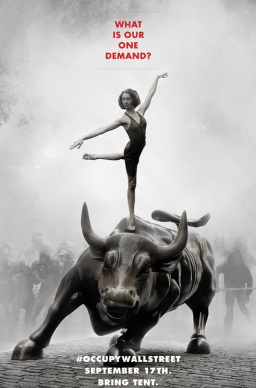
Occupy Wall Street, Occupy Chicago, Occupy San Francisco, Occupy Washington D.C., Occupy Topeka, Occupy Berlin, Occupy Paris, Occupy London, Occupy Brussels, Occupy Beijing, Occupy Moscow, Occupy Singapore, Occupy Tokyo, Occupy Melbourne, Occupy Delhi, don't occupy Iraq, don't occupy Afghanistan, leave Jerusalem the fuck alone. Occupation, when peaceful a close neighbor to vocation, something to do, answering the call. When we hear an aria we don't answer, we applaud, we weep.

This is the blissful moment. Not Qaddafi, not dead tyrants dragged through the streets, but a new birth of love. The pen crawls across the page and the reader creepeth with it.

Pure power of presentation, the it is (il y a, es gibt), of, in language. Pure communicativity of Liberty Park. What are your demands? It's the wrong question. A poem is an operation, maneuver, arrangement, something to be moved through. Objectivity--content--distracts from and inhibits the readers's focus on the experience of movement as such. Potential energy, a perched stone.

Occupy your own body, Cathy Wagner says. Try that one on for size. Debt as negative space. You are too big to fail.

You are beautiful protesters. Blue morpho that changes, that drinks, that flies, what do you want?


What you want is what you are.

I am with you.


Sunday, October 16, 2011

Berlin Diary


Thursday, September 29, 2011

Berlin. Fog of sleep deprivation coloring an otherwise perfect blue autumn day a sort of miasmic yellow in my mind. Bus ride, taking in the printed shirt, ice-cool glasses and goatee of a young man who would not be out of place in Bucktown or Brooklyn or anywhere: a hipster is a hipster is a hipster. But this hipster appears to be traveling with his late middle-aged parents, her with hair dyed purple-black, him gently balding, in glasses that don’t challenge his son’s. Mesmerized by the U-bahn’s sinuousness, the way the unseparated cars wriggle together and apart and up and down as they pursue the tunnels. Remembering that that was the first thing they got back online, postwar, the U-bahn, when everything else was still smashed to shit. ’47?

 Winterfedltplatz.

Two blocks from the Nollendorfplatz U-station to Winterfeldtplatz, where I find the “work flat” of my friend Peter where I will be staying for the next two weeks. It is a lair, such as I have scarcely dreamed of. In the room where I type this a large window swings open like a door to admit the mild morning air and view of a squared-in courtyard, typical of the city I’m told, cool and white, shaded with greenery, governed by the rectilinear forms that I can already tell will form my chief impression of the city. And a blue sky lids it.

But the apartment! It is crammed with books, floor to ceiling; I haven’t seen anything like it since my night at the Waldrops’ in Providence. A sort of expressionist spoof on a classic sort of painting stands high above the doorway, a mustached shabby-looking man in an overcoat and his basset hound in a landscape, looking sidewise out of the picture in a manner sure to unnerve me late at night. Books on the floor, books behind me on shelves, books in every room: one feels stalked by them, books in German and Swedish and quite a lot of English; I can see all my dithering over what books to bring was entirely in vain, there’s plenty here to feed me. Plus it has the advantage of being touched by Peter, the whole thing shimmers with his personal mana, Peter the author of European Trash, translator of Benjamin and Shakespeare, who couldn’t meet me this morning because he’s getting back late from the production of his new translation (in Swedish) of Die Zauberflote in Stockholm. He is a man of prose, and I am here to learn prose, or to evade it—no difference.

Self-portrait as Corydon in front of a Cy Twombly at Hamburger Banhoff.

I’ve longed for this, it terrifies me. One more painting, right over the desk, a blue river at night with a greenlit bridge and the sort of squat, hatted houses I saw from the plane, a sailboat without sails in the foreground. It’s not detailed at all, just color and brushstrokes, a signature in white that I can’t make out. The Spree? The Seine? The path taken by Rimbaud’s drunken boat? Clearly it’s here as a point of departure, invitation to a voyage like the note Peter’s left me on this desk. Fingers of green paint under the bridge mark the reflections of the lights in the water. You don’t put your hand on a river and you can’t clench it with your fist. You open your fingers and feel the flow.

Memorial to persecuted gays at Nollendorfplatz U-bahn.

Saturday October 1
Brandenburg Gate.

Went to bed at ten, exhausted from many hours wandering the city, up Potsdamer Strasse to Potsdamer Platz, then further north to the Brandenburg Gate, east in the tide of tourists Unter den Linden, turning north onto Friedrichstrasse, then once I reached the Spree following it west until I came to the Reichstag. I walked and walked, on not very much lunch and not enough water, from midday to evening. Everything mellow golden, perfect autumn-summer weather. Young people, sharply dressed middle-aged middle-European Volk, an abundance of tourists.

Memorial to the Murdered Jews of Europe, with Die Welt balloon in the background.

Though my map told me it would be there, I was shocked to encounter the memorial on my way up Eberstrasse with the park on my left: A field of monoliths or stelae taking up a full city block, irregular in height: not the stones themselves, some two thousand of them, but the undulating ground they are pitched on, create this impression. Ich bin ein Jude, I said to myself over and over again, a touch melodramatically. But I felt for the first time the shock of it, what this city is, underneath the manifold beauties of its nineteenth and twenty-first century architecture (it’s the middle century, the twentieth, that’s missing).

Ignored relic.

As abruptly as this feeling had arrived, it departed, as I again let myself be swept up to the Gate, which in an easy irony I found swathed with Coca-Cola banners set up for some kind of festival that’s going up this weekend. The city begins to take on a generic generic European quality here, like the imaginary monuments decorating the euro notes. The Spree could have been the Seine, could have been the Danube: a river walled in, patrolled by the ugly long excursion boats, lined with restaurants. Between the tables at one café was a mysterious concrete obelisk with the words dauer sauer mauer bauer written upon it, and a historical plaque I only notice now in the photograph. Not a brick in the Wall, surely, not there on the river. steady sulky wall cage, my dictionary tells me, though Bauer also means pawn, peasant, bumpkin.

Ubiquitous "Kepab" stand.

Giraffe made of legos at Potsdamer Platz.

The Reichstag was beautifully lit, with a long green lawn in front of it where groups of young people, some of them speaking French, sprawled and lounged. I sat under a tree and read a few poems from Joseph Donahue’s Terra Lucida:

                        wandering, pouring spices on the fire
                        as the moon pours a bitter wine

                        over the coals of the city,
                        dousing with sparks

                        wherever you are not.

Each lyric is headed or titled “00,” a kind of double negation that reminds me, inevitably, of the code for international dialing on the telephone.

Soul explosion.

Sitting in front of the open window at the desk, the stars are still out. Is that Orion? I am seethed and jumbled and uncertain. Tomorrow will visit the address of my great-great-grandmother Elenor Reitzer Montag, whose existence I only just learned of, who lived here at the turn of the century, around the time of Benjamin’s Berlin childhood, at Steglitz Lepsiusstrasse 20. There’s a tension, a strong one, between the ordinary culinary pleasures of being in Europe and the peculiar history that has had its hidden hand in shaping me and the destiny of what I am forced to call my people. Melancholy and irony are summoned, but offer no defense, any more than they did for Joseph Roth. The restaurant I ate at last night was named for him, on Potsdamer Strasse, a cozy pub-like place with his pictures everywhere and quotations on the walls, even copies of his books—I leafed through a collection of his Paris feuilletons while eating my schnitzel. Paris for Roth was freedom, France a restoration of the childhood that the Great War had stolen from him; Berlin had been a purgatory, an object of satirical rage, a place not to feel nostalgia for even before Hitler came to power. By Roth’s lights I’m working backwards, being here.

Part of Roth's signature on the ceiling at Joseph Roth Diele.

The people stream by, the Berliners, whom I haven’t much of a handle on. They seem sophisticated, oddly yet smartly dressed, intellectual in fits and starts (I was joined at the outside table for a while by a woman of Asian descent reading something by or on Shakespeare, and her German husband or boyfriend brought out a stack of books from the used bookshop next door—yes, Peter’s street is a writer’s paradise, almost a parody of one). Many people whom you’d think ought to know better wearing silly T-shirts with English or pseudo-English phrases on them—I’m surprised such English-for-the-hell-of-it is still in fashion, don’t these people know our empire’s on the way out? And cigarettes all the time, smoked by middle-class people; struck by how much cigarettes are a class marker back home but here they’re still universal.

Chocolate shop.

Speaking of empire, no sense whatever on the street of the present crisis in the Euro, and Germany’s new role as reluctant banker and savior to innumerable collapsing economies. Me not speaking the language, of course, but still, no mood of crisis that I can perceive, any more than the desperation back home is perceivable in the upper-middle-class enclaves I frequent, aside from the unpicturesque human flotsam clustering around the Greenwood care center or the halfway house on Main Street, whose numbers have not appreciably increased since the crash. But who knows? Like the people around me, I don’t focus on these things, I am consumed by daily life and the things I think I can control: career, family, relationships. Politics migrates inward and becomes something else, not even a climate, mere opinion, as one resigns almost gratefully one’s faith, misguided once again, in a savior politician like Obama. The only solutions reside outside existing institutions: we need to put pressure on what exists so that it collapses or adapts under the strain. But it will take more than Liking things on Facebook to accomplish that

Seen at the movie theater where I saw Attack the Block, near Hackescher Markt.

Why is the sun setting? My body seems much slower this time in catching up with its time zone. Remembering someone’s lovely claim about how the soul cannot travel much faster than walking speed, and so when you fly to another continent it can be days or weeks catching up with you. Now for the house of my great-great-grandmother, whom my cousin Ava, my main source for information about my mother’s family, says had a daughter, Illona whom, she writes, “was taken to Auschwitz in 1943 where she perished.” Ilona, who was she? She perished. It’s a good word, perishing, it suggests, doesn’t it, something of the completeness of the annihilation, the more-than death, that enfolded the Jews here. Death of personhood, death even of memory. Who was it I read recently that remarked of the third generation’s typical obsession with the past? Claudio Magris, was it? Or was it Joseph Roth, who said of his generation, the WWI generation, that it was in the unhappy position of putting their grandfathers on their knees, and telling them stories?

Historical revisionism at work at Karl-Marx-Allee near Alexanderplatz.

Sunday, October 2
Forty-one today.

Lepsiustrasse 20.

There wasn’t anything to see, of course. The building was a tawny stucco thing, clearly postwar in its construction, in Steglitz, a perfectly ordinary pleasant bourgeois neighborhood, leafy and quiet. Who knows if its character was remotely similar a hundred years ago. What’s reinforced is that sense of ordinary life, how ordinary and full of preoccupation all these lives were, until the war came. So hard to understand the connections between ordinary life and “History,” how one apparently transcends the other. Yet this must be an illusion: how we live our lives, the little decisions we make, must somehow accumulate into gigantic convulsions capable of sweeping all that ordinariness away. “Capitalism” seems too simple an explanation, though it explains a lot. Certainly an ordinary blameless bourgeois life led now cannot be separated from the drain on the Earth’s resources, the carbon filling the atmosphere, the animals whose habitats we destroy.

Caspar David Friedrich, Frau am Fenster (Woman at Window), 1822

Spent a couple of hours at the Altes Nationalgallerie, looking at nineteenth-century artworks by guys with names like Schinkel (Karl Friedrich, painter and architect, who virtually built the city). There were some interesting things in there, a few Max Beckmanns; but it’s my understanding that the most interesting parts of this collection were dispersed or destroyed as degenerate art in the 1930s. The Caspar David Friedrich paintings were not as compelling as the famous ones I’ve seen reproductions of, though the Rückenfigur motif does keep popping up in those landscapes he chooses to people. A lot of contemplating the moon goes on. All of Friedrich’s paintings seem to be about looking; there’s a very good one, taller than it is wide, of a woman, her back to us, looking out of and blocking our own view through a window, creating a little drama out of our own frustrated desire to see. And there’s a seascape with a hole in the clouds, dead center of the painting, that has the same effect.

House, Kreuzberg.

Wall, Kreuzberg.

Saw a bit of Kreuzberg, which has a sizable Turkish population. Big tenement-like blocks of buildings studded with satellite dishes—a look I associate with Third World-countries where the infrastructure is unreliable. Astonishingly vigorous and profligate graffiti, some of quite striking. On my map I saw “Orthodox synagogue” so I walked down there, to the banks of a river where a church bell was ringing incessantly. The synagogue itself was a depressing sight: fenced off, security cameras everywhere, plastic sheeting over the windows to deflect (I presume) rocks, a booth marked Polizei. I later learned (and saw) that every Jewish site in the city enjoys, if that’s the word, that level of security. There was no one around except a single policewoman walking slowly back and forth along the river across the street from the shul. It is, emphatically, not a living place, in spite of the off-puttingly cheerful Mediterranean blue color of some of its columns.

Fraenkelufer Synagogue.

A man approached me as I was walking away and asked me if I knew what the building was. “Synagogue,” I blurted, and when he didn’t understand me, I pointed toward the freestanding metal information plaque that explained the synagogue’s dismal history: “Da.” There was a bit of black comedy in that moment: me the Jewish guide to the ruins of German Jewry, historian of what I don’t understand, unable to communicate in the language of a no doubt innocently curious German who has possibly never met a Jew.

Philharmonic building.

Mahler’s First Symphony at the Berlin Philharmonic: kitschy and glorious: he has been thoroughly plundered by pop culture, so that I hear incongruous echoes continually. The eerie opening sounds like nothing so much as the opening notes of the old Star Trek theme, just before William Shatner intones space. There’s a part in the second movement where the clarinetist puts so much soulful squeal into his playing that it sounds like a klezmer band; is this in the original, is that Mahler’s homage to Jewish folkways, or was it the interpretation of the musician or tonight’s conductor, Zubin Mehta (an Indian who lives in Israel)? When the trumpets sound it’s like the cavalry, or a fox hunt. His symphonies are intensely narrative, film scores avant la letter, but the man died in 1911; did he go to the cinema, where orchestras often played along?

Tribute to a composer at Deutsche Oper U-Banhof.

October 4

A rather kindly old man just helped me through the mysteries of the German Laundromat, which operates on a kind of federal system or Bunde: you feed your money into a single control panel that runs all the machines and dispenses soap as well. Now my clothes are being treated a bit roughly by the machine and I’ll dry them and fold them and stuff them in my backpack to go home. Last night I spent a long, late evening with Ken Babstock at a macabre little bar in Charlottenberg with puppets and marionettes everywhere. None of the other clientele, whom were never more than three in number, was a day under seventy, and the bartender looked to be in his eighties at least. Topics included but were not limited to: the elder generation of Canadian eco-poets; sight versus sound when it comes to word spacing; the dismal state of the world economy; the dismal state of American politics; question: is history taking place, right now, in the form of the Occupy Wall Street movement?; Toronto’s similarities with Chicago; childcare challenges for expatriates; whether or not I should go to Prague; his favorite poets of the moment (August Kleinzahler, Peter Gizzi); my favorite poets of the moment (Lisa Robertson, Jennifer Moxley); August Kleinzahler’s failings as a teacher; the influence of Michael Palmer; the influence of Erin Mouré; the benefits and drawbacks of the PhD; the generally deplorable state of cuisine in Berlin; and much else. We exchanged books and I very nearly persuaded him to go out for another drink when the puppet bar closed, but he wisely declined.

Jewish Museum exterior.


Victor Kégli, Hershel and Gretel in the Jewish Museum (2011), just outside.

The Jewish Museum. The architecture, by Daniel Liebeskind, is shattering; that basement area, with the three Axes—of Continuity, of the Holocaust, and of Exile—was for me the center of the experience, compared to which the (adequate) exhibits above ground seemed like something of an afterthought. The Axis of Exile ends in the Garden of Exile: a group of stone pillars with plants and trees growing out of their tops, and a slanted ground that makes walking between them a disorienting experience, which is of course the point. Had the thought that, according to the onto-topological argument implicit in the design, the Garden of Exile was where I was born. It’s not strictly true—my father was born in the U.S., my mother was born in Hungary in 1942 and only emigrated after the war—but it feels true. How long have I felt, even at home, not quite at home, on slanted ground, everything looking straight but not feeling straight?

No comment.

The Axis of the Holocaust ends, as it must, in a cul de sac: a tower or “void” that was one of the most terrifying rooms I’ve ever stood in. It’s a bit like a concrete grain silo, unheated, with a few holes and slits admitting a minimum of daylight, as well as ordinary Berlin street sounds. It actually felt like being inside a grim sort of musical instrument: the sounds of my footsteps seemed to echo, the scrape of soles on concrete, the faint rasping of my fingertips on brushed metal. 

Menashe Kadishman, Fallen Leaves.

Friday, October 7

Show your wound, says Joseph Beuys. Yesterday at the Hamburger Banhoff seeing some of his work for the first time. The video of How to Explain Pictures to a Dead Hare, Beuys’ head encapsulated in what looked like gold leaf, the upper left corner of the image obliterated somehow, like a dead zone in the lens. At one point holding the rabbit’s ears in his mouth so as to make its paws prance across the floor with his hands. Show your wound, the hole, the inadequacy that you are, the vampiric double-gash of the equals sign in I = I.


Reading Andrew Joron’s prose, The Cry at Zero, which I brought with me as vade mecum. His hunger for a beyond to the dead-end of social construction, his focus on the body as a local instant of the cosmos. Neo-surrealism: insistence on emergence, the novum, the astonishing fact that life arose from the unpredictable interactions of inorganic matter. Connections spawning in my mind with Quentin Melliassoux’s attack on "correlationism," the postmodern doctrine that you can never discover or even approach X, only a socially and ideologically mediated viewpoint on X. His magnificently simple example of a form of knowledge that contradicts this: our knowledge of the world before life, before a human or even merely biological sensorium existed. Speculative realism: entertaining the possibility of a world that exists independently of our knowledge and the beyond, therefore, of ideology. The winds of intellectual fashion are tending in this direction, which is reason enough to be cautious. But it is not surprising that I, long dissatisfied with the purely social and nearly nihilistic dispensations of postmodernism, would feel myself pulled in this direction, which promises a non-dogmatic, un-idealist access road (ein Weg) to the universe.

Little face inside Bruce Nauman's Room with My Soul Left Out, Room That Does Not Care (1984) at Hamburger Banhof.

Aside from Beuys I was most impressed by the variations on architecture and utopian construction on offer at the Hamburger Banhoff. There was a magnificent exhibition of Buckminster Fuller-esque globes or “biospheres” suspended by wires that filled the museum’s great hall by an Argentian artist, Tomas Saraceno, called Cloud Cities. Some of the globes you could enter, and climb up into and roll around in on the clear plastic floor suspended high above the ground, like the bouncy houses at street fairs that Sadie likes so much; she would have loved these. Some of the globes are gardens, with plants inside, sometimes permitted to flourish their long grasslike leaves up and out the top of their globes.

Saraceno's Cloud Cities.

There were other utopian/dystopian dwellings deeper in the museum. An Israeli artist, active apparently for just six years before he died at a very young age, built ascetic model houses that looked a little like miniature versions of the desert dwelling of Luke Skywalker’s Uncle Owen and Aunt Beru. There was one model that you could go inside, made of white painted wood, and inspect the tiny bunk, the little bathroom/shower, the kitchen which would have room, just about, for a single burner, with a skylight that the top of my head emerged from. Inevitably one imagines what it would be like to actually live in such microscopic quarters. And at the end of the long hall of exhibitions a terrifying piece by Bruce Nauman, which I couldn’t help but find reminiscent of the Holocaust Tower in the Jewish Museum. Inside a darkened hangar-like hall of the museum is a black structure, basically cross shaped, dimly lit by yellow brutalist sconces, with a grilled floor at the center where you can look down into a similarly cavernous space or up through a hole to the Banhoff’s roof. An intrinsically chill and lonely construction.

Graves of Helene Weigel Brecht and Bertholt Brecht.

Also of note was a film in one of the basements by an artist named Anri Sala, Dammi i colori (2003), in which the camera surveys an unnamed city, “the poorest in Europe,” which indeed seems to stand in ruins (Wikipedia tells me the city is Tirana, in Albania). However, many of the buildings we see are brightly and idiosyncratically colored; this seems in some way credited to the work of our onscreen guide Edi Rama, a friend of Sala's, the mayor of Tirana, and an artist in his own right. People live in the direst poverty (unforgettable shot of an old man, in unaccountably purple pantaloons, stepping into a second pair of trousers, conducting his toilette outside for all to see in a bitterly matter-of-fact way) but surrounded by bright, almost Disney-esque colors. Color and ornament are seen attempting to supplement and make up for tragic deficiencies in the city's infrastructure, making it one of the most incisive and moving commentaries I’ve ever seen on art’s desire to do real work in the world, while never falling into the fatal gap in which artists deceive themselves into thinking that their artworks, merely by existing, actually accomplish this.


Another night Donna Stonecipher took me to a German intellectual bookstore, Pro Qm, that was very nearly a parody of itself: everything clinical white, the customers and employees all serious and intent and intense, in severe eyeglasses, browsing through what is truly a remarkable collection of books on art and social theory, many of them in English. Everything was expensive, much more so than in the states, so I refrained from buying anything except for a cheaply printed paperback, Everything under Heaven Is Total Chaos. This is one of Slavoj Zizek’s favorite Mao quotations, which in full reads “Everything under Heaven is total chaos; the situation is excellent.”


Window, Kunsthaus Tascheles.

There was a talk there, based on a dissertation with the imposingly simple title of Dichte: not referring to poetry but density, it was a work of urbanist theory. Apparently all dissertations must be published here, and of course the dissertation is just a stepping-stone on the way to the habillitationshrift and full professorship; Donna says there’s no such thing as a young academic in Germany. The talk was all in German so was interesting to me from a sociological point of view, until standing on a hard floor for an hour subtracted even that level of interest. Fortunately afterward there was excellent Vietnamese food and I got to know Donna a bit better. We talked about what I dubbed “the zone of inarticulacy” that she and certain other poets I admire (herself, Camille Guthrie, Sarah Gridley—not sure why this list is all-female) preserve for themselves: refusing or rejecting the growing imperative in our intellectual culture to explain oneself, to write criticism, to package your work in advance of its own imperatives.

A rare sign of Jewish life, near the KaDeWe department store.

Fountain outside KaDeWe.

This came up again last night when I went out for a very late pizza dinner with a motley collection of expatriate artists and litterateurs, most of them in their late twenties and early thirties, after the ambassadorial launch of the first novel of a young Irishman, John Holten, called The Readymades. His very beautiful American girlfriend told me that in art school she had been told that one had two choices as an artist, the political or the exploration of one’s own subconscious. Reductive to the point of ludicrousness, the stark choice thus presented does suggest something of the real terrain young artists are asked to negotiate. And while there are clear paths and nearly automatic comradeship promised by the first option, which in Clarice’s view tends to mean art accompanied by or interpermeated with text, the second option is necessarily lonelier and for a visual artist must mean the outright rejection of textuality (explanation, recitative, critique).


Monday, October 10, 2011

Still there’s the shadow. Though I’m not religious, I’m not unaware of its having been Yom Kippur over the weekend, and there’s a real sense I have here of being unwritten into the Book of Life. Because real life is home where Emily and Sadie are, and my friends and my routine. Perhaps I’m not the traveler I’ve dreamed of being. Or is it just Germany, der Vaterland, that has me feeling oppressed and low? Hard on myself. I expected something of this trip—some turn, some Wende—that, if it’s occurred, I’m not aware of it yet. Quandary and squandering—do they have the same root?

Lassitude. Acedia.

Graffiti at Mauerpark, Prenzlauer Berg.


Wednesday, October 12
Only now toward the end have I really been able to write, to address my novel afresh. I went back into the manuscript and started organizing things a little, creating section breaks, filling in a good deal—the transition, basically from when Gustave and M are reunited in Paris to their flight to Cherbourg, where they finally make love that one and only time and she tells him the story of her failed attempt to visit Auschwitz. Just now I was able to write again some more, a fair chunk of M’s story, as she tells it to Miklos, of her life just before and after Ruth was born, in Queens, for which I borrowed a few details of my mother’s biography, right down to the IRS job. I don’t remember a lot of what I was told, so memory tips imperceptibly into invention, which is what I want, after all—it’s a novel.

Marx and Engels, together again.

So there’s that feeling of redemption that comes after writing, especially when it comes fluently and there’s more than a couple of pages produced. Whether it will seem valuable when I reread—that’s of no consequence, don’t look back, forward! It is a novel, it may not be a great novel, it will bear its flaws of sentimentality and structural inconsistency and be downright puerile in spots, but it wants to be a novel and it will be, it will be my novel, and perhaps it will be only the first, or else I will be released by it, the achieve of it, and can go back to poetry with a clean and fit conscience.

View from inside Gedächtniskirche.

The novel. I want to believe I’ve crossed some tipping point here, that from now on it will just seem like a job of work, and fun, and not some precious goddamn bit of china that I have to carry oh so carefully in very short little bursts, setting it down after just a few steps for fear of its cracking. If I can just go on like this, a little, at home, I can make my goal of a finished draft this year. Why the fuck not? It’s my novel, it goes on as long as I say it goes on, I’m writing it. A certain amount of—I don’t know, surrender, is vital to any creative project, and I do want to respect certain rhythms, be open to chance, contingency, reality, as I’m writing. At the same time it’s nothing magical – it’s not a poem. And if I learn nothing else except that novels aren’t poems, it would be a very worthwhile thing to learn at last.

Paul's Boutique, Prenzlauer Berg.

Doors to Jewish Cemetery, Prenzlauer Berg.


Looking up Victory's skirt at the top of the Siegessäule.


Popular Posts

Followers