Monday, January 31, 2011

Arcadia Ego, or: We Have Always Been Pastoral

Joyelle McSweeney continues to elaborate her theory of necropastoral in her latest post, a summation of the necrotic yet vital qualities she identifies with that "defunct, anachronistic, dead, imperial and imperialistic literary form." I think that's a fair characterization of how pastoral has been used—there is most definitely a pastoral ideology "contrived to represent separation, quarantine, timelessness, stasis, protection from upset and death." At the same time, it's an inherently unstable genre, which has demonstrated self-consciousness about its own project from the beginning. Consider the first of Virgil's Eclogues, in which two shepherds talk about current events. One has become a refugee, his land seized by the state to be given to demobilized soldiers; the other has, through his poetry, won at least provisional reposession of his land through the direct intervention of the sovereign, whom he has caught in a nostalgic mood:
In Rome I found the young man in whose honor
We sacrifice at our altars every month.
He said, "Go feed your flocks as in the old days;
Herdsmen, raise your cattle as you used to."
(David Ferry, trans.)
The uncanny quality in this eclogue is the absence of jealousy or political friction between the dispossessed Meliboeus and that fortunate senex Tityrus; "It's not that I'm envious, but full of wonder." The dialogue becomes Meliboeus' elegy for the life with flocks and fields that he will know no more, and ends with Tityrus' invitation to linger for at least one more night as his guest, for, "Already there's smoke you can see from the neighbor's chimneys / And the shadows of the hills are lengthening as they fall. " Et in Arcadia ego: not just physical death, but social and economic death, are part and parcel of the pastoral experience, and Tityrus has no guarantee that "the young man" in Rome won't change his mind tomorrow about his status.

This possibility is elaborated in the ninth eclogue, which essentially retells the story of the first from the dispossessed shepherd's point of view. "A stranger came / To take possession of our farm, and said: / 'I own this place; you have to leave this place.'" To which his interlocutor, the naive Lycidas (whose name Milton will take for his great pastoral elegy of that title) responds:
But I was told Menalcas with his songs
Had saved the land, from where those hills arise
To where they slope down gently to the water,
Near those old beech trees, with their broken tops.
"Yes, that was the story," Moeris replies, "but what can music do / Against the weapons of soldiers?" And once again elegy, that nearest neighbor to pastoral (and isn't "pastoral elegy" very nearly a synonym for "necropastoral"?) takes hold as the two shepherds sing sorrowfully of a land that seems always already lost: "Time takes all we have away from us." The master poet, Menalcas, who was powerless against political violence, remains offstage in this eclogue, like Godot; "The time for singing will be when Menalcas comes" is the poem's last line.
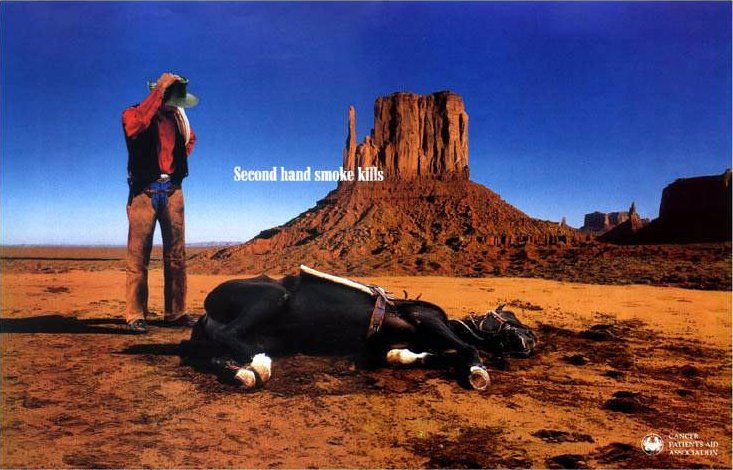

It's impossible to read these poems and feel assured of pastoral as the perfect fantasy of the locus ameonus or virga intacta that it presents itself as in its most ideological forms (the Marlboro Man, for instance, though of course even his iconography has become infected by death). Consider, too, Leo Marx's characterization of American pastoral in particular as the conjuration of a "middle landscape," ideally situated between a hostile wilderness and the corruptions of capitalism. But his book The Machine in the Garden is a close examination of how the boundary between the two is actually a wavery and porous line. Its iconic scene is an excerpt from Nathaniel Hawthorne's notebook, in which a forest revery is interrupted, then reconstituted, by the sound of a locomotive thundering not so very far away.

In Deleuzeian terms, a pastoral poem deterritorializes or rhizomes (if that can be a verb) the landscape it reflects, but the most interesting such poems don't close the loop through an authoritative reterritorialization. Instead the represented landscape remains open, infected if you like, by the visible passage of the reader's desire to flee complexity/multiplicity/the city/death. McSweeney's necropastoral, in my view, is valuable insofar as it's an updating of the pastoral to be responsive to the most current environmental conditions (taking late capitalism in this sense as the environment or "climate" of contemporary poetry). I'm especially interested in her notion of necropastoral as a means of processing (or maybe "confronting" is a better word) "contamination," both in its ideological senses (the racist pastoral fantasy of the anti-immigration America First crowd) and its biochemical one. As Joyelle puts it, "the necropastoral is the toxic double of our eviscerating, flammable contemporary world, where avian flu, swine flu, mad cow disease, toxic contamination via industrial waste, hormones in milk, poisons leaching out of formaldehyde FEMA trailers, have destroyed the idea of the bordered or bounded body and marked the porousness of the human body as its most characteristic quality."

I wonder if Joyelle has read any Bruno Latour, who has introduced the concept of the "quasi-object" to ecological thought: a social "object" which is also kinda-sorta a subject, of which toxic entities like hormones in milk are pardigmatic examples. This would be the darkest example yet of necropastoral, in that it parodically achieves the reconciliation between subject and object, self and other, human and nature, that is at the root of the pastoral fantasy. The (contaminated) body becomes indistinguishable from its (contaminated) environment. It's difficult to be sanguine about this from the perspective of normative environmentalism, but it's exciting allegorically, as a means of imaginatively contesting fundamentally undemocratic fantasies of purity (something ecology at its most misanthropic is fully capable of manifesting).

Saturday, January 29, 2011

Fourier Series - The Movie

I am nigh-ecstatic to be able to direct you to this "kinetic translation" of my book Fourier Series, designed and programmed by its publisher—nay, its wizard—William Gillespie of Spineless Books:

Fourier Électronique

Yee-haw!

Also, this is a good time to announce to all who might care that I will be at AWP in DC next week. There are a couple of Tupelo/Severance Songs related events of interest:

Tupelo Press Off-Site Reception

Petits Plats Restaurant
2653 Connecticut Avenue NW
Washington DC 20008
(202) 518-0018
www.petitsplats.com

Join us at Petits Plats (close to the conference hotel) for drinks, hors d'oeuvres, and short readings by a few of our 2010/2011 authors. Join us in a toast to Tupelo's authors and staff for eleven years of dynamic publishing!

Friday, February 4
6:15 - 8:30 pm


With short readings by (in order of appearance):

Ilya Kaminsky

Nancy Naomi Carlson

Daniel Khalastchi

Aimee Nezhukumatathil

Ellen Doré Watson

Kristin Bock

Michael Chitwood

Kazim Ali

Rebecca Dunham

Stacey Waite

Dan Beachy-Quick

Joshua Corey

Megan Snyder-Camp


Please RSVP for this event:
Send an email with the number in your party to mgauthier@tupelopress.org.
Please put "AWP Reception" in your subject line,
and feel free to bring a guest.

I'll be signing advance copies of the book at the Tupelo Books table on Saturday at 11:30 AM, alongside Megan Snyder-Camp whose new book is called The Forest of Sure Things.

Saturday, January 15, 2011

Joyelle McSweeney's Necropastoral

As you might suppose, I'm completely fascinated by Joyelle McSweeney's recent posts on "necropastoral" up at Montevidayo. It's a little unclear to me as to whether she's talking about pastoral as an always-already uncanny undead genre, outside and yet adjacent to the polis ("the temporal and geographical sureties of the court, the urbs, the imperium itself"), or if she isn't suggesting a sub- or paragenre called necropastoral, with its own distinct aesthetic characteristics. The former seems to be the case in her original post, while the fascinating post on Sylvia Plath suggests the latter, and might lead in a direct line therefore to the necropastoral aspects of gurlesque.

It makes perfect sense to read Plath's Ariel as a kind of parody or burlesque of the pastoral, when the latter is constructed as the reservoir of "natural" values. I'm especially struck by the image of the infant's mother dissolving into the ambient environment in "Morning Song"; Joyelle calls it "a total mediumicity in which Art moves from the infant to the speaker, from the infant into the material surround, creating the body of the poem." This "mediumicity" seems very similar to Timothy Morton's notion of ambience as the tendency of environmental writing in general to "re-mark" the boundary between subject and object, transgressing that boundary even, without ever erasing it. For Morton the Freudian "oceanic feeling" or the Emersonian transparent eye-ball with its ecstatic "I am nothing, I see all" seems to be fundamentally ideological, not an erasing of the barrier but a manifestation of the subject's desire to swallow the object whole. For Plath, I imagine, the poem read as pastoral highlights how that genre has been gendered as a playground for the inviolable masculine subject but strips the feminine object-subject bare; the mother-speaker of the poem is dissolved by the infantile demand that she become the feminized object-atmosphere of "nature." The subject here is swallowed by her own object-hood, "cow-heavy and floral / In my Victorian nightgown." And the poem, and the book as a whole, is a luridly violent rebellion against the demands pastoral makes for women to become more-and-less than human, more-and-less than sexual, more-and-less than alive.

I'm reminded of Lisa Robertson's "How Pastoral: A Manifesto" and her claim there that "I needed a genre for when I go phantom"--phantom in this context bringing us very close to Joyelle's necropastoral (though it's a notably less embodied sort of word, and there's a definite aesthetic distance between the cerebral, even Apollonian necropastoral of a book like The Weather or The Men versus the Dionysian variety embraced by Plath and the poets I associate with the gurlesque. But I need to think more about the larger, rather seductive claims Joyelle seems to be making about pastoral in general. Necropastoral seems rather more specific than "postmodern pastoral" or even "avant-pastoral," the terms I've grown accustomed to playing with; it would seem to go beyond a pastoral that merely foregrounds its own artifice, the better to play with the tradition of turning nature into a standing reserve for sovereign authority and cultural norms. Is it a zombie pastoral, the pleasure of the walking dead in devouring brains, the hypersublime viral pleasure of mindless multiplication, unlife, earth without world?

Wednesday, January 12, 2011

You Villain Touch; or, the Body of Genre

In my first meeting with this semester's starry-eyed Introduction to Creative Writing students, I played a little game where each student shares a word that they like and another word that they despise. It's a functional icebreaker and, as far as the favorite words go, also serves as a simple diagnostic tool, dividing the class roughly into the aspirational (words like "hope" and "individual") and the ear-driven ("indubitably" is the one I recall). The negative words are more interesting. After three different students independently came up with "moist" (a word that occurred last semester as well), I began writing down the disliked words on the board:
moist
crusty
secreted
slice
Another disfavored word that I didn't write down sums the rest up, both sonically and in terms of meaning: grotesque. Each word is heavy on sibilants and, except for slice, hard C and T sounds. And each describes an object failing to maintain its boundaries, spilling liquid (moist, secreted), crumbling (crusty), or dissevering (slice). Words that conjure disintegrating bodies. Words that make your flesh creep—a phrase that in itself conjures that crucial aspect of the grotesque, the uncanny aliveness and strangeness of your own body, which is coterminous yet refuses to play along with the social and psychological boundaries of the self.

Thinking a lot today about the grotesque as a genre, or anti-genre, in light of various books on my radar. In the senior seminar I'm co-teaching this spring with Davis Schneiderman, our chosen texts are William Gillespie's new novel (but perhaps I should borrow Geraldine Kim's coinage, Povel), Keyhole Factory; and the much-noted anthology edited by Lara Glenum and Arielle Greenberg, Gurlesque: The New Grrly, Grotesque, Burlesque Poetics. I'm also reading the brand new collection edited by Mary Biddinger and John Gallaher, The Monkey and the Wrench: Essays into Contemporary Poetics (in which my esteemed colleague Bob Archambeau has a useful essay on the Victorian pretensions on the can-poetry-matter crowd). Last but not least, a book that does not yet exist but which G.C. Waldrep and I are slowly laboring into being: The Arcadia Project: North American Postmodern Pastoral. All these things form a constellation in my mind on the question of boundaries in American poetry, and in poems themselves.

Touch me not: one of the early warnings, or irresistible come-ons, in the English literary tradition, when it comes to touching:
Whoso list to hunt, I know where is an hind,
But as for me, hélas, I may no more.
The vain travail hath wearied me so sore,
I am of them that farthest cometh behind.
Yet may I by no means my wearied mind
Draw from the deer, but as she fleeth afore
Fainting I follow. I leave off therefore,
Sithens in a net I seek to hold the wind.
Who list her hunt, I put him out of doubt,
As well as I may spend his time in vain.
And graven with diamonds in letters plain
There is written, her fair neck round about:
Noli me tangere, for Caesar's I am,
And wild for to hold, though I seem tame.
This famous sonnet of Sir Thomas Wyatt's, an imitation or riff on Petrarch's "Rime 190" is widely understood to be an allegory about the poet's desire for Anne Boleyn. It's a poem about impossible pursuit, partly because pursuit is barred by the power of the sovereign (Caesar, aka King Henry VIII) and the Ovidian transformations of Boleyn, who takes the form of an animal (a deer, "an hind") but also, in the poem's most famous line, something even more uncatchable: "Sithens in a net I seek to hold the wind"). The poet yearns to touch, catch, and "hold" the elusive beloved but she is "wild for to hold, though [she] seem tame." To hunt this hind means to risk "running wild" in the sense of total dissolution of the self; for the revenge of the sovereign must be total in nature. Wyatt's social death, his death at court, would precede his inevitable physical death should he be caught in the act of sexual treason. The power of eros becomes the eros of power, with this difference: unable to assume the power of Caesar (itself a power greater than any single body can contain), the power of touch threatens annihilation; and yet such touch, clearly, is a consummation devoutly to be wished.

In the American tradition there's overt celebration of touch, mingling, pressing the flesh, but this celebration masks a profound ambivalence. Walt Whitman is surely the poet laureate of touch and its Dionysisan tendency to blur and bend the principium individuationis:
Mine is no callous shell;
I have instant conductors all over me, whether I pass or stop;
They seize every object and lead it harmlessly through me.

I merely stir, press, feel with my fingers, and am happy;
To touch my person to some one else’s is about as much as I can stand.
From that "harmlessly through me" (implying a fundamental stability of self: "Apart from the pulling and hauling stands what I am") we pass quickly to touch as peak experience, the jouissance of "about as much as I can stand." And the section that follows is even darker:
s this then a touch? quivering me to a new identity,
Flames and ether making a rush for my veins,
Treacherous tip of me reaching and crowding to help them,
My flesh and blood playing out lightning to strike what is hardly different from myself;
On all sides prurient provokers stiffening my limbs,
Straining the udder of my heart for its withheld drip,
Behaving licentious toward me, taking no denial,
Depriving me of my best, as for a purpose,
Unbuttoning my clothes, holding me by the bare waist,
Deluding my confusion with the calm of the sunlight and pasture-fields,
Immodestly sliding the fellow-senses away,
They bribed to swap off with touch, and go and graze at the edges of me;
No consideration, no regard for my draining strength or my anger;
Fetching the rest of the herd around to enjoy them a while,
Then all uniting to stand on a headland and worry me.

The sentries desert every other part of me;
They have left me helpless to a red marauder;
They all come to the headland, to witness and assist against me.

I am given up by traitors;
I talk wildly—I have lost my wits—I and nobody else am the greatest traitor;
I went myself first to the headland—my own hands carried me there.

You villian touch! what are you doing? My breath is tight in its throat;
Unclench your floodgates! you are too much for me.
Many commentators see this moment in the poem as a moment of masturbation and not the nigh-unbearable contact with another's flesh. But this is nearly irrelevant to the larger question of the power of "villain touch" to destabilize the self and threaten it with foundering. Je est un autre, as Rimbaud says, and one's own body (Whitman's queer body) may be as "autre" as another's.

Or as Jeff Goldblum's mad scientist puts it in The Fly, "The flesh makes you crazy."

Flash forward a hundred years to the Confessional poets. And when I think about what's most compelling about their work, what makes them sexy--there's no better word--it's not the dubious glamour of insanity ("My mind's not right") but the ways in which Berryman and Lowell and Plath admit the treacherous terrain of tremulous bodies in contact with other bodies into their poems. Consider for example Berryman's own "touch me not" poem, "Dream Song 4":
Filling her compact & delicious body
with chicken paprika, she glanced at me
twice.
Fainting with interest, I hungered back
and only the fact that her husband & four other people
kept me from springing on her

or falling at her little feet and crying
"You are the hottest one for years of night
Henry's dazed eyes
have enjoyed, Brilliance." I advanced upon
(despairing) my spumoni. -- Sir Bones: is stuffed,
de world, wif feeding girls. --

Black hair, complexion Latin, jewelled eyes
downcast . . . The slob beside her feasts . . . What wonders is
she sitting on, over there?
The restaurant buzzes. She might as well be on Mars.
Where did it all go wrong? There ought to be a law against Henry.
--Mr. Bones: there is.

The seemingly indifferent and self-possessed object that is the desired woman's "compact & delicious body" has the effect of shaking Henry's always precarious subjectivity all to pieces; "fainting with interest" (the first word suggests a Keatsian "swoon"; the latter word suggesting that we are very far from any Kantian idealized aestheticiation of the body-object; Henry's interest in her is decidedly culinary), he is torn between the violently opposed actions of "springing on her" (closing the absolute distance between subject and object) or "falling at her little feet" (abjectifying the self while placing the beloved on a properly Petrarchan pedestal, an action which notably sustains rather than terminates her inaccessibility). Villain touch in this poem is all mental, all fantasy, but it's still powerful enough to shake this speaker apart, calling his minstrel-doppelgänger Mr. Bones into existence in the final strophe, a mark of Henry's habitually split self. "There ought to be a law against Henry / ...there is." It's Henry's identity as transgressor, as transgressed, as divided by painful (erotic or deathly, or both; see "Dream Song 382") contact with others, that makes him and The Dream Songs so memorable.

The question of genre and the comparative fleshliness or bony spiritualization of American poetry connects, I think, directly to this question of contact between subject and object; or in broader national terms, the divide between democratic melting pot and xenophobic nationalism. Of course it was Lowell who gave us the metaphor of "the raw and the cooked"' in poetry, that is so weirdly apt to this question of the role of the flesh, the grotesque and carnivalesque. Lowell meant, broadly, the "raw" poetry of Ginsberg and the New Americans versus the "cooked," more traditionally formal poetry nurtured by the New Criticism. He was referring primarily to poetic form, but as with any strong metaphor, the vehicle of raw and cooked can overpower the tenor of form and bring poetry, abruptly, into more or less sublimated contact with the flesh.

I am tempted to be contrarian here and to argue that, just as Berryman and Lowell are more preoccupied with the raw terrors of embodiment than you might expect, so too is a poet like Ginsberg surprisingly concerned with bodily integrity and the construction of an impermeable subjectivity: the egotistical sublime. The phrase of course evokes John Keats and his notorious characterization of "the camelion poet" as boundariless, permeable body: "A Poet is the most unpoetical of any thing in existence; because he has no Identity - he is continually in for - and filling some other Body." And Ginsberg, who demonstrates Whitmanian sympathy with others in "Howl," does not go so far as Whitman does as to risk dissolution; his "I" exists in ambiguously distanced relation to "the best minds of my generation" who engage in Dionysian ecstasies of gay sex and drugs, and which only comes back into the poem as self-in-touch-and-at-risk with the appearance or reappearance of Carl Solomon: "Ah Carl, while you are not safe I am not safe and now you're really in the total animal soup of time." That's a terrifically ambiguous phrase as far as Lowell's metaphor goes--total animal soup, isn't that somehow raw and cooked? When we are "in the soup" we are in chaotic contact with the heterogenous, and in danger of being eaten besides! But it's Carl who's in the soup, not Ginsberg, who steps back in the second section for his jeremiad against "Moloch" and who only fully inhabits the poem as an I that is "with you in Rockland / where you're madder than I am"; but that repeated phrase, "I'm with you in Rockland" only serves to reiterate the speaker's separation from the "madder" Solomon, who only threatens actual contact "in my dreams" at the poem's conclusion: " in my dreams you walk dripping from a sea-journey on the highway across / America in tears to the door of my cottage in the Western night." To my cottage: a strikingly pastoral image evocative of Yeats and Pound in Ireland or, perhaps more pertinently, the person from Porlock who's arrived just in time to prevent Coleridge from dissolving into the total animal soup of "Kublai Khan."

I see that I've yielded to temptation; I see also that pastoral has come up, as I knew it would. Because pastoral is that fantasy of subject-object, culture-nature reconciliation, though in actual pastorals the supposed reconciliation is firmly on the subject's terms (as in Romantic and Transcendentalist pastoral) or more rarely the object's (as in the Objectivist pastoral of an Oppen or a Francis Ponge, "taking the side of things" [Les partis pris des choses]). One might say that an anthology like American Hybrid takes a pastoral position by constructing a wishful "middle landscape" between raw and cooked poetries (editor Cole Swensen, curiously the only of the two editors engaged by the critics in The Monkey and the Wrench, calls it "a thriving center of alterity"). We can imagine a hybrid itself as "raw" or "cooked," with the "cooked" end of the continuum implying synthesis and blending, while "the raw" preserves the individual identities of its components in what I envision as a lightly dressed salad. In general the anthology's critics see it as a cooked anthology that's pretending to be raw--that it represents a re-inscription of white mythology, constructing an imaginary exterior (and superior) to the fraught and intrinsically political zone of contention that is po-biz, from which so many poets and critics regardless of aesthetic position seem to want to escape.

What has this got to do with that villain touch? Everything, if the yearning for touch ("Contact! Contact!" Thoreau cries) weren't always in the Western tradition countered by fear of touch, by our dim or acute suspicion that our boundaries, our bodies, are porous and penetrable. ("Secure our borders!" the Tea Party cries, which like all such movements seeks not political power but the end of politics as such, not just "politics as usual.") To identify with the porous and penetrable is to take a step toward the grotesque (consider the drag queen), inverting powerfully gendered and hierarchical assumptions about who gets to be a speaking (lyric) subject. When young women speak from the uncanny position of the object, as in the gurlesque; or when flarfists make deliberately bad-tasting animal soup out of kitsch; or when the writers associated with New Narrative (I have in mind a loose confederation of largely Bay Area authors, the sons and daughters of Kathy Acker, many of whom are represented in Biting the Error) tell baroque stories of desiring machines and bodies-without-organs; or when almost anyone takes the trouble to translate poems written almost anywhere else in the world (the most intimate and intimidating form of poetic touch, it seems, for American readers)--then we are exploring and exploding, without dreaming of erasing, that terrifying and seductive boundary, permeable and mortal as human skin.

Olson again crystallizes things for me, return us to "Maximus to Gloucester, Letter 27 (withheld)." "No Greek will be able / to discriminate my body"--Olson rejecting the philosophical tradition of humanism running at least from Socrates to Descartes, reducing his body to res extensa. "I have this sense / that I am one / with my skin." A sense refined, I think, by Olson's experience among the Maya, whom as he told Creeley seemed to hold their bodies differently from Americans: "it's so very gentle, so granted, the feel, of touch -- none of that pull, away, which, in the States caused me, for so many years, the deepest sort of questions about my own structure." The return to the body--or not the body, but a body, what a body, Olson's gigantic body, Maximus, mountainous locus of difference. It's easy to read the last lines of this poem as the return of the egotistical sublime, but:
Plus this—plus this:

that forever the geography

which leans in

on me I compell

backwards I compell Gloucester

to yield, to

change

Polis

is this
The landscape (the landscape!) exerts its pressure on Maximus, "leans in" on him, transmits through him a compulsion on Gloucester, not because he is artifex, Mussolini-manque, but because he has a citizen-body, and to be such a transmitter, in contact, on that boundary between self and other, subject and object, well. "Polis / is this."

Saturday, January 01, 2011

Black Mountain Days

The former Studies Building. Photo taken December 30, 2010.

Happy New Year. Back from a week in the environs of Asheville, North Carolina, where we enjoyed a family vacation commune-style with two other families. When not playing with the kids (five of 'em, ranging in age from a few months to seven), I immersed myself in Black Mountain College lore, visiting the tiny storefront museum in downtown Asheville, reading memoirs by Fielding Dawson and Michael Rumaker, and, on the last day, visiting the site of the college, now a summer camp for boys.

Black Mountain College has loomed large in my imagination since I first learned of it when discovering the perplexing and generative tangle that is the work and life of Charles Olson. Like so many American experiments in utopian community, it combined high idealism with wild impracticality; the students and faculty there tried to combine living off the land with the life of the mind, but the latter usually won, so that the place seemed to be perpetually and continually falling apart practically from the moment of its founding by radical educator John Andrew Rice in 1933 to its ignominious unraveling in 1956. There's an affecting anecdote about the days of the college's decline, according to which a wealthy benefactor was supposed to signal whether or not he was going to save the college by sending an airplane over the campus; students and faculty supposedly stood in the fields for days, waiting. Whether or not the story is true, it exactly parallels the story of Charles Fourier's days waiting every afternoon for years after lunch for the wealthy benefactor he'd advertised for to appear, making his dreams of the first utopian phalanstery a reality. Needless to say, these benefactors never appeared; we're left only with the pathos of the frail wishes of these artist-visionaries, hoping against hope that some angel of capitalism would appear to rescue them from--well, capitalism.

The memoirs of Dawson and Rumaker are very different. Dawson's Black Mountain Book is fragmentary, impressionistic, animated by grudges, particularly against Olson himself, with whom Dawson had a falling out subsequent to his days as a student at the college (Olson apparently resented his representation in a previous book of Dawson's about his experiences at the college, the rather wonderfully titled An Emotional Memoir of Franz Kline). The Rumaker book does a better job of conveying what it actually felt like to be a student at the college, in spite or because of the fact that it's more conventionally structured as a portrait of the artist as a young man, the author much tougher on his young, directionless, unformed queer self than he is on those who surrounded and instructed him. The portrait of Olson that emerges in Rumaker's book confirms for me my own fascination with the man: like Richard Hugo, the imaginary mentor of a much younger self, he was a gigantic man, alcoholic, sloppy, bruised and bruising, casually sexist, and yet tremendously sensitive, delicate even, obsessed with playing the role of Big Daddy yet arguably more a nurturing figure, androgynous or mother-like. Wanting to be the Master and yet enacting daily for his students, and now his readers, the struggle to become the master, embodying in his own towering flesh and towering Maximus the gap between human and universe.

Somehow I'd gone all this time without hearing Olson's voice, in spite of the many recordings available. But I was stunned by my encounter with these all-too-brief videos of him reading. Here he is reading "The Librarian" in March, 1966:


"Who is / Frank Moore?" Love that. And here he is again:


As one blogger correctly remarks, "His voice is like lightning dragged through smoke." And that accent! It makes him much more homely to me. The videos don't quite convey his size, but they do get a lot of his physicality across: the big gestures, the little smile, the violence with which he opens that bottle (of wine? of beer?) before reading "The Librarian." The blackness of those eyebrows. The shamanic confidence and charisma of his declamation of the poems, which nevertheless continue to convey the partial, rough, unfinished quality that fascinates and sometimes repels me when I read them. Everything the man ever wrote is closer to field notes or correspondence than it is to finished essays or poems (but his actual notes and letters, with the exception of the Mayan Letters, are almost unreadably gnomic or else saturated by the hipster lingo of his day ("you dig," for "you understand," etc.), not unlike Pound's letters). When it works, that rough notational quality transmits the materiality and immediacy of Olson's materials, presenting a marvelously democratic continuity between stimuli inner (personal history, memories, emotions, psychology, and crucially, his own oversized body) and outer (the history and landscape of Gloucester, the Yucatan, the writings of Melville, letters to the editor, etc., etc.). Riding the margin between imwelt and umwelt, populating that margin with his own musical imagination, making us recognize the strangeness and freshness of where and what we are. At its best, Olson's writing dwells in the zone that Thoreau found at once sublime and inhospitable: "The solid earth! The actual world! The common sense! Contact! Contact! Who are we? Where are we?"

This re-encounter with Olson has me resolved to make him central to the Environmental Writing class I'll be teaching in the coming semester; I believe and hope that, as difficult as his writing can sometimes be, that even dead he can be a charismatic teacher, showing by the example of his words (and through the odd and compelling little documentary about him, Polis Is This, featuring narration by John Malkovich, of all people) and, even more, the example of a man thinking and reaching and assembling, in motion, live so to speak, how a writer can respond to space and place in a kind of simultaneous ecstatic layering of everything one knows and can find out about it.

**********
Coming in March!


Severance Songs
Poems by Joshua Corey

Winner of the Dorset Prize, selected by Ilya Kaminsky

$16.95 paper
ISBN 978-1-932195-92-7
Poetry

Publication Date: March 2011

In his third full-length book of poems, Joshua Corey puts the sonnet to the test with this sequence of alternately fractured, ventilated, and unrhymed poems written in the aftermath of 9/11 while Corey was living at a pastoral remove from war and terror in upstate New York. The tension between idyllic personal circumstances and horrific world-historical events led Corey to produce this series of layered poems, variously sardonic and sincere in tone.

Advance praise for Severance Songs:

“Joshua Corey’s book of sonnets is formally playful and emotionally raw, with an intensity of expression that is at times harrowing. . . . It is indeed the suppleness of the poet’s voice, in concert with his loves, fears, and the voices that he has ‘stood upon,’ that makes Severance Songs such an extraordinary volume.” — Paul Hoover

“In Severance Songs, Joshua Corey tends to the always-mysterious border that connects the interior and the exterior. Is one inside the tale if one alludes to it? Is the eye tethered as witness to what it sees? And who can avoid singing these ‘culpability cantos’? Yet if the lush Eden of intimacy foresees our later expulsion, this poet shows us how to stand at the garden’s threshold where ‘reaching builds on reaching.’ Corey risks the possible emptiness inherent in rupture to seek out the ways we are ‘knotted to one another’s possibilities.’ The architecture of the poem, he reveals, is replete with doors and windows and it is for us to discover whether we are looking in or looking out.”
— Elizabeth Robinson

“These songs shuttle between a past and a future, cast adrift or severed from a violent, ashen present into a necessary untimeliness, . . . What then of the sonnet, repository of desire and enemy of time? It is, as ever, that form by which we re-imagine subjectivity to confront altered circumstances, and to assess ‘the shipwreck of the singular’ in the maelstrom of the many. . . . (T)he poem is a skipping record of the effort ‘to be less alone,’ ‘to find an algorithm from inside mortal eyes.’ Yet the song itself is implicated, as is each citizen, in the mendacity and the war against meaning, since there is no ‘outside.’”
— Michael Palmer, from “On Joshua Corey” in Conjunctions

Joshua Corey was born in New York City, grew up in northern New Jersey, and graduated from Vassar College in 1993 then earned an M.A. in English literature and an M.F.A. in creative writing from the University of Montana. He was awarded a Stegner Fellowship in creative writing from Stanford University in 1999, and received his Ph.D. in English from Cornell University in 2007. He is the author of Selah (Barrow Street Press, 2003), Fourier Series (Spineless Books, 2005), and two chapbooks: Compos(t)ition Marble (Pavement Saw Press, 2006) and Hope & Anchor (Noemi Press, 2007). He lives in Illinois and teaches at Lake Forest College.

from Severance Songs:

Thrash metal from a passing car dates

as a means of aggression—sap in blades

answers a human’s humid sprawl. So eyes seek
a line of hills where napalm walked. Anniversary

forswears the details in a triptych, foresees
the third as an artificial lake hemmed
by red dams surrounding creeping mists

into which civilian legs go scissoring.
A made thing, a view of delving, an ack-ack
trembling the Palestine Hotel. Of the earth,
of this foundry, I hew cold knowledge
by handle. At peace I do piece-work, at war

I warehouse for wiser generations
these culpability cantos, weary to put down.

Wednesday, December 15, 2010

Novel History


Another semester has come and gone, and I find myself besieged with projects for the winter break. My third book, Severance Songs, is in press and will be released by Tupelo in March (though I'm hoping to have copies to read from in time for the AWP conference in Washington, DC at the beginning of February). GC and I are making progress with The Arcadia Project: our table-of-contents in progress includes some stunning poems which will form, I believe, a new and necessary constellation. Anthologies don't really create anything new, of course, but they can call new attention to what's already there. I have hopes that we will be directing new readerly and critical attention to the burgeoning intersection of innovative, lyric, and environmental poetries.

Then there's the novel, always the novel, proceeding in fits and starts, at times to my eye an incoherent assemblage of narrative odds and ends, at other times suggesting a pattern, even a depth, trompe l'oeil-style. It takes the form, both narratively and in its writing, of an investigation of the past or pasts. Its key chronotopes include: Paris, 1968; New York City in the early Seventies; upstate New York in the mid-Seventies to early Eighties; Vienna just before and after the Great War; Budapest in the Thirties and Forties; present-day Rome, Trieste, Ljubljana, and Chicago. Right now I am immersing myself in novels of the Austro-Hungarian Empire: Robert Musil's The Man Without Qualities (as magnificent as I'd heard), Joseph Roth's The Radetzky March, Sandor Marai's Embers. The Dual Monarchy is an old fascination of mine: I find its atmosphere of an empire built on liberal values in irreversible decline compelling and all-too-relevant to the situation of contemporary America. It's also a key component of the tragic story of the struggle of European Jews to assimilate into Germanic culture, a struggle whose tragic outcome has had a powerful if oblique impact on my own life as the son of a Jewish mother born in Hungary in 1942, whose own parents survived Auschwitz, who seemed to spend significant stretches of her own life imaginatively reliving the suffering she herself was too young to remember. Now I follow, as if in her footsteps. It's a path I've often followed in my poems; I am trying to see if narrative can get me any closer, any more intimate, with the central mystery of the life I seem compelled, if not condemned, to relive.

Writing history presents many opportunities and traps. In the class I took with him at Naropa this past summer, Laird Hunt called it "the hobnailed boot problem": the details that writers weave into their historical fictions end up calling way too much attention to themselves as desperate or feckless attempts to render the world of the past. This is especially notable in those writers who, however deep their historical research, seem unable to imagine human behavior as being itself profoundly inflected by the otherness of the past. Tracy Chevalier's Girl with a Pearl Earring is one example of this: in spite of the little homespun details about Griet's manner of dress or the kinds of work she does in the kitchen, the novel's language is the sort of degree-zero plainspeak that marks the book as the movie-in-waiting that it is. A more recent example is Julie Orringer's The Invisible Bridge, a project with some similarity to my own: Orringer imagines the life of her Hungarian-Jewish grandfather when he was a young man, working as an architecture student and graphic designer in the years leading up to and during World War II. Her research is meticulous and she gets many historical details right, yet I never believed for a second that her hero thinks and speaks as a man of his time and place. The problem is exacerbated by her choice of third-person limited narration, putting us close inside Andras' consciousness; that consciousness is so ordinary, so purely reactive to the dire historical events that even a moderately informed reader sees coming from miles away, that it drains away the sense of a living organic world (the goal of mimetic historical writing) and forecloses the possibility of creating the sense of the past as other—another country, as L.P. Hartley (who?) put it.

It's that latter form of historical writing that interests me, and that is both the goal and modus operandi of my own attempt at fiction. The strangeness of the past, and the unknowability of a (m)other's consciousness, met by an urgent need to imagine these things: that's the entire drama of the book. My research is necessarily casual, unmeticulous, intuitive, because I don't pretend to know what can't be known--what it felt like to experience the past, or to be this person--even as I and my narrator(s) are hell-bound to make the attempt. The research I've done is partly factual, but it's more the mood and texture of these vanished worlds that I seek to construct through scraps serendipitously assembled. You could call it a Proustian project, except the Madeleine in question is one I've never tasted; rather, I have to imagine what it is as well as it what it tasted like. Citizen Kane, that greatest of shaggy dog stories, comes to mind: "Rosebud," like Eliot's notes to The Waste Land, explains everything and nothing. It's the pursuit of Rosebud that makes the story, just as every detective story is at its most compelling when the hero is farthest from solving the mystery, but lives immersed in half-fathomed clues, surrounded by witnesses and suspects and femmes fatale, hard up against the limits of his knowledge and of his own character.

For this writer, the pressure of otherness has to manifest through and in language: through the energy of diction, of music, and through the unspooling and hyperextension of syntax. The long, wandering, obsessively cadenced sentences I've been writing do more, I hope, to present that urgent pursuit of history, and the texture of a mind in contact with mystery, than any particular details of tramway stops in turn-of-the century Trieste or the style of whiskers worn by a mid-level official in the service of Franz Joseph ever could.

Monday, November 29, 2010

Hunting Is Painting


I am very pleased to announce the official release of the first book by the very first Madeleine P. Plonsker Emerging Writer, Jessica Savitz's Hunting Is Painting. Here's what I said about Jessica's work last year:
There were a number of challenging and exciting manuscripts submitted for the first annual Plonsker Fellowship at Lake Forest College, and it wasn’t easy to choose among them. But the manuscript submitted by Jessica Savitz, with its arresting declarative title, Hunting Is Painting, leaped from the pile with its deeply and authoritatively strange configurations of lush lyric language that comes close, often, to the condition of song in its use of refrain and repetition; like Gertrude Stein with a larger vocabulary. The poems follow the rigorous logic of the book’s title, a metaphor or allegory of “gun as microscope,” or as she declares with horrifying and truthful matter-of-factness, “Slaughtering the animal / Was like freeing him with a knife / From a little trap.” The hunter’s attributes of ruthlessness, canniness, and respect for one’s prey, formulate the book’s remarkable aesthetic, which concentrates its attention on facts—of personal biography, of animals and their habitats, of artworks and artists—and bring them suddenly into higher resolutions, new configurations. Some of the poems remind me strongly of Whitman in their readiness to empathize with fellow creatures, human and nonhuman. At the same time there’s a predatory fierceness that startles and clears the eye, so that this poet is one who can recognize that “the dying arrangement is a living being” (“dying and animate / to direct light, or to create privacy”). With sharp, sometimes appealingly goofy wit, the poems confront us with the necessary violence of sensemaking: we kill what we notice, and what we do not. But our gaze preserves the objects of the world even as it pierces them, and they in turn pierce us. I get news from these poems about our condition, and about the price artists are all too willing to pay for a snapshot, a painting, or a poem. They innovate upon their own necessity, and bring us closer to the real.
A year later I can affirm that the book is odder, more beautiful, more whimsical and affecting than I first found it. And it has wider ranging subject matter: one of my favorite sections now has to do with the happily doomed love affair of a couple named Snodgrass and Cleo. It's a treat, any way you slice it.

The book is distributed by Northwestern University Press and it's also available on Amazon. Interested would-be reviewers should backchannel me.

And: this is a fine opportunity to remind writers under forty of fiction and hybrid prose that the 2011 deadline for the fourth Madeleine P. Plonsker Emerging Writer's Residency Prize is April 1, 2011. The judge will be Kate Bernheimer, prolific author and editor of a remarkable anthology of fractured fairy tales, My Mother She Killed Me, My Father He Ate Me, available now from Penguin Press.

Sunday, November 14, 2010

Collaborators with Reality, Part Two

The future, like the past, belongs to poets who perform the self, who metastasize their corporeality, shame, and will-to-power on the page. When younger women do it we call it the Gurlesque. When younger men do it we don't have a name yet, but the men are there: Anthony Madrid's ghazals and now there's Nick Demske by Nick Demske, both of whom foreground their own names as a sort of body to stand outside of, ex-statically. Here's a little video of Madrid performing (as you'll see the word "reading" is just plain wrong) a poem from his manuscript The Getting Rid of What Cannot Be Done Without at Myopic Books:


Put aside the page and close your eyes, Madrid. Bring us into the presence of the oracular, the medium, the stance of he who testifies to something beyond. A stance that's never (only) ironic.

*

The public has always responded to the writer's personality, or the performance of that personality, and writers have always done a striptease with how much or how little of the "authentic" self and its experience can be located in a given work. The Romantics, broadly speaking (Goethe-Wordsworth-Byron through Dickinson-Whitman) can be defined at least epiphenomenally by the performance of persona, though the grandiosity of the High Romantics has become impossible except ironically. It's Low Romantics like John Clare, combining precision of observation with a performance of abjection and self-consciousness that gets linked, appositively, to the objects of that perception, that offer a way forward now.

*

I am: yet what I am none cares or knows,
My friends forsake me like a memory lost;
I am the self-consumer of my woes,
They rise and vanish in oblivious host,
Like shades in love and death's oblivion lost;
And yet I am! and live with shadows tost

Into the nothingness of scorn and noise,
Into the living sea of waking dreams,
Where there is neither sense of life nor joys,
But the vast shipwreck of my life's esteems;
And e'en the dearest--that I loved the best--
Are strange--nay, rather stranger than the rest.

*

Poets are no longer famous, yet they go on performing personality, just like the ordinary "stars" of reality television. Some of them still lay claim to craft, subject matter, something to say, like the contestants on Top Chef or Project Runway. The purer breeds (Real Housewives, Jersey Shore) stand seemingly naked in "the nothingness of scorn and noise, / Into the living sea of waking dreams" to delight and scandalize us. Poets like poems are disposable (but recyclable) commodities. Poems interrupt the prose of life (as the formatting of poems in The New Yorker has always taught us), indistinguishable from cartoons or advertising.

*

The difference between poetry and reality television is that reality television is popular.

*

Warhol's Marilyn Monroe silk screens and his Double Elvis work as metaphors because their images are so common in the culture that they can be used as shorthand, as other generations would have used, say, the sea. Marilyn and Elvis are just as much a part of the natural world as the ocean and a Greek god are.
—David Shields, Reality Hunger #240

But the gods have not returned, as nature has not returned. Celebrities no longer have the iconicity they once had, any more than poets do. (High Romanticism = the Hollywood studio system. Low Romanticism = straight to video.) As Warhol predicted, everyone is equally (un)famous, equally (un)worthy of performance and attention. Romantics of all stripes mine our nostalgia for a glamor, heroism, gods, nature that the individual, even a famous individual, never can possess. (I wish I was Cary Grant, said Cary Grant.) As Schiller says, the sentimentalisch poet always defines himself by self-conscious difference from the naive poet. It doesn't matter whether or not naive poets actually existed. We have had to invent them, as we have invented media to which we deform and conform our lives. Because mimesis, like the sublime and beautiful, is not a quality of objects or artworks. It is a faculty of the self.

*

When I say "collaborators" I mean the decentering (as opposed to the death) of authorship, the defederalization of the author. But I am also thinking of >épuration légale, of those French women with their heads shaved in 1944, marching in ignominy to social death past jeering crowds, bearers of the shame of collaborating with power, sleeping with the enemy, doing what it took to survive.

*

I long for scenes where man has never trod;
A place where woman never smil'd or wept;
There to abide with my creator, God,
And sleep as I in childhood sweetly slept:
Untroubling and untroubled where I lie;
The grass below--above the vaulted sky.

Monday, October 25, 2010

Collaborators with Reality

It's been a curious sort of October. On the second I quietly turned forty. It wasn't meant to be that quiet - Emily had planned a secret party for me - but I fell ill with a nasty case of strep throat and spent two weeks in bed, hardly able to swallow or speak, watching the first two seasons of The Rockford Files, reading nothing, writing less, teaching not at all. Now I'm recovered and back at work, thinner, taking a look about me, taking stock of various projects.

More and more I'm aware of, without quite succumbing to, the crisis of confidence in literature which has been rumbling under the surface of the culture since at least the NEA's infamous 2004 "Reading at Risk" report, now in full-blown panic mode with the advent of e-books and the rapid decline of models of literary distribution based upon copyright. This past weekend the British magazine Prospect published a think piece by Tom Chatfield, "Do Writers Need Paper?" It's an elegant bit of hand-wringing, notable for how archaic the laments of nominally successful writers quoted in it are; one Lionel Shriver is quoted saying she has "a conventional authorial life: I get advances sufficient to support me financially; I release my books through traditional publishing houses and write for established newspapers and magazines." She worries that should "electronic publishing takes off in a destructive manner… the kind of fruitful professional life I lead could be consigned to the past." Am I crazy for thinking that sort of "professional life" is already in the past? How many literary writers--heck, how many writers of thrillers and potboilers--make a comfortable living from writing alone? The notion of literary writing as a "profession" seems positively quaint, worlds away from the idea of vocation (with its accompanying whiff of monklike devotion to chastity [originality], obedience [aesthetics], and poverty [poverty]) that functions for me as the necessary veil between writing and the grim progressive specialization that alienates every function of life from every other function.

I digress. As many have observed, the old model of authorship is crumbling, and success is no longer measured in sales but in the size and vibrancy of the networks writers and readers are building together, connections counted in terms of page views, Facebook friends, and the size of one's Google (to use the awkward, vaguely phallic noun-phrase adapted by Keith Gessen in his appropriately titled novel All the Sad Young Literary Men). And as Chatfield observes, the waning of literature as we've known it has hardly meant an end to narrative and storytelling; it's just authorship as we've known it that is dying: "Today, in an age of collaborative media, most of our grandest, most popular narratives are the products of team efforts: from sprawling television dramas like The Sopranos to the latest Hollywood movies or hit videogames." Increasingly, according to Chatfield, the long labor of single authors is being supplanted by collaboration. The writer's garret has been supplanted by the more sociable writer's room familiar from TV shows like 30 Rock, not to mention the writer's workshop (though that may, ironically, be where the myth of the lone genius author makes its very last stand).

It is increasingly fashionable to say that even those of us who are not primarily collaborators - the writers of poems, stories, novels, essays - do not work alone. I am reading David Shields' manifesto Reality Hunger, a compilation of quotes that makes the implicit argument that to remain relevant, writers must seize the means of appropriation and bring larger and less digested chunks of "reality" into their work, shunning the tired artifices of fiction, whose reality-effects are all worn out. Shields lists an interesting constellation of artworks that suggests the porous boundaries of the new genre or anti-genre that he sees forming (the term he seems happiest with is the "lyric essay" associated with John D'Agata, whose statements are cited liberally throughout Shields' book):
Jeff Crouse's plug-in Delete City. The quasi-home movie Open Water. Borat: Cultural Learnings of America for Make Benefit Glorious Nation of Kazakhstan. Joe Frank's radio show In the Dark. The depilation scene in The 40-Year-Old Virgin. Lynn Shelton's unscripted film Humpday ("All the writing takes place in the editing room")..... Curb Your Enthusiasm, which--characteristic of this genre, this ungenre, this antigenre--relies on viewer awareness of the creator's self-consciousness, wobbly manipulation of the gap between person and persona.
You get the idea: these are fundamentally fictions that trespass on the real, that rely for their aesthetic effect on the viewer's consciousness of manipulation (and yet that really was Steve Carrell's chest hair getting ripped out, yowch!). Of course you've noticed that all of Shields' examples thus far come from non-literary media. He gets on shakier ground, in my opinion, when late in this section of the book he finally starts talking about the written equivalent of this sort of reality-performance:
The appeal of Billy Collins is that compared with the frequently hieroglyphic obscurantism of his colleagues, his poems sound like they were tossed off in a couple of hours while he drank scotch and listened to jazz late at night (they weren't; this is an illusion). A Heartbreaking Work of Staggering Genius was full of the same self-conscious apparatus that had bored everyone silly until it got tethered to what felt like someone's "real life" (even if the author constantly reminded us how fictionalized that life was). At once desperate for authenticity and in love with artifice, I know all the moments are "moments": staged and theatrical, shaped and thematized. I find I can listen to talk radio in a way that I can't abide the network news--the sound of human voices waking before they drown.
Billy Collins? Really? Is that the best example available of a poet who satisfies the new craving for "reality"? It seems to me a long, long distance between Collins' easy-listening poetic and the highfalutin' T.S. Eliot allusion that Shields ends this passage with. And yet Collins is one of the few genuinely popular poets out there, and Shields' manifesto craves and ratifies, more than reality, what is popular. (He could easily have swapped titles with Steven Johnson, whose book is called Everything Bad Is Good For You.) Collins comes off as only slightly more educated Joe Sixpack in his poems; there's just enough erudition and self-consciousness in there to make his readers feel smart, while at the same time the slapdash quality that makes this reader wince is a pleasing mark of the poet's "authenticity." Shields' attack on fiction (notice the snide implicit assault on the postmodern "self-conscious apparatus" of writing that is untethered to "real life") can sound uncomfortably close to an assault on imagination itself.

Yet the man is on to something. What he calls "reality," to take a cue from Wallace Stevens, is really just another level of imagination, except that what's crucial to this antigenre is its arousal of and dependence on the reader's imaginary participation in the work. It's a kind of bait-and-switch: the overt, self-conscious presence of the meta in these works creates the illusion of something incontrovertible and real that the meta qualities of the work floats intangibly above, as metaphysics presumes physics. These shows and texts pull open, to a greater or lesser degree, the suture between authenticity and artifice and invite their audiences to fill the gap, to take pleasure in a sort of sublime. I say "sublime" because the reality effect Shields is after depends on the indeterminacy of the suture: pure documentary with its adherence to verifiable fact is incapable of arousing this emotion, which as Kant tells us depends on the defeat of the understanding and what he calls "vibration": "a rapidly alternating repulsion and attraction produced by one and the same object" (Critique of Judgment, Section 27). We feel reality's presence in the work, but that presence is unquantifiable (if quantified and found wanting the resulting disappointment is titanic; c.f. James Frey, who comes up for frequent discussion later in Shields' book).

There is then a connection to be drawn between the devolution of literature as we once understood it, a semi-autonomous realm of authors whose ownership of their work was sufficient guarantee of its authenticity (and look how much aura clings to authorial names like Joyce, Woolf, Faulkner, and Beckett), and the rise of the paraliterary antigenre that Shields celebrates. Though his celebration strikes many readers as a capitulation, we must take seriously the nexus that Shields' book unfolds between the transformation of literature on the genre level and the transformation of the field of the literary as such into one more facet of an increasingly level media landscape in which the lines between producer and consumer become ever more blurry. The question for writers now, it seems, is whether to join Shields at the barricades of the lyric essay and memoir; to fight a residual action, harkening back to the heroic artifice of authenticity that bears the name of modernism; to write genre fiction (more popular than ever); or to surf the wave, captured by no single authorial identity, finding opportunity in crisis without yielding too quickly to cynicism, curmudgeonliness, or the reality bandwagon.

My intuition suggests, however, whatever paths open or close to individual writers in the next twenty years, that collaboration - in myriad forms - is here to stay, and will be at the center of art's vitality going forward. For artists themselves now assume the role of the "pieces of reality" that compose what continues to be the most compelling and versatile legacy of the twentieth century: the collage.

Wednesday, September 15, 2010

The Burning Typewriter, or, Elif Batuman Strikes Again


Elif Batuman has amplified her criticism of the discipline of creative writing (which I've written about before) in a review-essay that she, or more likely her editors, snarkily titles "Get a Real Degree" (elsewhere on the LRB site the piece is given another polemical label: "Down with Creative Writing"). The book under review is Mark McGurl's The Program Era: Postwar Fiction and the Rise of Creative Writing (though because Batuman is writing in the London Review of Books she reviews the British edition, which means she gets to use the effete yet somehow sinister Anglicism "programme"). McGurl, one gathers from the review, has come to praise rather than to bury the creative writing programs that are now at the center of what used to be called "American literature"; Batuman, however, sharpens the critique more or less implicit in her wonderful memoir of book-induced delirium, The Possessed. The review's title says it all: the MFA in creative writing (she and McGurl focus myopically on fiction, sigh) is implicitly less "real" than the PhD in literature that Batuman herself holds. I, of course, a perennial student, hold both; and I often scrutinize the two, wondering which has done more to illuminate, form, and deform my life.

Batuman's piece gets to the heart of the tension between the two modes of approaching literature and the literary: a literary scholar comes to value historicization and contextualization above all else, and when reading a novel tends to focus on the ways it was influenced and generated by other novels. Self-expression is ancillary to the task of scholarly writing, and there's also the assumption that literature, and the criticism of literature, is a collective enterprise, an ongoing conversation. Lit begets lit, as crit begets crit.

Creative writing students, on the other hand, value self-expression, originality, and "creativity" itself, displaying what McGurl calls "not a commitment to ignorance, exactly, but … a commitment to innocence." PhD's are sentimental, in Friedrich Schiller's parlance, and MFA's are naive (an idea pithily expressed in the title of D.G. Myers' book on the history of creative writing programs in the U.S.: The Elephants Teach. That's another bit of snark, expressing the notion that having actual writers teach writing is like having elephants teach zoology).

Batuman's problem with this, aside from the anti-intellectualism and puritanism of the position she ascribes to creative writing, is that it leads to mediocre fiction. There are fascinating observations in her piece classifying the major strains of contemporary American fiction, and the ways in which suffering and being an outsider have been made paradoxically central to the task of writing for the "authenticity" they bestow - McGurl is brilliant on this, apparently, turning the workshop bromide "find your voice" into an imperative to "find someone else's voice," with William Styron's ventriloquism of Nat Turner as the paradigmatic example. There's some meaty stuff in the middle of the essay, and no doubt in McGurl's book, that make both worth reading.

But what I found most compelling about her argument is the claim that workshop culture has produced a remarkable improvement in literary technique (which McGurl compares to the strides made in the 20th century by athletes and technology), and yet the books that contain so many brilliant, limpid, and evocative sentences aren't any good. This isn't McGurl's claim: he thinks that fiction-writing in America is now at an unprecedentedly high level, and the problem is the combination of overproduction and a deficit of readerly attention. But I find Batuman's claim much more convincing: there's a void at the center of the MFA program that we might call "content"; its absence turns technique ("craft") into an end in itself, and does nothing to challenge the solipsism that every American takes as his birthright, but which is fatal to the task of producing literature (the term Batuman the PhD emphatically prefers to "fiction"): a profound imaginative investigation into the real conditions of human existence, always historicized (i.e., possessed of the means of tracking origins, changes, and consequences over time) if not necessarily "historical" (c.f. James Wood's attack on "hysterical realism").

This "content" needs other sources than "experience" (with the most "authentic" of such experience being the suffering of the marginalized): it means the disciplined study of history, geography, and other social studies, and it means the full-hearted embrace of great books. There's a keenness, voracity, or desperation in that last which I'm not sure can be taught, but I did find my PhD studies facilitated my overpowering curiosity about books rather more than my MFA workshops did.

Still, I'd like to say at least one word on behalf of the innocence that Batuman so eloquently criticizes. I do think creative writing needs to be taught differently; my own experience has shown me that a creative writing class that incorporates substantial quantities of reading, and which engages specific content (as my Environmental Writing class does) is richer than a course devoted to a particular genre and its techniques. But practicing writers, especially the important group (a minority, surely) who don't teach, ought to have the right to renounce the task of being village explainers. You do need to study, or devour, literature in order to make your own. But you owe it to no one to make articulating your particular practice any sort of priority, though the rewards for doing so are as ample as they are superficial.

I've spent so much energy, much of it on this blog, on sorting and classification, to the point where I can't read a poem without sorting it into its particular literary-historical bin: this is post-Language, this is post-Confessional, that's nth-generation New York School (like Cypher says about the Matrix: "all I see blonde, brunette, redhead"). I'm addicted to tables and graphemes and other means of placing and locating texts. And I've painstakingly acquired the habits of scholarly writing, which insist that you not write on a given poem or author without familiarizing yourself with "the literature" on that subject - "literature" here losing its sublime qualities and taking on nearly the dead sound with which corporations and salesmen employ that word.

On the cusp of forty, I'm losing interest in this mode of approaching literature, though it's become an ingrained and necessary professional habit (I am, after all, a teacher). There's no pathway back to "innocence" for me, and I'm not sure I'd take it if there were. But I do think it's possible for there to be a dialectic between innocence and experience (Blake surely believed this, and there's also Paul Ricoeur's notion of "second naivete" - thanks to Bobby Baird for mentioning him). I must believe that the mediated historico-literary experience I acquired as a PhD student can be overcome and sublated and integrated into that original, word-drunk voracity that no one taught me (my mother taught me), and that it might be possible to say or make something that I can't explain - so deeply rooted must it be in the most comprehensive modes of experience - but which magnetically attracts, above and behind and beside the hard-won tricks of technique, a content imbuing truth, humor, and wisdom.

Tuesday, September 14, 2010

Something to write and not writing it at the other blog.

Monday, September 06, 2010

Announcement: The 2011 Madeleine P. Plonsker Emerging Writer's Residency Prize

Lake Forest College is pleased to recognize José Perez Beduya as the winner of the Madeleine P. Plonsker Emerging Writer’s Residency Prize, now in its third year. He will be in residence on the campus of Lake Forest College from February 1 to March 31, 2011, where he will work to complete his winning manuscript, Throng. He will receive $10,000 and, upon editorial approval, the finished book will be published by the &NOW Books imprint of Lake Forest College Press, with distribution by Northwestern University Press. He will also take part in the Lake Forest Literary Festival and offer a series of public presentations while in residence at the College.

The Madeleine P. Plonsker Emerging Writer’s Residency Prize is awarded to an author under forty years old with no major book publication. This year the winner was selected by guest judge and poet Jennifer Moxley from a field of six finalists chosen by the editors of Lake Forest College Press / &NOW Books. Ms. Moxley’s latest book is Clampdown (Flood Editions, 2009), which has received enthusiastic reviews in such publications as Ploughshares and The Nation.

Born in Manila, Jose Perez Beduya earned his BFA in Painting from the University of the Philippines and his MFA in Creative Writing from Cornell University. His work has appeared in High Chair, Beloit Poetry Journal, Colorado Review, Ploughshares, Fence, Lana Turner, and Boston Review. A recipient of a Lannan Foundation Scholarship at the Santa Fe Art Institute, Jose resides in Ithaca, New York, where he works as a writing tutor for a community college.

Of the winning manuscript, Jennifer Moxley writes, “Jose Perez Beduya’s manuscript-in-progress Throng intelligently layers literary, political, and spiritual registers into a subtly moving work. Throughout Beduya’s manuscript, a shimmering subjectivity—sometimes singular, more often plural—emits an intermittent signal, coming in and out of view like some mysterious lost 'other' flashing a pocket mirror against the sun in hope of rescue. Historically and geographically displaced, the desiderata of this gentle 'we' yet remains the interconnection between human beings. It is common now in poetry to condemn what’s wrong with the world. This makes sense, since so much is so. Less common are songs of spirit and of the existential urgency that does not fade even when everything else is broken.…. His control of form guides the reader into hearing his music while he carefully unfolds the lyric event of each poem.”

The Madeleine P. Plonsker Emerging Writer’s Residency Prize is made possible by a donation from a local philanthropist who was impressed by the College’s recently established publishing enterprise, Lake Forest College Press / &NOW Books. The previous winners are Jessica Savitz, whose poetry book Hunting Is Painting will be published in October 2010, and Gretchen E. Henderson, whose work of fiction Galerie de Difformité will be published in October 2011. The series editor is Joshua Corey.

Emerging writers interested in applying for the 2012 residency—in prose or mixed cross-genre—should send a curriculum vita, no more than 30 pages of a manuscript in progress with a separate cover page, and a one-page statement of plans for completion to: Plonsker Residency, Department of English, Lake Forest College, Box A16, 555 N. Sheridan Road, Lake Forest, IL 60045. The author’s name should appear only on the cover page of the manuscript sample. Submissions must be postmarked by April 1, 2011 for consideration by editors Robert Archambeau, Davis Schneiderman, and Joshua Corey. The guest judge will be announced in the coming months. Please send direct inquiries to andnow@lakeforest.edu with the subject line: Plonsker Prize.

The 2011 Madeleine P. Plonsker Emerging Writer’s Residency Prize Finalists and Semifinalists:

Winner: José Perez Beduya, Ithaca, NY – Throng
First runner-up: Jasmine Dreame Wagner, Southbury, CT – Registers Vanishing
Second runner-up: Mary Hickman, Iowa City, IA – Totem

Finalists:

Geoffrey Babbitt, Findlay, OH – Wind on a Hook
Amaranth Borsuk, Pasadena, CA – Handiwork
Claire Elisabeth Donato, Brooklyn, NY – Off to the Nervous Museum

Semifinalists:
Julie Phillips Brown , Ithaca, NY – The Adjacent Possible
C.M. Burroughs, Pittsburgh, PA – The Vital System
Ryan Downey, South Bend, IN – MAW MAW
Steffi Drewes , Emeryville, CA – untitled
Katherine E. Factor, Idyllwild, CA – Many Had Parasols
Nina Budabin McQuown , Brooklyn, NY – Cruise Ship
Sara Nicholson, Philadelphia, PA – untitled
Robert Ostrom, Brooklyn, NY – Stands Outside
Catherine Theis , Chicago, IL – The Fraud of Good Sleep

Thursday, August 05, 2010

Postmodern Pastoral: John Cage


"During that opening performance, I had seen and heard more acutely and complexly than ever before during a programmed aesthetic event. Very little of what had taken place was in a descriptive or referential relation to the natural world, but when I thought of how it had engaged my attention I could only liken it to watching ocean waves in infinite variety spuming against rock on the coast of Maine, or sky and water becoming one in the heat and stillness of a South Carolina low-country afternoon, or even moving through the endlessly interesting medias race of humanity in downtown Manhattan."

"Master of Nonintention"

"Cage wanted his art to introduce us to the pleasures of nature and everyday life undistorted by domineering ego. His motive, like John Dewey's, was fundamentally environmental: if creature and environment become separated, both die. Almost all of Cage's work, if actively engaged within the terms its structures suggest, directs audience attention to the ambient context in which it takes its time and place."

Cage: "The fifth paragraph of Walden speaks against blind obedience to a blundering oracle. However, chance operations are not mysterious sources of 'the right answers.' They are a means of locating a single one among a multiplicity of answers, and, at the same time, of freeing the ego from its taste and memory, its concern for profit and power, of silencing the ego so that the rest of the world has a chance to enter into the ego's own experience...."

—Joan Retallack, introduction to Musicage.


Monday, August 02, 2010

Miramare: the blog


In a misguided effort to make procrastination more efficient, I've launched a second blog devoted entirely to the journey of my novel in progress. Come to Miramare and see the sights.

Wednesday, July 21, 2010

Call for Work: THE ARCADIA PROJECT

Robert Smithson's Spiral Jetty, photographed in 2008.


I can’t even enjoy a blade of grass unless there’s a subway handy or a record store or some sign that people do not totally regret life.
–Frank O’Hara, “Meditations in an Emergency”

Scheduled for publication by Ahsahta Press in May 2012, and edited by Joshua Corey & G.C. Waldrep, The Arcadia Project seeks to explore the relationship between the postmodern and the pastoral in contemporary North American poetry.

In the twenty-first century it is only a short leap from civilization and its discontents—from the violent inequities of the “global village”—to the postmodern pastoral. Postmodern and pastoral: two exhausted and empty cultural signifiers recharged and revivified by their apparent antipathy, united by the logic of mutual and nearly assured destruction. With gas and food prices climbing, with the planet’s accelerated warming, with the contraction of our cheap-energy economy and the rapid extinction of plant and animal species, both the flat world of global capitalism and the green world of fond memory are in the process of vanishing before our eyes. As Frederic Jameson once remarked, “It seems to be easier for us today to imagine the thoroughgoing deterioration of the earth and of nature than the breakdown of late capitalism; perhaps that is due to some weakness in our imaginations.” It is to that question of imagination—dystopian and utopian—that this anthology addresses itself.

Any work in English by writers working in North America that addresses the pastoral in a postmodern idiom, vocabulary, or context, or vice versa, is welcome. Please send up to 15 pages of poetry, in standard electronic format (PDF, .doc, .docx, .rtf, .wpd) to Joshua Corey & G.C. Waldrep at postmodernpastoral@gmail.com. Previously published work is acceptable; please provide acknowledgments or a publication history in that case. Deadline: 9/1/10.

Please feel free to forward this call to others, post on your blog, etc. We look forward to reading your work.

Sunday, July 18, 2010

On a Sunday

Trained it down to DePaul's Loop campus this morning to take part in a panel, "Why Writers Should Blog," alongside Tony Trigilio (whose surrealist Shimmy's Blog, co-authored by his half-feral cat, is a treat - check out Shimmy's little one-act play in which the cast of The Mary Tyler Moore show debates the hygiene of fired General Stanley McChrystal) and Jac Jemc (whose Rejection Collection humorously congregates and comments upon the rejection letters she's received). Here's an extremely loose paraphrase of my semi-extempore comments:

Blogging Is Dead; Long Live the Blog

Not too long ago, I could think of no good reason that writers shouldn't blog. At least, not writers who were interested in actual contact with their readers and with other writers - who sought many of the most immediate benefits of publication without having to go through the filter of an actual publisher. But earlier this year Harriet, the blog administered by the Poetry Foundation, announced that it was discontinuing its old format--inviting a diverse group of poets on a rotating basis to blog whatever was on their minds--becoming instead a sort of poetry news aggregator, the 1010 WINS of Parnassus. Part of their reasoning behind this move was that all the "action" in poetry commentary was now taking place on Facebook and Twitter. The blog, they strongly implied, was dead.

It's true that nowadays, a lot of the most interesting discussions, provocations, and manifestos that I used to read on poetry blogs now happen on Facebook. Many of my poetry acquaintances have either abandoned their blogs or simply post much less frequently. But there are obvious problems with the Facebook model of social media, particularly as applied to literature and literary community. Facebook is the ultimate gated community, and what gets posted there is visible only to one's friends; at the same time, the very meaning of the word "friend" has been perhaps permanently diluted by the site. This was brought home to me during the conversations around the "Rethinking Poetics" conference held at Columbia University earlier this summer. It stirred up a great deal of conversation and controversy among participants and non-participants alike. But you weren't going to hear some of the most interesting discussion of the conference unless you were on Facebook. It fell to those attendees with blogs, or access to friends' blogs, to take the conversation into the actual public sphere, where it belongs.

Blogs used to be akin to both the front and back yard of one's literary house. In the front yard you'd make statements to the world at large about who you were and what you were about: there you'd display your topiary animals, your pink flamingos, flaunt the lack of a lawnmower, or what have you. The backyard - the emails and comments streams blogs generate - was where you'd host your barbecues and parties, though unfortunately increasing amounts of energy have had to be spent wrestling with or ejecting one's most unruly or obnoxious guests. Now Facebook is the backyard, for invitees only, and the parties are more civilized and sedate. But what's going on in the front yard? Who's sitting on the porch swing? Who's brewing up a pitcher of lemonade or sangria to offer to one's neighbors, or opening their literary house to those necessary strangers of literature, the readers?

As Gertrude Stein once said, "I write for myself and for strangers." And Facebook makes a poor substitute for the salon she and Alice B. Toklas curated together at 27 Rue de Fleurus. Blogs are for the self - and for strangers - in a way that Facebook can't be. Now, I don't blog as much as I used to, largely because of the demands of teaching and parenting. And no form of new social media has replaced, for me, the task of writing poetry and fiction - the old social media by which one communicates with the ultimate strangers, the great dead writers of the past whom one has loved, and readers unknown and unborn. But blogging has come to feel, in the new context created by Facebook and Twitter (both of which I take full advantage of), less ephemeral than it was - somehow closer to print, or at least to newsprint.

Tony's talk stimulated and confirmed some of these ideas: he called his blog a kind of "performative notebook," which I thought an enormously resonant description. From the beginning, of course, this blog has been a notebook, as its tongue-in-cheek title implies. But it's a notebook in public, written "live" in a way that one never writes for print, for an audience of friends and strangers. There's a marvelous tension between the idea of the notebook - such a solitary creature - and that of performance, which always involves bodily display. There's a high-wire quality to it that's scary and attractive. Finally, we hit upon the useful idea of "the bloggy" - which is to say that blogs are a genre unto themselves, a medium with its own possibilities, a material that resists the writer in characteristic and interesting ways. Blogging for me has long ceased to be ancillary to my writing practice, and is instead a practice in its own right, for its own sake. And in that context blogs are still very much alive.

*****

After the panel, I drifted over to the Art Institute, taking full advantage of my faculty discount to make that amazing museum an extension of ordinary life. Yet a visit there can't help being an event. Notes from a visit to the Modern Wing:

"Abstract Painting"'-'Gerard Richter 2000. From Donna & Howard Stone Collection. Totally gray without being pure gray, like strip layered upon strip of duct tape with intervening lighter grays.


Janine Antoni - Amercan b. 1964. "Mortar and Pestle,"'1999. A photo of a tongue licking an open eye. Can't tell the sexes of licker or licked. Humorous homage to Un Chien Andalou.

By same artist: "Caryatid" (2003). Life-sized photo of woman standing on her head with top of head in vaguely Asian blue and gold vase. The vase itself, broken, stands sculpturally beside the photograph.

Photo in light box by Jeff Wall with a name and image straight out of a Tom Waits song: "Rainfilled Suitcase" (2001).

Katharine Fritsch (German, b 1956). "Ghost and Pool of Blood" (1989). Disturbing sculpture of a white-shrouded, not quite human figure standing before a red pool with what looks like a syrupy consistency.

"Sound&Vision"'- exhibition taking its name from the Bowie song.


Sublime, terrifying video installation by a French artist, Pierre Huyghe, "Les grands ensembles" (The Housing Projects) 1994/2001. Two residential towers in a foggy snow-strewn landscape, with bare Beckettian trees, their lights flashing and syncopating in rhythm with a driving electronic beat. (I mis-typed "a driving"'and my phone turned it into "androgynous.") The buildings are models and you can see it's a sort of diorama, particularly when the trees shake in the wind. But it seems to communicate something lonely and apocalyptic and darkly witty. I wish I could write a poem as simple and yet layered, pregnant, haunted.

Pomo pastoral: John Baldessari's "Songs: 1. Sky/Sea/Sand, 2. Sky/Ice Plant/Grass"' (1973). Photos of a red ball tossed in the air, the photos arranged on the wall to become notes of a musical score. The lowest notes show the balls on the sand of a beach; for the highest notes, it's midair.


On my way out up the stairs I pass a very large canvas by Georgia O'Keefe, "Sky Above Clouds IV," inspired by airplane travel. Reminds me of how Gertrude Stein's sense of landscape was inspired by plane trips, looking down at the earth and seeing Cubism. The info card says the painting has often been compared to Monet's water lilies.


The path to Michigan Avenue passes through Impressionism. Bonjour Gauguin, "Why Are You Angry?" Van Gogh's postman with the luxuriant beard. Ongepotchket mix of furniture with the paintings creates the sense that post-Modern Wing the main museum has become an afterthought. There they are, the lilies themselves: Monet's transcendental myth of light. Haystacks, cathedrals, London. Hello Toulouse-Lautrec, how gaudy and interior you are this afternoon. Harald Sohlberg, you Swede, what are you doing here? Your eerie "Fisherman's Cottage" with its dark foreground of trees foreshadows Magritte. Seurat, pass by, you died young. White-skinned bathers. Where have you gone, John Singer Sergeant? You are like Renoir without as many illusions. A Monet seascape dispels the illusion of multiple picture planes. And out to the grand staircase and the muggy street.

Popular Posts

Followers