Friday, June 04, 2004

A beautiful day has become, I imagine, a beautiful evening. I have to imagine it because I'm stuck here at The Bookery. Outside the Ithaca Festival has begun: musicians, food stands, craft booths, and other miscellany in celebration of "ten square miles surrounded by reality." This seems to mean slightly more business at the store than usual, but only slightly. Folks must do their serious book buying during the day. But they do buy them, even the wacky things I insist on stocking. Renee Gladman's The Activist has sold, I'm glad to see. I've just gone through the SPD catalog doing my part to keep the shelves cutting edge. Hopefully I'll be here when they arrive: it's fun to stack up all the new books at once and give each on a glance before I shelve it.

Tonight I'm looking through the newest Yale Younger Poet, Peter Streckfus. His book The Cuckoo seems like a vast improvement over the last dozen or so Yalies (though I do have a soft spot for Loren Goodman's Famous Americans). Lovely images are rigorously and surprisingly confined by form, then released by wit. Here's his poem, "Ode":
The most beautiful thing in my life today. A nut brown flea
floating in the middle of a lake underlain with white flowers.
                                                            My bowl of tea.

The armor glistens, its equine head and legs stammer
in this new element, knocked by arrow or hammer

                                                  that fatal moment in the field.
That's rather nice, isn't it? Like a tiny samurai movie. He has a few poems referencing the career of Ronald Reagan that aren't too successful. I like when the wit flirts with creepiness:
Encephalitis

If your drop of lemon juice leaves the lemon in your hand and the oyster doesn't wriggle upon being touched by the juice of the lemon you should not eat it for the oyster is not whole in its mind.
It's a book with lots of world in it, particularly fragments of Buddhism, Basho, and general Japanophilism. A blurb on the back from Arthur Sze perhaps defuses charges of Orientalism. What the book really seems to practice is a brand of aestheticism that hopes to make contact with reality by referencing another culture whose traditions and rituals were once matters of life and death. We Westerners are probably unable to see the apparent seriousness around the Japanese tea ceremony any other way. That there are rituals in our own lives every bit as important, but less colorful due to our casual intimacy with them, is difficult to remember. It's easiest when traveling back in time: I cringe when I think of the clothes my mother let me wear in junior high. Who knows how much grief I would have been spared if I'd stopped wearing those horizontally striped polo shirts a size too big for me? Anyway, this is not meant to dis Streckfus; I think I deploy similar manuevers in my own poems often enough. I try to remember that it's not the real Asia refracted through a poem like my "She Is Made a Gift to the Emperor," but a palpable fantasy of it. Is this clear to readers? Probably not. A similar activity, but one less fraught with cultural imperialism, is the co-optation of past Western cultures—really even just simple allusion. When a bit of Shakespeare manifests in one of my poems, it's meant largely to activate the reader's sense of the past, of a world not like ours that we nonetheless fit for our purposes. Hm. These thoughts may stem from my current reading of, yes, Ezra Pound. Yes, I'm reading The Cantos. Completionist madness? I'm certainly not looking forward to all the warmed-over Confucianism; the Malatesta bit is already boring me and I'm not even in double digits yet (well, actually I'm in four digits: Canto VIII). But there's also some achingly beautiful stuff in there: no one writes better about the sea except Pound's protege H.D. So much flows from Pound; not coincidentally, I find thinking in the wake of Heidegger to be very useful and stimulating, though I'm often bored by Heidegger himself (and of course his politics are as bad or worse than Pound's; Pound at least, arguably, expressed remorse for his activities). Should everyone read The Cantos? I would never say that. But I think there's a very real sense in which it can be said that any poet who does page as field, or who incorporates others' texts into their work, or who uses poetry to think about history, or pursues (perhaps even non-disastrously) a political engagement in their poetry, already has. Maybe he isn't speaking to you, but I feel pretty directly addressed by Basil Bunting, here:
On the Fly-Leaf of Pound's Cantos

There are the Alps. What is there to say about them?
They don't make sense. Fatal glaciers, crags cranks climb,
jumbled boulder and weed, pasture and boulder, scree,
et l'on entend, maybe, le refrain joyeux et leger.
Who knows what the ice will have scraped on the rock it is smoothing?

There they are, you will have to go a long way round
if you want to avoid them.
It takes some getting used to. There are the Alps,
fools! Sit down and wait for them to crumble!

Thursday, June 03, 2004

Well, it looks like things are moving toward a peaceful resolution here. Lesson one has to be relearned again and again: tone is impossible to control in an e-mail. I read things that weren't there and other people heard things not said by me. The larger issue that I am wrestling, wrestling, wrestling with is power. Like many of us, my self-image has not caught up to my adult reality: it's all too easy for me to return mentally to the 4th grade lunchroom. I have not always taken responsibility for the influence I may have or even the threat I might be perceived as simply because it doesn't usually occur to me that I have any real power. But I do, of course—anyone with a public voice does—and that means taking responsibility, treading lightly where I need to and knowing I can be effective on my own behalf or on the behalf of others. It also means recognizing that I will inevitably be attacked for simply having a modicum of power, whether I exercise it consciously or not. This is hard for me to come to terms with. In spite of cultural-studies instincts that tell me "everything is political," I am not by nature a very political person. I have no taste for intrigue or conspiracy, even in a good cause. (Fourier would say I rank low in the "cabalist" passion.) While I realize in the abstract that people might talk unkindly about me behind my back, it doesn't occur to me to be on guard about such a thing. In fact the en garde position is entirely foreign to this would-be avant-gardeist (or avant-garde sympathizer). Malice shocks and dismays me every time because I refuse to concede that my ambition (to be a better poet, to be a well-published poet, to influence the world for the better, and not least to get and keep a good job) means that I am taking the food out of someone else's mouth. Why should poetry, of all ridiculous things, be tied to an economy of scarcity? I want to believe that there's turf enough for all who want it—better, that we can each build the structures we need on the "land" we already possess. Naive? Probably. But without such naivety, how to preserve the open-heartedness which makes my life worth living and my poetry worthh writing? That might be lesson two, a far more difficult trick.

Wednesday, June 02, 2004

Thanks to all who have expressed support—especially appreciated given the necessary vagueness of my complaint. It's difficult to understand the depth of misinterpretation that I've been subjected to; I can only assume that I've become the unwitting object of a few people's free-floating ressentiment. Well, since I can't really say any more, I won't. But thanks. We will resume regular posting shortly.
Depressed. Can't go into details about it, but some efforts at community building here in Ithaca have backfired seriously—paved with good intentions and all that. It's literally incredible to me that I could be perceived as a threat by anyone, but I guess that it's naive in the extreme for me to expect that everyone will take my good faith on face value. I need a thicker skin and keener ears for this business, sadly.

Nonetheless, the Auberginians shall forge ahead.

Tuesday, June 01, 2004

Okay, so I'm trying to teach myself InDesign in order to render the aubergine anthology with the insouciant beauty that it deserves. For the record, I'm listing all the participants one more time:

Tim Botta, "Fried Flowers of Aubergine"
James Collins, "In Defense of Aubergine"
Shanna Compton, "Purple Heart"
Nicole Cordrey, "The Effort of Living"
Joshua Corey, "[Subcutaneuous, interstitial: two rules]"
Alan DeNiro, "Siege Mentality"
*Julie Dill, "Audrey Ostriker Loves Luther Vandross"
Jilly Dybka, "Auberginian Sonnet"
Noah Eli Gordon, "Poem"
Paul Guest, "Summer Ending In"
Shafer Hall, "A Catalan Atlas"
Michael Helsem, "[the Lord of Dark did of huge]"
Geof Huth, "White with Winter"
Mark Lamoureux, "Aubergine"
Scott McDonald, "Aubergine Haiku"
Catherine Meng, "DOCUMENT 19 one riff short"
K. Silem Mohammed, "Truck Waffles"
Daniel Nester, "I'll Have You (Club Mix)"
Katey Nicosia, "Mad Apple"
Gary Norris, "An Egg Plant"
*Anthony Robinson, "Obligatory five minute sonnet on unrequited something"
Michael Schiavio, "Before Gabriel Blows His Horn"
Matthew Shindell, "Aubergine"
Laurel Snyder, "Poem which can end in no ending but this ending"
*Adam Strauss, "[Last semester I'd said I'd roast Aubergines]"
Jason Stuart, "Expat Math"
Maureen Thorson, "The aubergine libertine in his green limousine"
Mark Yakich, "To My Young British Poets"
*Tim Yu, "Poem: To Americans Abroad"

Although I have included a few poems (marked by an asterisk) that don't actually end in the word "aubergine," that really was the idea and I reserve the right to exclude them if space doesn't permit or what have you. Though it's not too late to revise, if you have a mind.
And here is Kent's response (see below):
Josh,

Thanks for this reply. We are of similar political minds, in the broad
sense.

But in terms of the poem, I would want to say that the last stanza is
not to be taken so literally as you seem to have it... I don't know any
poets who would do such things, as the political portrait painted there
at the end should make clear. It's all a fairly fantastic projection, to
say the least. The hyperbolic disjuncture in the last section (i.e., the
"alignment" of a "Poets Against the War" poet --I was in the anthology,
remember!-- with the torturers) is strange, admittedly, hopefully
disturbing to some extent, and even at some deeper levels --levels
beyond the protocols of ideological "alignments"-- true, yes.

But again, certainly not in a literal sense... It's meant, rather, to
take the poem elsewhere, beyond the expected and proper parameters of
our political "good behaviors," which we are usually so eager to affirm
(as you do in your reply, and as I do all the time, much more than you,
probably), in our polemics and our poetry. The poem wishes to unsettle
that easy, self-congratulatory relation to the ideological, and point,
as I said, toward other spaces less comfortable to acknowledge-- spaces
that are present everywhere: in our private lives, in our poetic
communities, in our dreams, and so on. None of which is news to many,
I'm sure, but I don't see any reason why such "news" can't be in
"political poems." You could say men and women die everyday for lack of
the self-acknowledgment of such news, don't you think?

And not that we should stop the straight partisan work and writing we
do(!), and not that I have a handle on what those "darker spaces" are
made of, or how this weird, little, fleeting poem came to be, or what
the exact purposes of its energies are... But it does seem to have
struck a nerve-chord with many readers these past few days, and that
makes me feel glad it got written.

tu amigo,

Kent
More later if the spirit moves me.

Monday, May 31, 2004

Kent Johnson solicited my thoughts on his now infamous poem, "Lyric Poetry After Auschwitz, or 'Get the Hood Back On.'" Here they are:
Hi Kent,

I have read the poem. I guess I want to say I'm glad to see you doing that thing you do. But you know, the petty rivalries of American poets look like pretty venial sins compared with the acts at Abu Grahib. And I find your alignment of poets with the soldiers who committed that acts to be a dubious one, since I happen to agree with those who argue that these soldiers were not acting as individual agents but were carrying out an all-but-written mandate from the Defense Department. Poets are as guilty of living off the embers of a dying imperium as any other American, but very very few of us are agents of the state. Even an NEA grant or a job in a public school or university is hardly equivalent to being a soldier in an army. If I or any other poet feels personally indicted by that penultimate paragraph--and sure, I feel indicted, why not admit it?--that probably has more to do with my reflexive willingness to consider my own culpability, aka the much-maligned phenomenon of liberal guilt. But I'm not going to waste a lot time on this emotion; instead I'm going to do my small part in booting the hell out of office those people without any such reflex. That is, those with severe and arbitrary limits on their empathy, which is the real failure of all the personae you present in the poem. Which is not to say that I think a President Kerry is going to make everything hunky-dory or do much of anything to alter the fundamentals of U.S. foreign policy. I'm going to work after he's elected to move him to the leftward; I want to see Dennis Kucinich and Ralph Nader in his cabinet; in short, I want a better compromise than we've got now. Because what we've got now is fucked. And if I have anything to thank Geo. Bush and company for, it's for raising my awareness of my complicity in evil, and for stimulating my desire to do good. Which may or may not have anything to do with my practice as a poet. It probably does. It has already certainly impacted that other much-maligned phenomenon, the subject matter of my poems. What necessary alignment exists between the form of reproduction I choose for those poems and their form/content is something I'm still actively investigating. For now, I choose to build locality into my practice--to foster community. The geopolitical for now remains confined to that odious cellblock, subject matter. At least it's not longer wearing a hood.

Your friend,

Josh
On a Memorial Day when we as a country can't seem to remember a damn thing, it seems particularly appropriate to add Kirsten Kaschock to the blogroll. "You are living on the site of an atrocity."
Quiet rainy Memorial Day spent cleaning the house and watching The Office Series Two on DVD. Heartbreakingly funny, although the order of experience is really more funnily heartbreaking. Is it over now? It seems over. Sad.

Sunday, May 30, 2004

Flawless weather today. Bill Clinton gave a pretty okay speech yesterday but it didn't have enough red meat in it for this Democrat with anarchist tendencies. Gimme Al Gore. They say us liberal types are willing to give Kerry a pass right now because we hate Bush so much, and I guess that's true. But even if he's elected—which right now seems like a fair possibility—we are all going to have to work harder for real justice and equity. Clinton said one thing which moved me in his speech: he said that a tiny percentage of our defense budget (he may have said $120 million, which is a droplet in the bucket) would make it possible for the more than 1 billion children who "never darken a schoolhouse door" to go to school. This energized me and made me angry at the same time: why didn't he propose that when he was President? It seems crystal clear to me that the only way to win the war on terror—or more significantly, to break the back of the war metaphor—is to make ourselves more friends in the world. One of the first steps is to stop doing all the bad things we do. But beyond that, a campaign with real financial muscle behind it to build schools, feed the hungry, provide low-interest business loands, and foment genuine self-determination for people would take the wind out of the fundamentalists' sails. Every bomb we drop, every door we kick in creates another terrorist. What is so freaking hard to understand about that.

I didn't even want to talk about politics today, I just wanted to say how terrific the new Magnetic Fields album and Nellie McKay's album are. But of course Nellie's tremendously political. The label on the CD says it all: "a cross between Doris Day and Eminem." Wonderful, funnny, bitterly witty stuff.

It will soon be time for barbecue.

Friday, May 28, 2004

Feeling sleepy. Bill Clinton may be in town: he's giving the Cornell commencement address tomorrow at 9 AM. Emily and I are planning to go to pretend he's still president for an hour or so. Though you can't go home again: my feeling is that Bush & co. have made the egregiousness of American foreign policy in general more visible: they didn't invent it. Which doesn't mean there isn't a qualitative difference between their depredations and those conducted under Clinton: the destruction of any semblance of international cooperation has definitely made us much less safe than we were. Anyway, he's probably being whisked in and out of town an hour before and an hour after the speech, but who knows? Maybe he'll come into the Bookery for a browse after dining at Moosewood. Though he doesn't strike me as a big fan of vegetarian food.

Browsing through some poetry books tonight: Drew's book Sugar Pill reads like a witty attempt to comprehend the world by an anthropologist who just woke from a deep sleep: "I guess the ground used to be a more formidable barrier", he muses. I love the procedure of the first section of Eric Baus' The To sound: surrealist prose poems grasping (literally) at birds and sisters are periodically broken down into their constituent phrases in a page-as-field arrangement. I will keep reading. Also, I'm finally breaking down and buying the store's copy of In the American Tree. It really is a useful and comprehensive survey of what I can't help but call the most important movement in American poetry since the New Americans. We can't understand our present moment (which is not quite the moment of this book) without them. I'd love to teach a seminar on Language poetry; maybe I'll do it someday. "What Was Language Poetry?"--a question that pushes us toward asking the more urgent question, "What Is Poetry For Now?"

Wednesday, May 26, 2004

Reading Bürger's Theory of the Avant-Garde again today. The artwork, or in my case the poem, provides a space in which an otherwise unavailable fullness of being for both writer and reader is realized in the imagination. One is heard; one is appreciated. The individualistic mode of production/reception is one of the guarantees of the imaginary nature of this satisfaction. The desire for a more complete satisfaction manifests not as an attempt to break through this wall but through a repetition compulsion. One more poem, one more book.... The glamor of the author (celebrity) is the fantasy of readers: you will be the representative of our dreams (specialness that is an exaggerated form of dignity, basic personhood). The dream matters more than its representative, of course. How difficult it is for the artist to remain conscious of this, and to refuse the fatal imaginary glamor. Celebrity in its purest sense reflects the division of labor: bearing the image of libidinal satisfaction is the celebrity's sole function. But fame is tempting because it reactivates the sociality that writers in particular feel estranged and insulated from. At the same time, the unknown isolato has an inverse glamor of her own: the emptiness and partialness of satisfaction that all people are subject to under advanced capitalism is projected upon this figure. Who is not secretly laboring unappreciated and underfed in the garrett of what we used to call the soul?

And when I post this on my blog I'll be looking for confirmation of my own personhood through the highly mediated sociality of the Web. Which has reduced somewhat my sense of lonelienss; but which has also made my sensitivity to the imaginary nature of my libidinal satisfactions (Bürger lists these succinctly: "humanity, joy, truth, solidarity") more acute, and made poetry-as-usual seem increasingly insufficient. I may not be avant-garde, or "post-avant" either (a parenthetical in this regard: is choosing to be published by a commercial press, assuming one is given that option, choosing glamor or simply hoping for a wider readership, and is there a difference?). But my dissatisfactions are similar to those of the historical avant-garde. And like them, my dissatisfaction is predicated by a period of aestheticism—a personal period that has not yet come to an end—taking aestheticism to mean a rejection of the means-ends world we were born into in favor of homemade satisfactions, from the crude (yet highly social) fantasies of Dungeons & Dragons to the savoring of lyric individuation (an insistence on the auratics of style not too far off from glamor, from fetishizing the author and authorship). This romanticism lingers in me, though I have become altogether disillusioned with lyric experiences distilled too obviously through a given class and/or commodified as sweet-and-sour slices of the life no one is actually allowed to lead. (I am thinking here in particular of the working class tragicomedy I associated with Richard Hugo and James Wright as well as the deflated middle class yearnings of Robert Hass and Billy Collins.) Which is not to say my experience of lyric is classless; far from it. Rather, I'm drawn toward poetry that expressly and reflectively manifests its filiation with a group or class that I sympathize with or belong to: leftist intellectuals, feminists, ironic humanists. These groups share a sense of estrangement from the praxis of life under capitalism and produce poetry implicitly or explicitly critical of that praxis. In the experience of collectivity (real but fleeting) flickers the possibility of a new life praxis not built around competition or the accumulation of capital, cultural or otherwise. But that praxis remains entombed in the artistic autonomy of authorship that I am as yet loath to sacrifice, for fear of discovering I've given up my imaginary satisfactions with no real ones materializing to take their place. Without putting too much pressure on the concept of the blogosphere, I do feel that its capacity for non-hierarchical voluntary association offers me something like an oppositional poetic praxis worthy of the name, realized in and through a living community.

The artist only seems to have direct control over the conditions of intent and production (Bürger 50-51), though surrealist and Oulipian techniques do offer an indirect attack on the means of reception, potentially turning readers into writers (I have always thought that turning readers into writers was the Holy Grail of poetry: imagine a writing that actually created or expanded Negative Capability in the reader! But generally writers have influence over reception through activities other than writing: teaching, curating reading series, etc.) The emphasis on collectivity I see happening through poetry blogs suggests that production is the most accessible site for avant-garde activity: any gesture toward abandoning one's rights and demands as an individual author still seems to have radical potential in an artform designed to expand the rights of subjectivity. Taking part in a group or circle or school, however provisional (the more provisional the better, perhaps) diminishes the “lone genius” expectation we as a culture still seem to have of artists, and redistributes glamor (from each according to their ability, to each according to their needs?). The stronger alternative, as Bürger relates, is “the radical negation of the category of individual creation.” The practice of hyperauthorship is thus the most prominent avant-garde practice that I am aware of still in circulation today. But even as dedicated a practitioner as Kent Johnson risks being re-absorbed into the institution of poetry—he can’t count on idiotic and out-of-touch literary reactionaries to keep him fresh forever. Our vociferous defense of his practice only goes to show how hyperauthorship is becoming one more tool for the poet's toolbox that we don't wish to be denied access to. Perhaps I overstate the case. I honestly don't know if I'm prepared to make the sacrifices necessary to be avant-garde—and I do think it's more a matter of being than doing (or rather, of writing by itself alone). The sacrifices are real. The sacrifices anyone makes to be a poet are already considerable. Whatever I do, it can't be for the sake of "street cred" or in support of any sort of claim for authenticity. That's just inverse glamor once again. How to get out of glamor and into personhood? How to kick the aura habit? How much of it is the writing, and how much the parawriting? Yes Roy Batty said musingly, amusingly. Questions.

Tuesday, May 25, 2004

Here's my response to the MoveOn.org Iraq survey:
In most respects I sympathize with those Iraqis who have said in so many words, "Just get out and let us deal with the possibility of civil war." And I am suspicious of our leaders' motivations: decades of U.S. foreign policy show that we are more interested in so-called "stability" in the Middle East (which largely translates to stability of the oil supply) than in democracy. I fear that those Democrats who talk about U.S. troop increases--such as Hillary Clinton and yes, John Kerry--may themselves be more interested in the oil supply's stability (a keystone of American hegemony) than in the safety of our troops--though they are certainly under tremendous stress because of the decisions made by Rumsfeld's Pentagon. At the same time, to simply leave the china shop in a shattered condition strikes me as immoral. I support--and I hope Kerry will support--a plan similar to that outlined in Peter W. Galbraith's article "How to Get Out of Iraq" in the May 13, 2004 issue of THE NEW YORK REVIEW OF BOOKS (http://www.nybooks.com/articles/17103). Establishing a loosely federal government in Iraq (with the support of the United Nations) would enable us to withdraw our troops in the most timely fashion. This seems like the only way to ensure a reasonable amount of self-determination for the Kurds, Sunnis, and Shi'a. Will it transform the Middle East according to the dreams of Wolfowitz and the other neocons? Of course not. But anyone who dreams that the so-called war on terror can be won through military force, through a Westmoreland-esque war of attrition, is not dreaming of peace, or even of victory. It is a dream of perpetual war for war's own sake. We must awaken from it, now.
Very sad news at lime tree. Our thoughts are with you, Kasey.

Monday, May 24, 2004

For Nada and Gary

Epithalamion: how to say it?
Belted beside a player piano?
Or quired behind a file of hired sea nymphs?
Where to stand? Hip-deep in the loving cup
where two lovers' lips make the leaps?
Pleding Troth, Truth's downstairs neighbor
whose broken English belies sad eyes?
Lovers of this little world, unite! You have much to gain by chain.
Queen of clank, King of clink, kiss and make up
a republic in which we all someday can live.
Give yourselves away, be brides,
be merry and multiply, square roots
of our song. How to sing it? Alone
with us, in this company, swear nothing, love long.

Thursday, May 20, 2004

Heading to New Jersey tomorrow to see my dad and NYC the following day for more relatives, Emily's friends, and my tri-monthly pilgrimage to the St. Marks Bookshop. On Sunday, it's the wedding reception for Gary and Nada! Yay! Will I see you there?

Wednesday, May 19, 2004

Just read over the whole Fence brou-ha-ha in Ron's comment boxes. What a remarkable capacity they have for attracting ire, though I do understand how some people might see their responses to criticisms (albeit anonymous and cowardly criticisms) as high-handed. The Fence editors have not always been the best defenders of themselves, as the Evans controversy showed—on the other hand, it's difficult to keep your cool in the face of attack. People are mighty pissed off at the thought of wasting their $20 fees. Who knows—maybe the money I've sent (and will probably continue to send) to the Fence Modern Poets Prize constitutes a donation that won't ever result in my publishing one of those beautiful French-flapped books. But as should be obvious, I'm the last person now to complain about the unfairness of contests: I've won two without any previously existing relationship with the judges and editors. It does increase my faith in the process. Plus, I feel confident enough now to spend my money supporting publishing projects that I like, even if I will not be directly included in them. The books Ron has been discussing by Wagner, Sharma, and Corless-Smith are all wonderful books; I'm happy if my $60 (three years of entry fees) helped make them possible. I'm going to try and let that be my guide as to where I spend contest money in the future. Though truth be told, it would be nice to bypass the whole thing for my next book. As I've said before, I'm attracted to the model of something like the New California Poetry series, where there's a reading period and no fee. I actually prefer the activist intervention/tastemaking of an editor or team of editors to being anonymously anointed by a judge you're liable never to meet. Why do any of this if not to build relationships—what else could "wanting to be read" mean? Even if you only want to be read by posterity—especially then.

Tuesday, May 18, 2004

Jason Stuart, Geof Huth, and Michael The Unruly Servant are on board with delicious aubergine poems, bringing us to twenty-six, one for each letter of the alphabet. Perhaps we should stop there. But I'll consider additional contributions if people go to the trouble of writing them.

In the word of Stan Lee, Excelsior!
Jonathan reminds me of his asterisked contribution. That makes twenty-three!
Noah has thrown another poem onto the fire. It's called "Poem."
Whoops! How could I forget Reen's sublimely "eeny" contribution, "The aubergine libertine in his green limousine"? So that's twenty-one poems. Of course I realize now I don't know (Mau)reen's last name. Perhaps she'll fill me in.
Okay, I've collected no fewer than twenty poems for the Aubergine prankthology—first copy gets sent Priority Mail to Mr. J.D. McClatchy. I suspect I'm missing a few. If you wrote an aubergine poem and don't see your name and poem title on the list below, please send me the poem in an e-mail. And if you do see your name there, and you want a copy of the chapbook I'm putting together, send me an e-mail with your mailing address.

The Auberginians thus far are:

Tim Botta, "Fried Flowers of Aubergine"
James Collins, "In Defense of Aubergine"
Shanna Compton, "For J.D. McClatchy"
---, "Purple Heart"
Nicole Cordrey, "The Effort of Living"
Joshua Corey, "[Subcutaneous, interstitial: two rules]"
Alan DeNiro, "Siege Mentality"
*Julie Dill, "Audrey Ostriker Loves Luther Vandross"
Paul Guest, "Summer Ending In"
Shafer Hall, "A Catalan Atlas"
Michael Helsem, "[the Lord of Dark did of huge]"
Mark Lamoureux, "Aubergine"
Scott McDonald, "[Old hatchling Tanning]"
Catherine Meng, "DOCUMENT 19 one riff short"
K. Silem Mohammed, "Truck Waffles"
Daniel Nester, "I'll Have You (Club Mix)"
Katey Nicosia, "Mad Apple"
Matthew Shindell, "Aubergine"
Laurel Snyder, "Poem which can end in no ending but this ending"
*Tim Yu, "Poem: To Americans Abroad"

The asterisked (*) folks wrote poems that don't end in the word aubergine, but I'm including 'em anyway.
Pretty spiffy.
Congratulations Nada and Gary!

Monday, May 17, 2004

Drew may have the right read on our inability to process American wrongdoing—he suggests that decades of repressing the guilt for the evil done in the name of "America" (c.f. slavery, American Indian genocide) have made denial the most powerful reflex we've got. Nevertheless, I continue to believe against evidence to the contrary that truth is powerful and impossible to suppress permanently. This Slate article suggests that we're only at the tip of the iceberg when it comes to trouble for the administration and its supremely arrogant, cruel, and despicable actions and policies. This story ain't going away. And I'm not Michael Moore's biggest fan, but I think Fahrenheit 9/11 is going to have an impact. Now, if Kerry would only step up to the plate that the Bushies have obligingly dusted off for him. If you haven't already, head on over to MoveOn.org and send him that "Go Big" message. He needs to hear it.

In poetry news I found a copy of Ashbery's Hotel Lautreamont on our bargain shelf for $3.98 and I'm trying to remember if I have it already. It seems like every time I see an Ashbery book remaindered (it happens often) I'm convinced I already own it. Maybe I should write down what I have on a notecard and carry it around with me. For me a little late Ashbery can go a long way, but he sure does come up with great titles: "Not Now But in Forty-Five Minutes," "Private Syntax," "The Great Bridge Game of Life," "A Stifled Notation," "From Palookaville." He really does just riff, doesn't he? Somebody ought to do a study of casual poetry, if they could find a way to go about it. It's not just him and O'Hara—I'm convinced many poets, including myself, simply dash off a fair amount of stuff, and it's just as good or better than what gets labored on for hours and weeks and years. "If it doesn't come easy it doesn't come at all"—who said that? Might be a line from Augie March, which has bogged down a bit since its hero ran off to Mexico with the heiress to practice falconry. (Seriously, that's what he does.)

Slow night at the Bookery. Should read poems but I'd rather finish this Henning Mankell mystery. They're like candy. Poisonous candy.
Making a few exciting changes and additions to Fourier Series, inspired by some helpful comments by G.C. Waldrep, who was kind enough to read the manuscript. I'm also enjoying new work from him, a suite of poems titled Archicembalo. Making this kind of exchange possible is the whole reason I began blogging. Hell, it's the whole reason I write poetry.

Sending a big batch of Severance Songs off to magazines. When will this book be finished? I'm waiting for it to tell me. Speaking of finished books, hats off to the human verb for winning the Sawtooth Prize. There's some good karma at loose in our particular hemi-circle of the blogosphere.

Friday, May 14, 2004

As far as Cremaster goes, I hope people will take the widest possible approach to engaging it. Not simply reacting to the films as films, but to the media and marketing extravaganza that surrounded them: the hype, the backlash, the framing of art as institution (the man is seen climbing the Guggenheim: is there a more naked portrayal of artistic ambition anywhere), and so on. Individual sculptures; the soundtrack; events, people, and organizations alluded to by the films; sports (we've got football and some kind of motorcycle racing, not to mention all the climbing: the films foreground acts of endurance across distances, which is reflected in the experience of watching them). It's all fair game.
Sticky and hot today. Enjoying a romp through the somewhat diffidently titled An Anthology of New (American) Poets, edited by Lisa Jarnot, Leonard Schwartz, and Chris Stroffolino. In some ways it already feels a bit dated, only because in the present emergency I find myself searching for poems that speak to it. But any war residue in the book must belong to Gulf War Vol. 1, as it was published in 1998. Still, vital poetry here by poets both already familiar to me (Lee Ann Brown, Brenda Coultas, Jordan Davis, Drew Gardner, Peter Gizzi, Renee Gladman, Jennifer Moxley, Hoa Nguyen, Eleni Sikelianos, Juliana Spahr (her great "spiderwasp" poem/essay), Chris Stroffolino, and Elizabeth Willis) as well as some poets who I've only encountered glancingly and a few I've never heard of at all. Particularly struck by the free translations of Sappho and other Greeks by Bill Luoma; "The New Gate" by Garrett Kalleberg (of The Transcendental Friend), a poem of inaugural substance whose movement reminds me of a darker "Often I Am Permitted to Return to a Meadow"; Renee Gladman's "Arlem," which reads like a brief, oblique novel; the seriously silly poems of Jeffrey McDaniel, a poet new to me; Kimberly Lyons' wonderful longish "Eon"; and many other delights. Favorite title, by another poet I'm reading for the first time, Candace Kaucher: "There Is Only So Much Space in Time or Oh Boy! Transference". It's like a really good issue of some magazine or other, with all of the poets happening to be more or less under forty at the time it was published.

Reading this in part for guidance on an anthology I've been thinking of editing; I still haven't gotten over the baroque, absurdist, blankly mythological imagery of Barney's Cremaster Cycle, and I think an anthology of poems responding to or in some way interacting with his vision would constitute an exciting occasion. I already know of a few folks, most notably Deborah, have already written poems inspired by the films. Some of the Severance Songs I've been producing have a Barney-esque quality to them, particularly a series-within-the-series I've been doing of songs that use the end-words from Keats' sonnets. In some ways my model for this project would inevitably be Involuntary Visions, though I haven't actually read that anthology; nor am I interested in coalescing the poems around a particularly region, school, or movement. Bigger, odder, and certainly funnier than Kurosawa's Dreams (which I don't mean to disparage; it's a great film), The Cremaster Cycle could inspire all manner of fascinating reactions and rejections, precisely because its cries for interpretation are as overdetermining as its actual symbology remains stubbornly indeterminate. There are ideas if one wants them, particularly concering masculinity, patriarchy, anti-phallogocentrism, what have you; there are suggestive uses of language; fragments of narrative and character abound (Houdini, Gary Gilmore, Mormon history, etc.) and above all there is imagery as compelling as it is mysterious.

Of course I still haven't got the much smaller Aubergine prankthology rolling yet. But I do know I could get help printing and publishing a Cremaster anthology (whether I'd need or want permission from Barney is another question). If folks are interested, I'd be interested in seeing poems, though I can't promise I'll do anything with them for quite a while. There is that pesky dissertation to deal with, after all.

Thursday, May 13, 2004

Another day spent doing not much of anything in particular, except for considering which chunk of Fourier Series to give to Conjunctions. Or should I give them Severance Songs instead? The actual writing I'm doing I'm not much happy with. Or rather the re-writing. I have some poems in the notebook I put on the computer today and didn't feel my usual confidence about the changes I inevitably make in the process of transferring them—a key part of my process, though I do occasionally write directly on the computer. This too shall pass, but to what?

For sheer eloquence and heartbreakingness I can't put it better than Stephanie has.

Wednesday, May 12, 2004

On the one hand, the new templates are undeniably beautiful, mod even. And it would now be easy to put that overly serious photo of me up. On the other hand, I've always appreciated the low-techness of Blogger, and the no-frills look of my own page (in spite of past color troubles). On the third hand (where'd that come from?) would refusing to update the template merely be obstinacy on my part, more showy in its way than creating a page with all the now-standard bells and whistles? A condundrum.

Got notice today that I didn't get a fellowship to Bread Loaf. There was no one there I was dying to work with, nor was I, a happily cohabitating man, looking forward to "Bed Loaf" (I freely admit that when I went in 2000 that was my idea of the place). I was just hoping for a free Vermont vacation. Phooey.
Relaxing today: a day off. Morning at the coffee shop with the dog; afternoon watching the rain and reading the first novel I've thoroughly enjoyed in a long, long time: Saul Bellow's The Adventures of Augie March. A novel that actually uses the form well to track dozens of characters through history writ small and large, with a not inconsiderable amount of usable wisdom about life. Plus the prose is gorgeous, ecstatic, crammed with detail: he's a great, Joycean list-maker. I've read Bellow before, years ago, but the books seemed dated and full of self-importance. Either this novel, his first, is very different, or I am. Lately I've been thinking about narrative, what it would be like to embark on a long one. Years ago I wrote most of a novel but the impulse has been evaporated since. The Severance Songs are approaching their conclusion (I'd like to stop somewhere between eighty and one hundred) and yes, I have a dissertation to write, but I do feel the itch to try something more sustained than fourteen lines. But what? I don't have that insatiable curiosity about people and places which I think is the prerequisite for the kind of straight fiction I most enjoy—that which evokes a world. (The last writer who provided me that kind of pleasure in any consistent way was Patrick O'Brian, which is why I enjoy this poem by Mairead Byrne so much.) I'm more likely to attempt something with a less absorptive linguistic surface. Carole Maso and Lydia Davis are inspiring in that regard, as is the work of my new patron Christian Bok. I devoured Eunoia in Arizona and I love the way he swing-dances with narrative while hacking (if "to hack" can become a verb belonging to the sublime) out his set pieces: orgies, sea-fights, trenchermen's contests. Saturated by way of restriction, his book also manages to create the illusion of being overstuffed with world. Bountifulness.

On the other side there's spareness, where I find myself inclined for solace these days. After yesterday's horror I was comforted, though not soothed, by the intelligent mirror of anguish provided by Michael Palmer's "Seven Poems Within a Matrix for War" from At Passages. (Yes, I'm mentioning patrons a lot—but how extraordinarily fortunate I am to be patronized, so to speak, by writers for whom my admiration was already vast.) Read them if you don't know them: they came out of the first Gulf War (the same war, really) and they extract and examine our complicity in these things in a away that leaves me clear- and wet-eyed at once. Poems more urgent and immediately useful than I once found them to be. Useful in another way is Kasey's Deer Head Nation, which he kindly sent me a copy of. It's a pure product of America that makes you feel less crazy, that helps you recognize the ravings of the White Mouse for what they are. Which is all, maybe, that you can ask from poetry, especially at a time like this.

Tuesday, May 11, 2004

Can't get over the beheading story. Utterly and profoundly appalled. Sick to my stomach. The terrible temptation to believe that Arabs are in some way more savage than other people, which begets the temptation to see savagery in all, which begets the vision of the neocons' Leviathan. I won't go down that road. But the naked horror of it will not let me go. And the further violence it will justify. Nightmare time.
Sickened by the news, by both what "we" do and what "they" do. Sickened further by the thought of how the despicable things that "they" do justify, in many people's minds, the despicable things "we" do. But I'm glad that images of the war, the real war, are finally piercing the veil of ignorance Americans draw over themselves. Images began this war and maybe only images can end it.

A mouthful of ashes.

Monday, May 10, 2004

And we're back.

Jury's out on the new interface. Jury's in on Phoenix, Arizona: it stinks. Well, at least Scottsdale does: it's its own planet of the electrified undead, insulated by money in the form of water for fountains and swimming pools. The hostility of the surrounding environment just makes the city itself seem that much more impossible, and not in a glorious Bataillean way a la Las Vegas. Yuck and yuck. One redeeming feature: the kind and clever Matt Shindell, who bravely came to meet Emily and poet Jason Zuzga (getting his MFA at U of A in Tucson) and Jason's friend Robert and I at a ridiculously swank eatery/bar/silicone hangout called AZ 88, sight unseen. He gave me a copy of his beautiful chapbook, Were something to happen it would be both funny and interesting. Jason himself was also a redeeming feature, though as mentioned he doesn't live in Phoenix or anywhere near it; two righteous men do not a city make. I'm sure there are redeeming features; Matt and Jason labored mightily to point out a few. But I'm feeling uncompromising tonight in an Old Testament or Roman or otherwise ancient kind of way: Phoenix delendam esse. Sooner or later the drought will take hold.

Lots of thinking to do now about the Aubergine chapbook. But probably not until I'm done dealing with end-of-semester stuff this week. Please stay tuned.

Wednesday, May 05, 2004

The Meme That Wouldn't Die

A brililant cook offers us an auberginian recipe, albeit without the word "aubergine." And I'm sure I've missed a couple of other such contributions—if you wrote an aubergine poem, please e-mail me and I'll link to it or post the text. I will also put together a chapbook if no one more skilled will step forward; I've never done such a thing so the results aren't likely to be as beautiful as what Maureen came up with. (A little help, here?) What I can do, however, is extend an open invitation for any Auberginian to come to Ithaca and read sometime in the fall or following year. E-mail me for details. Want to read but haven't written an aubergine poem? It's not too late!

Taught my last class this morning and I'm sad to see the little nippers go. But also looking forward to a summer of research and writing. Is that perverse?

Off to Arizona tomorrow to visit Emily's grandmother and also to meet poet Jason Zuzga, who I am reliably informed is also something of a Fourierist. So if you write to me over the next four days and I don't get back to you right away, that's why.

Monday, May 03, 2004

Two intensely enjoyable books are keeping me company at The Bookery this evening. The very humorous sadness of Nabokov's Pnin has long been noted; in addition to the rapturous prose and wry nostalgia for a Russia that probably never existed, I'm tickled by the references to Ithaca and Cornell. And please, please go buy and read Renee Gladman's The Activist. A marvelous model of the poem-novel, a lushly abstract deconstruction of politics both vertical and horizontal, and bitingly funny to boot. To maladapt one of her own sentences, "[Her] repudiation was unbearable, in that it was the most high-spirited display of disaffection that I'd ever seen."
Gary opens a can of aubergine and whoop-ass.

I thought it might be edifying to post my explanation of the formal constraints that Fourier Series operates under:
The most obvious and visible formal constraint is not a constraint at all, but a mode of visual arrangement: the non-prose lyrics in the book (excepting the concluding section, "The Impeached Image, Wilderness") are all arranged in a quadrant or floating plus sign. However other constraints do apply:

- Based as it is upon the passional theories of Charles Fourier, the book contains a section for each grouping of passions invented by Fourier: "The Five Senses" or Luxurism, "The Affective Passions," or Groupism, and "The Mechanizing Passions," or Seriism.
- Each of the twelve passions (sight, hearing, touch, taste, smell, ambition, friendship, love/celadony, familism, cabalism [the passion for minute division and conspiracies], flitting/butterfly [the passion for constantly changing activities], composite [the passion for combining stimuli]) plus the thirteenth passion, unityism (the feeling of oneness between the individual and multitude) has a poem or poem grouping assigned to it.
- The Fourier series (not the mathematical procedure that goes by this name) is a way of arranging people for maximum efficiency and pleasure (two seemingly disparate values that Fourier believed would become one in his new harmonious society). The minimum number needed for a series would be seven people: three would be the central "pivot" and they would be flanked by two two-person "wings." Fourier’s idea was to foster healthy competition within the series while ensuring that no one group could have hegemony over the other. Therefore the lyrics arranged in the quadrants of the book are seven lines each (with one exception). Furthermore there are never more than three lyrics to a quadrant: a foursquare totality is never achieved.
- Fourier posited that the possible combinations of the above passions resulted in 810 psychological types. There are therefore 810 lines to the lyrics in the quadrants.

As you will see from reading the book, the constraints I’ve imposed are as thematic as they are textual.
It seems somehow appropriate that the gentlemen for whom the contest is named, Edwin Fitzpatrick and Pontius O'Dinn, are entirely fictional. They are fictional and ought to have been real; Fourier was real and may also simultaneously have been fictional.

Sunday, May 02, 2004

Thanks to all who have expressed (or perhaps merely harbored) good wishes. I had a wonderful weekend wandering aroudn stunned in the beautiful sunshine. This afternoon I spoke with William Gillespie, the editor and founder of Spineless Books, and I'm excited about the potential for the online version of Fourier Series. And I think the book itself is going to be very nice, too.

The aubergine phenomenon still has legs, as witnessed by this sestina from Mr. James Collins.

Saturday, May 01, 2004

Okay, the big news...

It seems like indecently good fortune, but I am very proud to announce that Fourier Series is going to be my second book. Here's the official announcement:
Announcing the winner of the Fitzpatrick-O'Dinn Award For Best Book-Length
Work of Constrained English Literature, as judged by Christian Bök:

Joshua Corey's Fourier Series
(forthcoming, Spineless Books)

Finalists:

If Language, by Gregory Betts
here/gone, by Karen Green
Blue Fire, by Wendy Walker

More details soon at
http://spinelessbooks.com/award

Spineless Books is the publisher of, most recently,
Drawn Inward, poetry by Mike Maguire.
http://spinelessbooks.com/drawninward
So, wow. Just wow. I'm deeply grateful, and deeply amazed.

Friday, April 30, 2004

Too many pretzels!
Six o' clock and nothing to eat but an apple and some peanut-butter filled pretzels.
Nicole ventures boldly into purple territory no fiction writer has entered before.

You all missed a fine reading last night by William D. Waltz and Kirsten Karshock, brought to you by Jane Sprague and Slope Editions. William read from his new, very entertaining book Zoo Music (some highlight poem titles: "Emerson in Vegas," "How to Keep a Job at the Crime Lab," "Manic-Depresion Can Be a Sexually Transmitted Disease"). Kirsten read from her dark, cruelly funny, and often beautiful book Unfathoms (there's a good review of it here; choice titles include "Imagined Births: a Collection of Disturbances," "Portrait of the Young Death as Alex," and a marvelous extended allusion to poor Mr. Ramsay, "'Very few people in the whole of England ever reach Q'"). A good time was had by all and there was (were?) tapas afterward.

Okay, I'm going to go ahead and reveal one half of my good news: Michael Palmer is going to introducing a few of my poems in an upcoming issue of Conjunctions. Which is thrilling, since I'm convinced he's one of the greatest living poets. Finishing National Poetry Month with a bang.
It's the last day of classes for Ithaca College and my neighborhood is already crawling with partyers at 2:30 PM. This does not bode well for a good night's sleep.

News soon....
Tim rains on our parade, and he probably has a point about the anvil's worth of weight forced to fall upon "aubergine" when it serves as the last word. But in to paraphrase our president's father, "This eggplant-ban will not stand." I think it's serving as well as any other voluntary constraint to produce interesting, amusing, occasionally moving poems. Along with a great deal of silliness, which always serves as its own justification. (Shanna's "Purple Heart" remains a highlight for me.)

That said, I think the aubergine meme is winding down. It had its day in the sun and now it's ready for harvest. I am going to look into a chapbook or some kind of web space. My technical capabilities are limited to creating a new blog that holds all the poems, but if someone more talented in this area wants to intervene, let me know.

Thursday, April 29, 2004

Sometimes I forget that aubergine is a food. Tim Botta reminds us.

I have some pretty big news that I'm bound not to reveal for another eighteen hours or so. It's pretty big, though. Pretty. And big.
I don't spend as much time with the squirrels as I should, but I love Kasey's D&D poem.
The Heresy Continues

Welcome Jason, Alan, and Scott to the glorious cause. Meng's on board with a new document. And this just in from the brave but blogless Shafer Hall:
A Catalan Atlas

Iberian as Hell, all farmers
all the time, all of
the eggplant farmers
jumping off their tractors

at once, and shaking loose
a big purple cloud of dust
and hair that settles on the wet parts
of the world: map of Aubergine.
An extraordinary second contribution from Shanna. And Daniel Nester is in the house with a poem and an intriguing definition.
And then there's this highly nominative contribution from Tim which breaks my rule-breaking rules. Sweet anarchy, tis thou that hast ravish'd me.
The revolution continues with new purple poems from Jilly and this beautiful bit of Milton-gone-wrong by Michael Helsem:
the Lord of Dark did of huge
throbbing corduroy sucks irritably,
He fought sulfur; power slamming imps
despite his shattered men and ghouls
to any trick that Lusty were none),
The lights went numb and stillness fell sung by
seraphs sealed the
space
with song; the the sticks.
And God was dead. The people flew in grief,
perfect entry sullies perfunctorily,
and quick with swift and prompt
aubergine.
My oh my it's a fine morning to stick it to the Eggplant Man.

Wednesday, April 28, 2004

Paul Guest joins the auberginian heresy. (Can't figure out how to link directly to his poem, but's it's a beaut, no matter how little time it took him to write). I think Nada ought to join, too, given her blog's color. (Her and Gary's nuptials are fast approaching!) We also have a particularly hilarious entry from Kasey, who I will always think of now every time I put marmalade on my mausoleum.

Tim: The preciousness or lack thereof of "aubergine" would derive almost entirely from context, nicht wahr? Yes, I too thought that there ought to be a Foetry red phone for just these occasions, like on the old Batman TV show.

Here is my own contribution:

Subcutaneous, interstitial: two rules.
A bruise, what you were thinking of saying:
prepositions. Known in advance, the bookie
licks his pencil and bets on war. Toward night
the sandy valley blues. It's a commoner's
refraction, brown in the iris but indigo skied,
when we see what we own or ought to. More than kind
the world behind your blue-black curtain,
paring its nails, the difference between dis-
interest and its singular cousin un
makes for a science of narrative. Or else
your purposive description of a corn
flour chip. Edible at last these undies sheen
like a language in the dark, aubergine.
Auberginians

Come on, feel the noise:

Laurel has a poem and a picture;
Shanna has a poem and a good idea;
Tim has a thought;
Mark has a poem.

Keep 'em coming!
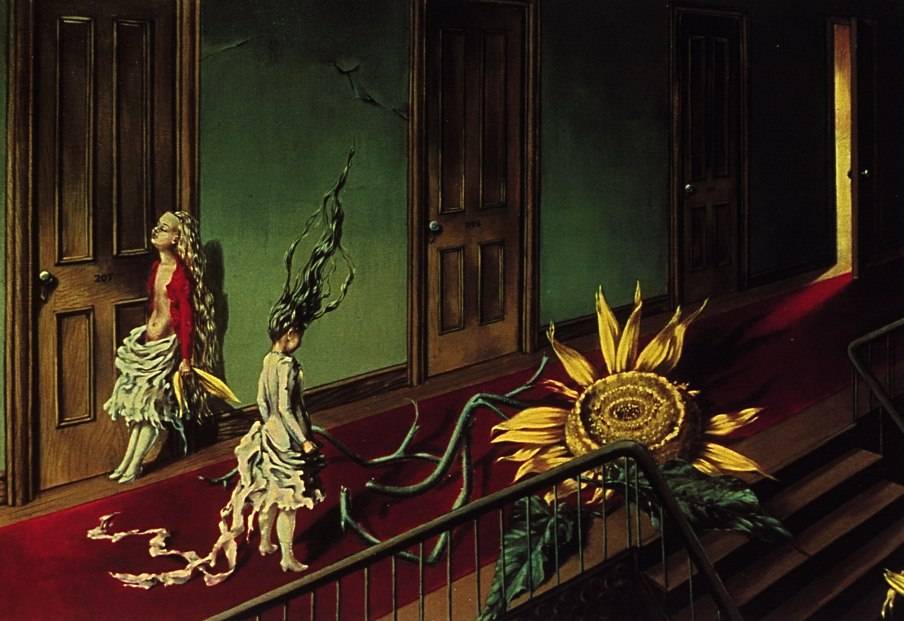
Amused and irritated by turns at the profile of Dorothea Tanning in this week's The New Yorker. Tanning herself is a hoot—she's had an amazing life, and she's created some images that I will not soon forget (some stranger-than-Balthus little girls here; a sculpture whose title says it all, "Pincushion to Serve as Fetish"). She's become a self-styled "emerging poet" at the age of 93, and her poetry is charming, judging from this sample from her forthcoming Graywolf book, A Table of Content. But the article, by Jane Kramer, does nothing to melt the impression of an American Poetry Wax Museum that New Yorker poetry continues to be an exemplar of. Consider these sentences:
Within a year of her flowers show, tanning, at eighty-nine, was publishing in McClatchy's Yale Review (" first serious published poem"). A year later, she was chosen for the anthology 'Best American Poetry 2000' [the Rita Dove edition]. By last year, she was everywhere: Poetry, Parnassus, The Paris Review, The New Yorker.
Everywhere? I don't know why I should care or be even faintly surprised, but the incredibly limited palette represented by Kramer's "everywhere" could set me to grinding my teeth at night. Here's the other irritating paragraph:
McClatchy used to help Tanning edit her poetry. (They're still arguing about a poem that ended with the word "aubergine." "I kept telling her that 'aubergine' is not the right kind of word to end a poem with," McClatchy says, but Tanning held out for several drafts, because as she says, "I fell in love with 'aubergine,' with the sheen, the wicked color, the 'O' of it.")
Now Tanning can, I'm sure, take care of herself, so I'm not going to get mad at McClatchy for trying to bully her out of ending the poem with "aubergine." But is it crazy irrational of me to ask that a reporter covering the poetry beat not come out and ask questions about what lies behind McClatchy's bizarre assumption. Why, for the love of Pete, is it a bad idea to end a poem with "aubergine"? Fagh. Phooey.

I hereby propose that we all write poems ending in "aubergine" and send them to poetry@newyorker.com. Who's with me?
Farewell, Thom Gunn.

Tuesday, April 27, 2004

Anagrammed!

A CRECHE DYE SOIR
RODE I A SCREECHY
COERCE A RYE DISH
I DO HER A SECRECY
CHOICE A DRY SERE
RIO DEERS A YECCH
HEY SIRE CREDO AC
A COY SCI ERRED HE
I OR A YECCH SEDER
HE A ROSY CIRCE ED
"I'm dreaming New York is tired. It lies down. The Empire State Building, the Chrysler Building are right there in each other's arms. The moon is looking down upon them."
Okay, I'm ready to inflict my dissertation prospectus on y'all. It has many modifications ahead of it, I'm sure:

Radical Modesty: Modernist Versions of Pastoral

Chapter 1: Introduction

This dissertation will propose new versions of pastoral as it has been practiced by formally innovative writers of the twentieth century. Pastoral as I conceive it is an imaginary poetic site characterized by its substitution of a logic of voluntary aesthetic association for what Peter Bürger has called “the means-end rationality of daily bourgeois existence” and, additionally and especially, the logic of domination and exploitation which attends all known means of organizing production within states and their institutions. By “voluntary aesthetic association” I mean both the representation of a radically democratic or anti-authoritarian ethos within the poems and the communitarian, anti-institutional association of poets themselves. Modernist pastoral is negative in character, but it is not allegorical, monadic, or utopian; that is, it is not a point-by-point negative image of the society it criticizes. Instead, it is a highly self-conscious image of life without domination and exploitation that exists on an ahistorical margin between a nature mediated by myth and a world reified by industrial capitalism; it constitutes an aesthetic space that refuses sovereignty over the nonaesethetic and is in fact constantly threatened by it. Pastoral ideology is easily mistaken for a fantasy of unmediated contact between the subject and nature, but it is more correct to say that it is a fantasy of an ecologically immanent, non-exploitative relation between the subject and the other (whether that other takes the form of exterior nature, other humans, or the unconscious). The mediating agency in pastoral is aesthetic judgment, which amounts to a cognition of Gelassenheit: letting the thing be. By this means aesthetic judgment comes to constitute an ethics, albeit a seriously limited one. The dissertation will explore pastoral as an aesthetic and ethico-political site as it manifests in the work and careers of four major twentieth century movements in Anglo-American poetry.

Chapter 2: Aporias of the Field, or the Pastoral Fragment

For the high modernist writers I will be concerned with, the limitation or weakness of pastoral becomes its strength, for in their work its primary and unintended function is to disrupt and de-center both capitalist modernity and the mythic totalities that these writers have assembled in opposition to that modernity. The pastoral moments in high modernist writing tend to exceed and undermine those writers’ own mythic intentions. In this chapter I will examine one or two major modernist figures (Pound, Williams, Lawrence, Woolf, and Stein are the most prominent potential candidates) whose mythic, often anti-democratic projects are disrupted by shards of pastoral imagery. Insofar as pastoral describes an alternative form of life, writers like Lawrence and Williams use their vision of non-exploitative engagement with nature to attack the social formations derived from capitalism. But in their longest and most ambitious works, the pastoral images fragment and undermine their prescriptions for a new totality. These fragments stand as firmly opposed to bourgeois capitalism as each writer’s larger project of coherence does, but they also resist that project’s authoritarianism, returning the human face at least momentarily to the center of a poetry predominantly concerned with new hierarchies of the exceptional. In the writing of Ezra Pound, for example, the figure of Thomas Jefferson acts as a kind of residual pastoral object, whose resonance as a symbol of rural, small-d democracy becomes the aporia within Pound’s valorization of Mussolini. Later, in the Pisan Cantos, the poet’s wretched condition once he is caught up in history (as opposed to capturing and reshaping history within his poem) makes it possible for him to rediscover compassion for those excluded from his painted Fascist paradise, and that “there / are / no / righteous / wars”. The poet turns to nature for moral relief: “Neither Eos nor Hesperus has suffered wrong at my hands”. (The “Lynx” Pound appeals to throughout Canto LXXIX may be a reference to the lynx in Virgil’s Eclogue VIII, “awestruck” by the songs of the shepherds.) And the famous “What thou lovest well remains” passage in Canto LXXX invokes the pastoral as a rebuke to Pound’s own epic ambitions : “Pull down thy vanity, I say pull down. / Learn of the green world what can be thy place / In scaled invention or true artistry”.

Chapter 3: Being with the Poem: Objectivist Pastoral

Pastoral became increasingly important to the Objectivist generation that followed Pound and Williams; as modernist poets whose leftist political commitments came into direct conflict with their writing practices, they ultimately sought to make their opposition to hierarchy and exploitation manifest itself within their texts themselves. The Objectivists extended Imagist principles to establish the ideal of the poem as an object occurring as naturally (or unnaturally) as any other object in the world, one thing among others, and thus wholly opposed and resistant to both instrumental/discursive and mythic/symbolist deployments of language. The anarchistic tendencies of their pastoral become especially clear here: by rejecting the mythic language as firmly as it rejects the instrumental, Objectivist writing attempts to diminish representation in poetic language (that is, the notion that a poem must symbolize or stand for something) as much as possible. This extends the principle of Gelassenheit to the poetic word itself—yet the results can be quietist, a re-assertion of the poem’s autonomy rendering it as “harmless” as the poetry that reinscribes the dominant ideology. A discussion of the poetry of Oppen and Zukofsky, who often deploy pastoral tropes, will be mingled with a discussion of their changing political commitments.

Chapter 4: The New Arcadias

Pastoral inverts the normal hierarchy by which cultural values are assumed to be the ideological superstructure of the economic base, produced by the feudal, capitalist, or communist organization of that base. Instead, Arcadia’s is a gift economy driven by the exchange of cultural products rather than commodities—archetypally, the shepherd’s song. This suggests that the small, extra- or anti-institutional poetry scenes of the twentieth century—Stein’s salon, Black Mountain, the Spicer circle, the New York School—had a strongly pastoral dimension. (The “An ‘Objectivists’ Issue” of Poetry, being an entirely imaginary gathering of poets not otherwise closely associated, might offer us the most genuinely pastoral literary scene of them all.) They also participated in the anti-authoritarian ethic of pastoral, standing opposed to and outside of the prevailing institutions of cultural value that were participants in capitalism and the state—this is nowhere clearer than in the 1950s, when loyalty oaths and the persecution of homosexuals revealed the universities as the ideological state apparatuses that they were. Jack Spicer’s “Pacific Republic” and Black Mountain College under the rectorship of Charles Olson were two pastoral anti-institutions that briefly thrived during this period. While the substitution of aesthetic values for all others and the anti-democratic, authoritarian stances of Spicer and Olson ultimately doomed these Arcadias, they managed to foster the New American Poetry that would eventually pass into and transform “official verse culture.” Perhaps the most purely pastoral poetry of the period—though a distinctly urban pastoral—was being written by Frank O’Hara and James Schuyler of the New York School—this may call for another, separate chapter, however.

Chapter 5: Pastoral Re-Visions

In this chapter, I want to look at the work of postmodernist poets for whom pastoral becomes the site for the re-emergence of visionary subjectivity; Robert Duncan and Ronald Johnson are the most likely candidates here. Duncan, of course, is the poet of The Opening of the Field and is an unapologetically “mythical” writer who appears to subscribe to a notion of sovereign aesthetics: that is, aesthetic knowledge is paramount and supersedes the theoretical and practical logics of modernity. Insofar as pastoral represents a withdrawal from history, Duncan’s work appears to withdraw too far into esoteric traditions that form a kind of alternative or counter-history. Duncan’s position is arguably most pastoral not in his poems but in his correspondence with Denise Levertov, in which he argued for the critical power of the imagination over her insistence on engagement with current historico-political realities. But I believe his poems also enact a dialectical struggle between esoteric vision and a more bodily, earthly vision. Also, his refusal to fetishize originality and his sense of himself as a “derivative” poet continues the Objectivist tendency to view poetic and cultural objects as objects in the world, literally “natural resources” for the poet. Ronald Johnson’s writing extends this tendency of Duncan’s even further and makes the connection between poetry and nature explicit: Wordsworth and Wordsworth’s daffodils are democratized into mosaic fragments that go into the construction of the garden/structure/spaceship that is ARK. Johnson’s notion of epic explicitly excludes history, pace Pound, which returns ARK to the zone of pastoral at, perhaps, the expense of pastoral’s critical power. His revision of the first four books of Milton’s Paradise Lost as RADI OS might offer a more promising version of pastoral, as he exchanges Milton’s authoritarian theodicy for a vision of free imaginative creation and love.

Chapter 6: Soft Architecture

Language writing in some ways extended the textual anarchism of the Objectivists even further: Ron Silliman’s influential book, The New Sentence tacitly equates the hypotactic subordination of sentences with the hierarchical subordination of human beings. The practice of the new sentence, which was meant to bring about an increased awareness of “syllogistic movement,” was further intended to create new and alternative modes of poetic organization (as explicitly advocated in the essay, “The Political Economy of Poetry”). While historically, Language writing was explicitly utopian and doctrinaire in its aims, some of the contemporary poets influenced by that movement have engaged directly with pastoral as a way to critique social and poetic practices: I am thinking especially of the Canadian poet Lisa Robertson and the Australian poet John Kinsella. Both use pastoral to critique contemporary historical realities: Robertson’s Xeclogue takes on the gendering of space, while Kinsella’s work examines environmental devastation and the pollution of both real and imaginative spaces. I will conclude the dissertation with a look at Robertson’s “Office for Soft Architecture,” a mostly imaginary collective that envisions a Ruskinesque “decorating” or “softening” of the hard edges of modernity through a close attention to surfaces: “the chaos of surfaces compels us toward new states of happiness.” “We are the Naturalists of the inessential,” the Office writes—a statement that gestures toward the openness of pastoral and the potential it continues to have for imaginative critique and freedom.

Monday, April 26, 2004

Huzzah for Stan

The good folks at Epoch emptied their library of literary magazines recently, and I scored a copy of the Stan Brakhage issue of Chicago Review. Here are some quotes that make me happy:
from an October 16, 1990 letter to Ronald Johnson:

In the strict sense Olson says "Myth is mouth", all his then follow-up of "Muthos" so-forth, I'd take my stance that both Poetry and narrative "encompass myth", yes; but I come to this logic also along-a-line of Hollis Frampton's only finding about 5 stories in the whole history of being human: he compared them to the 5 birdsongs: (1) Good morning, (2) I found a worm, (3) Fuck me, (4) Get out, and (5) Good night.... Anyway, the RESISTANCE is all—or at least worth the effort inasmuch as it tests the limits of known story, melody, and so on. I personally come more and more to believe (and a belief is all I can claim for it) that a biological evolution of aesthetics (i.e. an aesthetic base on the sense organs themselves, their inner processes—rather than just the immediate reception of the external world, the fashioning input into stories, symbols, soforth/muthos) would reval an outside limit of being human (what Olson called for, again and again, those last years) and thus a natural set of forms, therefore a being natural.

from a conversation between Brakhage, Johnson, and Jim Shedden:

SB: ....I'm paying homage to and re-presenting nature as one aspect of my work, and creating anew in thanks for what's been given to me. But also there is that thing I have—my sense of those cave beginnings, or any kid making a collection and storing it somewhere in the attic, hiding it, showing it maybe to his or her closest friend: all that is the anomaly of being human and being at odds with the given phenomenological world.
................................................
RJ: I've written a piece called "Hurrah for Euphony" for a young poet, where I say, "Poetry is quick with specifics. "Quick" points to "the quick and the dead." When you get the specific things, that's where poetry is alive.
SB: That's where film starts becoming picture, or illustration, so that's a danger for film as I see it. But what film can do is lift these specifics so they can be made to reverberate. You can create inferences, since the eye is always roving. The eye is very open to a reverberating spread of what we would call metaphor, I guess, in language, open to a multiplicity of visual means, but not an endless multiplicity. There's a skein or net of great exactitude.
................................................
SB: "Another way of looking at the universe." Well, I guess I'm a progressivist. You're probably right. But I'm moved to think that there is a move to a sanity of recognition of the universe that comes with that openmindedness that begins with Romanticism without that being dependent upon stitching things along the line of fact and logic. I see this openendedness as our only hope.

Friday, April 23, 2004

Please read Heriberto Yepez's "Poetry In a Time of Crisis." Now that's anarchism. Self-contradiction to destroy one's authority and by extension all authority. A stance inclusive I think of Kent Johnson's strategies of hyperauthorship.

The microscopic leap from a poetry of critique to a poetry of critique in which you, or at any rate your "subject position," are part of what gets critiqued. At the center of it, in fact.
Things Just Got a Whole Lot More Interesting Around Here Dept.

New at the Bookery:

Philip Jenks, On the Cave You Live In (Flood Editions, 2002)
Ronald Johnson, The Shrubberies (Flood Editions, 2001)
Pam Rehm, Gone to Earth (Flood Editions, 2001)
Alice Jones, Extreme Directions: The 54 Moves of Tai Chi Sword (Omnidawn, 2002)
Laura Moriarty, The Case (O Books, 1998)
P. Inman, At Least (Krupskaya, 1999)
Benjamin Friedlander, A Knot Is Not a Tangle (Krupskaya, 2000)
Dorothy Trujillo Lusk, Ogress Oblige (Krupskaya, 2001)
Laura Elrick, sKincertiy (Krupskaya, 2003)
Drew Gardner, Sugar Pill (Krupskaya, 2002)
Geoffrey Dyer, The Dirty Halo of Everything (Krupskaya, 2003)
Renee Gladman [did you know we were at Vassar together? I never met her], The Activist (Krupskaya, 203)
Hung Q. Tu, Structures of Feeling (Krupskaya, 2003) [re-order]
Rodrigo Toscano, Platform (Atelos, 2003) [re-order]
Brian Kim Stefans, Fashionable Noise: On Digital Poetics (Atelos, 2003) [re-order]
Lyn Hejinian, The Fatalist (Omnidawn, 2003) [re-order]
Rosmarie Waldrop, Love, Like Pronouns (Omnidawn, 2003) [re-order]
Rodney Koeneke, Rouge State (Pavement Saw, 2003)
Bill Mayer, The Uncertainty Principle (Omnidawn, 2001)
Liz Waldner, Etym(bi)ology (Omnidawn, 2002)
William Fuller, Sadly (Flood Editions, 2003) [I'd love to display this next to a certain Lyn Hejinian book]
Graham Foust, As In Every Deafness (Flood Editions, 2003)
Lorine Niedecker, New Goose (Rumour Books, 2002) [a gorgeous thing]
Paul Hoover, Winter (Mirror) (Flood Editions, 2002)
Robert Duncan, Letters: Poems 1953-1956 (Flood Editions, 2003)
Lisa Jarnot, Black Dog Songs (Flood Editions, 2003) [re-order]
Robin Caton, The Color of Dusk (Omnidawn, 2001)
Yedda Morrison, Crop (Kelsey St. Press, 2003) [re-order]
Katy Lederer, Winter Sex (Verse Press, 2002) [re-order]
Mei-Mei Berssenbrugge, Nest (Kelsey St. Press, 2003) [re-order]

plus three Lisa Robertson books I'm keeping for myself: Xeclogue (New Star Books, 1999), Debbie: An Epic (New Star Books, 1997, 2003), and The Weather (New Star Books, 2001).

Glancing at these titles in a recklessly generalizing state of mind, I find myself thinking about the avant-garde/experimental distinction. I think it's absolutely valid, which means that these authors, however radical in their textual practices (the Krupskaya titles are particularly notable for their anti-absorptive qualities, though their techniques and aims differ), are not avant-garde. Or at least that their texts are not self-evidently by-products of an anti-institutional praxis. But this does not erase distinctions: a small press with a unitary aesthetic vision is qualitatively different from even a university press, much less a commercial press. It's an institution of art but not synonymous with THE institution of art (if it's even meaningful to speak of such a monolith). Such a press is less oppositional than a-positional (to borrow a distinction from Jonathan Monroe's "Avant-Garde Poetries After the Wall"). I'm not sure if that helps to define what the social function of experimental writing may be, other than to speak broadly of forging new channels for the imagination to run down beyond the official ones. Meaningless pluralism? Perhaps not if we start calling experimental poetry critical poetry, or the poetry of critique, because its critical capacity (which often but not always means an active engagement with texts, modes, and arguments associated with social theory) is what distinguishes it from "mere" poetry (that which would necessarily include "official" and "mainstream" poetries, which otherwise have as strong a claim for answering the pressure of reality with that of the verbal imagination). Or as Ben Friedlander puts it:
Intellectual Labor

Your work
is all heart, mine
is mostly kidney,
purifying the blood,
producing piss.
The Pastoral/Anarchist Connection

From Tasso's Aminta:
O bella età de l'oro,
non già perché di latte
sen' corse il fiume e stillò mele il bosco;
non perché i frutti loro
dier da l'aratro intatte
le terre, e gli angui errar senz'ira o tosco;
non perché nuvol fosco
non spiegò allor suo velo,
ma in primavera eterna,
ch'ora s'accende e verna,
rise di luce e di sereno il cielo;
né portò peregrino
o guerra o merce agli altrui lidi il pino;
ma sol perché quel vano
nome senza soggetto,
quell'idolo d'errori, idol d'inganno,
quel che dal volgo insano
onor poscia fu detto,
che di nostra natura 'l feo tiranno,
non mischiava il suo affanno
fra le liete dolcezze
de l'amoroso gregge;
né fu sua dura legge
nota a quell'alme in libertate avvezze,
ma legge aurea e felice
che natura scolpì: «S'ei piace, ei lice».
A translation:
O happy age of Gold,
not because then the rivers flowed with milk
and the forest dript honey,
not because the earth untouched by the plough
gave her fruit,
and the serpents coiled without wrath or poison,
not because no gloomy cloud
spread then its veil
but in perpetual spring
(which now waxes hot and then to winter turns)
the cloudless heaven smiled with light serene
and ships never brought
to other shores foreign war or merchandise
But only because that empty
name without meaning,
that idol of error, idol of falsehood,
which has since been called
by senseless folk Honour
(which they made the tyrant of our nature)
did not with its anxieties
suffuse the gay pleasure
of the amorous crowd,
nor was its hard law
known to those spirits steeped in liberty,
but a law golden and happy
which Nature graved: Whatever pleases is allowed.

Thursday, April 22, 2004

I expect Joe to get a flood of e-mails answering his job advertisement, too.
An extremely useful and provocative collection of responses to questions about the state of contemporary American poetry—hosted by Joan Houlihan—is very much worth your attention. I find there's kind a favorite-Beatle effect in reading the commentators: do I identify more with the philosophical stylings of Oren Izenberg, the matter-of-factness of Norman Finkelstein, the will-to-categorical-power of Stephen Burt, the knowledgable contemporary analysis of Alan Golding, the anti-militaristic stance of H.L. Hix, the sheer contentiousness of Kent Johnson, or the prolix punk comedy of Joe Amato? Right now Joe's Yellow Submarine strikes me as the ship I'd be most eager to board: has there been a more prolifically pastoral pop group than the Beatles? From the octopus' garden to Strawberry Fields, their songs are 3 to 5 minute promesses du bonheur. The band itself seemed to be a little alternative society, centered on the good-natured musical duels of John and Paul: call 'em the Corydon and Thrysis of the 60s.

Well, I won't try to paraphrase any of the contributors' arguments further; they're well worth reading for themselves. Kudos to Joan for making this dialogue possible—though I wonder what she herself makes of it all. Will she agree, for example, with Izenberg's very reasonable claim that "a collection of individual, unconnected lines" is a contradiction in terms? Perhaps she'll join the discussion later.
A terrific article by Jonathan Lethem about his obsession with Marvel Comics in the 70s.
Good morning, faithful readers. Check out this review of my friend Gina Franco's new book.

Wednesday, April 21, 2004

I'm happy to announce that the University of Montana has invited me and other recent grads with books (including Richard Greenfield, Nils Michals, and Sarah Gridley—Sarah, if you're out there, phone home!—to come do a reading at AWP in Vancouver. Montana doesn't have any money, though, so I'm going to have to try and hornswoggle Cornell into paying for the plane ticket. I was already trying to put together a panel on "The New Nature Poem." Basically I'll do anything to get to Vancouver. Not just because of how beautiful it's supposed to be, or because I'm nostalgic for the Northwest—though these things are true. But because it is the city deeply described in Lisa Robertson's astonishing Occasional Work and Seven Walks from the Office for Soft Architecture. Here are a few of the knockout sentences that I've encountered so far:
The truly utopian act is to manifest current conditions and dialects. Practice description. Description is mystical. It is afterlife because it is life's reflection or reverse. Place is accident posing as politics. And vice versa. Therefore it's tragic and big (16).

What if there is no "space," only a permanent, slow-motion mystic takeover, an implausibly careening awning? Nothing is utopian. Everything wants to be. Soft Architects face the reaching middle (17).

Belief is difficult. It suits us to write in this raw city. Maybe it's the spanner-framed and buttered light slabbed or trickling into soot, soft clicking of louvred Chanel billboards, puce sky swathing the night-time overpass where on every radio of every taxicab Rousseau croons "we are born innocent" over and over in whining vibrato (25).

We will commute between our desire and our economy (27).

While "equilibrium" is a lovely suburban word—with its horse-games and moot-courts and love-games and libraries—it seems sad and impossible that this interminably symbolic landscape finally does not refer to anything other than itself (27-8).

Soft Architects believe that this site [New Brighton Park] demonstrates the best possible use of an urban origin: Change its name repeatedly. Burn it down. From the rubble confect a prosthetic pleasure ground; with fluent obliviousness, picnic there (41).

On our civic peninsula modesty always becomes potently ironic (53).

The artful redirection of liquidity may seem like a small thing—after all, what status do today's theorists grant fountains?—but for us, rising jets, downward falls, combinations, an oddly issuing spray, divert attention from the great constant impersonal desires so that we may notice and enjoy the supple nap and receptivity of human thought (54).

Why shouldn't we seek to describe happiness? (55)

Nevertheless, flow in itself, with its fatal grandeur, does not interest us; we prefer to describe obstacles to flow, little impediments, affect-mechanisms, miniaturizations of sublimity. In a certain way we adore each century through its impediments and fountains as also we can now feel an agreeably improper affection for the corporate grid (59).

Because we are both passive and independent, we need to theorize (77).
So, stoked am I. I'm also pleased, belatedly, to point you toward some new poems of mine over at Typo (along with work by John Latta, Christopher Janke, Aaron McCollough, G.C. Waldrep, and other friendly faces). And so to bed.

Tuesday, April 20, 2004

Finished a tentative prospectus and fired it off to my committee chair. When I've gotten more used to the damn thing I'll post it here. We're looking at a 200-pp. diss., minimum. That's actually not so long, but if I go ahead with it I've got an insane amount of reading to do. The Cantos in their entirety, and a re-reading of Paterson; maybe some more Lawrence poems, too. Zukofsky's "A", the whole thing. All of Oppen. Most of Duncan, including his correspondence with Denise Levertov. I think I'm leaving Olson out of it but maybe not, in which case Maximus. Spicer and his circle, the Black Mountain poets. The original New York School, probably. And then at least two contemporary poets with large oeuvres: John Kinsella and Lisa Robertson. Not to mention heaps more critical theory and assorted books on pastoral. The sick thing is that this all sounds like lots of fun. Just not all at once.
Finding myself totally caught up in and moved by the fate of my favorite Republican.

Monday, April 19, 2004

This is going to be an extremely important book; I'm relieved to hear about it. I always was more than half-persuaded by the "lunatic" arguments of "Philip Roth."
Joan Houlihan has written back to me objecting to my characterization of her e-mail as "mistrustful" and given me permission to post her actual reply. Here it is:
Dear Joshua,

Yes, I was aware of your remarks about me via your blog, but that had/has no bearing on my evaluation of your work. About your "conditions": I have zero time to have the kind of exchange you propose so I must decline your "offer."

Take care,
Joan

Sunday, April 18, 2004

Knight of the Sorrowful Countenance Dept.

I received an e-mail from Joan Houlihan, asking me to submit poems for her magazine Perihelion. She made no mention of l'affaire Skanky or my small part in it. So here's what I wrote in reply:
Dear Joan Houlihan,

Thank you for your interest in my work; it's always flattering to be a finalist, and even more flattering to be solicited. But before I send you any poems, I feel that we need to start a conversation.

I''m not sure if you're aware that I'm the same "Josh (Corey?)" whose response to your attack on Fence and Skanky Possum on my blog (http://joshcorey.blogspot.com) was classified by you as "unintelligible." (A category I feel you are all too quick to assign writers too, but I'll get to that.) So first of all, I don't want to put you in the position of offering publication to someone you may have viewed as unsympathetic to you. I tried to be very measured in my response to an article that I found to be a particularly irritating installment of your series "How Contemporary American Poets Are Denaturing the Poem." I strongly disagree with nearly everything you've had to say in that series, starting with the title and its assumption that there is a single "nature" that poetry can be said to have. (And your favorite bugbear, "coherence," strikes me as an obtuse goal for poetry; for me coherence is only a starting point. There's too much false coherence in the lines of your typical Poetry-Chicago poem, just as there is in the statements of our politicians.) But okay: everyone's entitled to their opinion, and I enjoy seeing sacred cows tipped as much as anyone. Still, your attack on the "avant-garde establishment" struck me as astonishingly mean-spirited, because I don't believe such an establishment exists. (Following Peter Burger, such a phrase is a classic contradiction in terms: the avant-garde are precisely those artists who attack the institutionalization of art. It would be more accurate, though not especially illuminating, to call the writing you so heartily dislike postmodernist.) The good folks at Fence, Slope, Skanky Possum, etc., while hardly perfect in their editorial decisions (who is?), created something where there was nothing with no visible means of institutional support, and they have earned my respect thereby. Furthermore, they support a lot of the contemporary work I most value--some of it even "makes sense" and does not require "great mental stamina" (though I have to say the building of such stamina is precisely one of the things I enjoy getting from reading poetry) to appreciate. At the risk of being tendentious, I'll quote a poem from the most recent issue of Fence that satisfies some of my demands for beauty and strife:

SEASON OF INACCURATE DESCRIPTION
Amy Eisner

Sun jiggling in its yolk.
Heavy thorax of the garbage truck.
Anthropologist of hoax.

We are beyond proliferation
and the many alliances
for which accuracy matters.

We can put a kidney in
and leave the old one there,
the new kidney in a new place.

Still, let us categorize.
A lacquer reflex moves the eyes
differently than velvety.

Variegations of the hybrid tea:
bordered, margined, penciled,
which is also entered: veined.

There are dots and blotches.
Methods of procedure. Planes
of insertion. Once, again

the sun's liquid heart strays.
Small storms of delight
frizzle the blinding dunes.

How stilly the lense
bends these rays,
spooning a glimpse--


Perhaps a better example would be G.C. Waldrep's poem "Vertigo," which you yourself have deemed good enough to publish in Perihelion--a poem I would not be at all surprised to see in Fence. Perihelion is, of course, why we're having this conversation, or why I'm attempting to have it. If all I knew of your work was the Boston Comment pieces, this e-mail would be a whole lot shorter: I would simply politely decline. But I do admire some of the writing you've chosen to publish there--in the latest issue I see poems I like by Waldrep, Ander Monson, and Sophie Wadsworth. And the interviews you've done, especially those with Timothy Donnelly and Stephen Burt, suggest that you may be more open-minded to other paradigms of poetic value than your essays will admit. This opens my own mind to the possibility that we might have things in common--some of your frustrations, if not your conclusions, have mirrored my own. The poetry I value most tends to have a certain vigor of form, something I suspect that you too value highly--and I have failed to find this vigor in some of the same "mainstream" poets you've taken to task in your columns. (I do see this vigor, in fact I sometimes see little else, in the Language poets--I don't usually wish to write like them, but I do think they have raised questions about poetry's capacity for critique that the poets who come after them have to deal with if they're serious about the art. Stephen Burt put it pretty well in his interview with you: "they often want, or say they want, to deflect attention from the self a poem supposedly represents, onto the social forces and networks which make up that self, and which (it is often claimed) language writing sets out to demystify, transform or expose." I also happen to be a huge fan of Rae Armantrout's, by the way.) Therefore, I think that it just barely might be possible for there to be, in Ezra Pound's words, "commerce between us." But rather than just the usual writer-editor relationship, I'd like us to have a conversation about poetic values. In other words, if I'm going to send you poems, I'd like it to be part of a dialogue in which I do my level best to persuade you of your errors. And of course you will probably be moved to reciprocate in kind.

If you are interested in such a conversation, please let me know, and I will be happy to attach some recent writing as a submission to Perihelion in my reply. I'd also like permission from you to post our exchange on my blog--though I still want to have our conversation even if you choose to withhold such permission.

Best wishes,

Josh Corey
Ms. Houlihan declined in a brief e-mail, citing time considerations. I can't quote her response without her permission, but I'll just say that she did know who I was and seemed to mistrust my motives. Oh well. As Lyle Lovett says, "What would you be if you didn't even try? You have to try. So please, if it's not too late, make it a. . . cheesburger."

Popular Posts

Followers