Paul Guest joins the auberginian heresy. (Can't figure out how to link directly to his poem, but's it's a beaut, no matter how little time it took him to write). I think Nada ought to join, too, given her blog's color. (Her and Gary's nuptials are fast approaching!) We also have a particularly hilarious entry from Kasey, who I will always think of now every time I put marmalade on my mausoleum.
Tim: The preciousness or lack thereof of "aubergine" would derive almost entirely from context, nicht wahr? Yes, I too thought that there ought to be a Foetry red phone for just these occasions, like on the old Batman TV show.
Here is my own contribution:
Subcutaneous, interstitial: two rules.
A bruise, what you were thinking of saying:
prepositions. Known in advance, the bookie
licks his pencil and bets on war. Toward night
the sandy valley blues. It's a commoner's
refraction, brown in the iris but indigo skied,
when we see what we own or ought to. More than kind
the world behind your blue-black curtain,
paring its nails, the difference between dis-
interest and its singular cousin un
makes for a science of narrative. Or else
your purposive description of a corn
flour chip. Edible at last these undies sheen
like a language in the dark, aubergine.
Wednesday, April 28, 2004

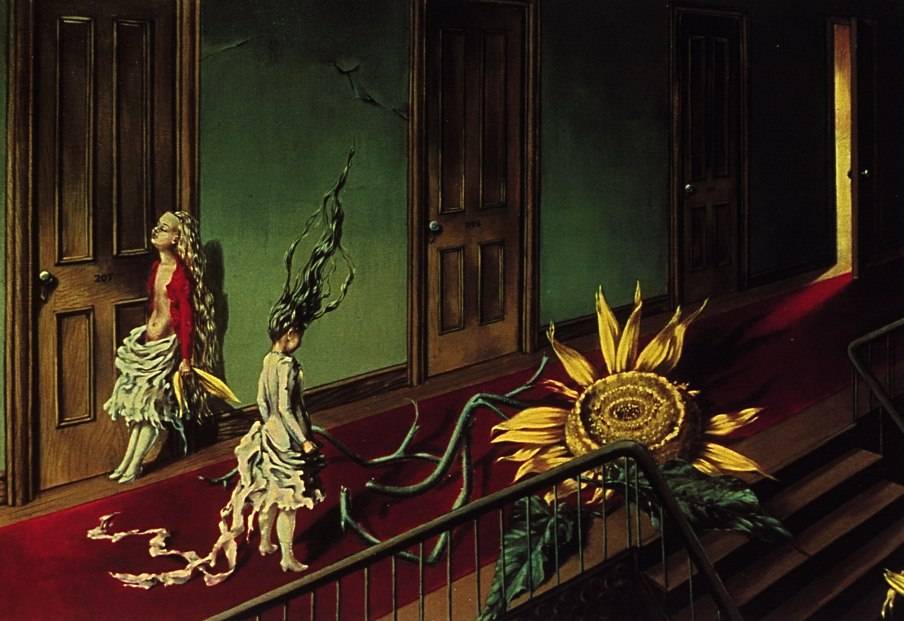
Amused and irritated by turns at the profile of Dorothea Tanning in this week's The New Yorker. Tanning herself is a hoot—she's had an amazing life, and she's created some images that I will not soon forget (some stranger-than-Balthus little girls here; a sculpture whose title says it all, "Pincushion to Serve as Fetish"). She's become a self-styled "emerging poet" at the age of 93, and her poetry is charming, judging from this sample from her forthcoming Graywolf book, A Table of Content. But the article, by Jane Kramer, does nothing to melt the impression of an American Poetry Wax Museum that New Yorker poetry continues to be an exemplar of. Consider these sentences:
I hereby propose that we all write poems ending in "aubergine" and send them to poetry@newyorker.com. Who's with me?
Within a year of her flowers show, tanning, at eighty-nine, was publishing in McClatchy's Yale Review (" first serious published poem"). A year later, she was chosen for the anthology 'Best American Poetry 2000' [the Rita Dove edition]. By last year, she was everywhere: Poetry, Parnassus, The Paris Review, The New Yorker.Everywhere? I don't know why I should care or be even faintly surprised, but the incredibly limited palette represented by Kramer's "everywhere" could set me to grinding my teeth at night. Here's the other irritating paragraph:
McClatchy used to help Tanning edit her poetry. (They're still arguing about a poem that ended with the word "aubergine." "I kept telling her that 'aubergine' is not the right kind of word to end a poem with," McClatchy says, but Tanning held out for several drafts, because as she says, "I fell in love with 'aubergine,' with the sheen, the wicked color, the 'O' of it.")Now Tanning can, I'm sure, take care of herself, so I'm not going to get mad at McClatchy for trying to bully her out of ending the poem with "aubergine." But is it crazy irrational of me to ask that a reporter covering the poetry beat not come out and ask questions about what lies behind McClatchy's bizarre assumption. Why, for the love of Pete, is it a bad idea to end a poem with "aubergine"? Fagh. Phooey.
I hereby propose that we all write poems ending in "aubergine" and send them to poetry@newyorker.com. Who's with me?
Tuesday, April 27, 2004
Anagrammed!
A CRECHE DYE SOIR
RODE I A SCREECHY
COERCE A RYE DISH
I DO HER A SECRECY
CHOICE A DRY SERE
RIO DEERS A YECCH
HEY SIRE CREDO AC
A COY SCI ERRED HE
I OR A YECCH SEDER
HE A ROSY CIRCE ED
A CRECHE DYE SOIR
RODE I A SCREECHY
COERCE A RYE DISH
I DO HER A SECRECY
CHOICE A DRY SERE
RIO DEERS A YECCH
HEY SIRE CREDO AC
A COY SCI ERRED HE
I OR A YECCH SEDER
HE A ROSY CIRCE ED
Okay, I'm ready to inflict my dissertation prospectus on y'all. It has many modifications ahead of it, I'm sure:
Radical Modesty: Modernist Versions of Pastoral
Chapter 1: Introduction
This dissertation will propose new versions of pastoral as it has been practiced by formally innovative writers of the twentieth century. Pastoral as I conceive it is an imaginary poetic site characterized by its substitution of a logic of voluntary aesthetic association for what Peter Bürger has called “the means-end rationality of daily bourgeois existence” and, additionally and especially, the logic of domination and exploitation which attends all known means of organizing production within states and their institutions. By “voluntary aesthetic association” I mean both the representation of a radically democratic or anti-authoritarian ethos within the poems and the communitarian, anti-institutional association of poets themselves. Modernist pastoral is negative in character, but it is not allegorical, monadic, or utopian; that is, it is not a point-by-point negative image of the society it criticizes. Instead, it is a highly self-conscious image of life without domination and exploitation that exists on an ahistorical margin between a nature mediated by myth and a world reified by industrial capitalism; it constitutes an aesthetic space that refuses sovereignty over the nonaesethetic and is in fact constantly threatened by it. Pastoral ideology is easily mistaken for a fantasy of unmediated contact between the subject and nature, but it is more correct to say that it is a fantasy of an ecologically immanent, non-exploitative relation between the subject and the other (whether that other takes the form of exterior nature, other humans, or the unconscious). The mediating agency in pastoral is aesthetic judgment, which amounts to a cognition of Gelassenheit: letting the thing be. By this means aesthetic judgment comes to constitute an ethics, albeit a seriously limited one. The dissertation will explore pastoral as an aesthetic and ethico-political site as it manifests in the work and careers of four major twentieth century movements in Anglo-American poetry.
Chapter 2: Aporias of the Field, or the Pastoral Fragment
For the high modernist writers I will be concerned with, the limitation or weakness of pastoral becomes its strength, for in their work its primary and unintended function is to disrupt and de-center both capitalist modernity and the mythic totalities that these writers have assembled in opposition to that modernity. The pastoral moments in high modernist writing tend to exceed and undermine those writers’ own mythic intentions. In this chapter I will examine one or two major modernist figures (Pound, Williams, Lawrence, Woolf, and Stein are the most prominent potential candidates) whose mythic, often anti-democratic projects are disrupted by shards of pastoral imagery. Insofar as pastoral describes an alternative form of life, writers like Lawrence and Williams use their vision of non-exploitative engagement with nature to attack the social formations derived from capitalism. But in their longest and most ambitious works, the pastoral images fragment and undermine their prescriptions for a new totality. These fragments stand as firmly opposed to bourgeois capitalism as each writer’s larger project of coherence does, but they also resist that project’s authoritarianism, returning the human face at least momentarily to the center of a poetry predominantly concerned with new hierarchies of the exceptional. In the writing of Ezra Pound, for example, the figure of Thomas Jefferson acts as a kind of residual pastoral object, whose resonance as a symbol of rural, small-d democracy becomes the aporia within Pound’s valorization of Mussolini. Later, in the Pisan Cantos, the poet’s wretched condition once he is caught up in history (as opposed to capturing and reshaping history within his poem) makes it possible for him to rediscover compassion for those excluded from his painted Fascist paradise, and that “there / are / no / righteous / wars”. The poet turns to nature for moral relief: “Neither Eos nor Hesperus has suffered wrong at my hands”. (The “Lynx” Pound appeals to throughout Canto LXXIX may be a reference to the lynx in Virgil’s Eclogue VIII, “awestruck” by the songs of the shepherds.) And the famous “What thou lovest well remains” passage in Canto LXXX invokes the pastoral as a rebuke to Pound’s own epic ambitions : “Pull down thy vanity, I say pull down. / Learn of the green world what can be thy place / In scaled invention or true artistry”.
Chapter 3: Being with the Poem: Objectivist Pastoral
Pastoral became increasingly important to the Objectivist generation that followed Pound and Williams; as modernist poets whose leftist political commitments came into direct conflict with their writing practices, they ultimately sought to make their opposition to hierarchy and exploitation manifest itself within their texts themselves. The Objectivists extended Imagist principles to establish the ideal of the poem as an object occurring as naturally (or unnaturally) as any other object in the world, one thing among others, and thus wholly opposed and resistant to both instrumental/discursive and mythic/symbolist deployments of language. The anarchistic tendencies of their pastoral become especially clear here: by rejecting the mythic language as firmly as it rejects the instrumental, Objectivist writing attempts to diminish representation in poetic language (that is, the notion that a poem must symbolize or stand for something) as much as possible. This extends the principle of Gelassenheit to the poetic word itself—yet the results can be quietist, a re-assertion of the poem’s autonomy rendering it as “harmless” as the poetry that reinscribes the dominant ideology. A discussion of the poetry of Oppen and Zukofsky, who often deploy pastoral tropes, will be mingled with a discussion of their changing political commitments.
Chapter 4: The New Arcadias
Pastoral inverts the normal hierarchy by which cultural values are assumed to be the ideological superstructure of the economic base, produced by the feudal, capitalist, or communist organization of that base. Instead, Arcadia’s is a gift economy driven by the exchange of cultural products rather than commodities—archetypally, the shepherd’s song. This suggests that the small, extra- or anti-institutional poetry scenes of the twentieth century—Stein’s salon, Black Mountain, the Spicer circle, the New York School—had a strongly pastoral dimension. (The “An ‘Objectivists’ Issue” of Poetry, being an entirely imaginary gathering of poets not otherwise closely associated, might offer us the most genuinely pastoral literary scene of them all.) They also participated in the anti-authoritarian ethic of pastoral, standing opposed to and outside of the prevailing institutions of cultural value that were participants in capitalism and the state—this is nowhere clearer than in the 1950s, when loyalty oaths and the persecution of homosexuals revealed the universities as the ideological state apparatuses that they were. Jack Spicer’s “Pacific Republic” and Black Mountain College under the rectorship of Charles Olson were two pastoral anti-institutions that briefly thrived during this period. While the substitution of aesthetic values for all others and the anti-democratic, authoritarian stances of Spicer and Olson ultimately doomed these Arcadias, they managed to foster the New American Poetry that would eventually pass into and transform “official verse culture.” Perhaps the most purely pastoral poetry of the period—though a distinctly urban pastoral—was being written by Frank O’Hara and James Schuyler of the New York School—this may call for another, separate chapter, however.
Chapter 5: Pastoral Re-Visions
In this chapter, I want to look at the work of postmodernist poets for whom pastoral becomes the site for the re-emergence of visionary subjectivity; Robert Duncan and Ronald Johnson are the most likely candidates here. Duncan, of course, is the poet of The Opening of the Field and is an unapologetically “mythical” writer who appears to subscribe to a notion of sovereign aesthetics: that is, aesthetic knowledge is paramount and supersedes the theoretical and practical logics of modernity. Insofar as pastoral represents a withdrawal from history, Duncan’s work appears to withdraw too far into esoteric traditions that form a kind of alternative or counter-history. Duncan’s position is arguably most pastoral not in his poems but in his correspondence with Denise Levertov, in which he argued for the critical power of the imagination over her insistence on engagement with current historico-political realities. But I believe his poems also enact a dialectical struggle between esoteric vision and a more bodily, earthly vision. Also, his refusal to fetishize originality and his sense of himself as a “derivative” poet continues the Objectivist tendency to view poetic and cultural objects as objects in the world, literally “natural resources” for the poet. Ronald Johnson’s writing extends this tendency of Duncan’s even further and makes the connection between poetry and nature explicit: Wordsworth and Wordsworth’s daffodils are democratized into mosaic fragments that go into the construction of the garden/structure/spaceship that is ARK. Johnson’s notion of epic explicitly excludes history, pace Pound, which returns ARK to the zone of pastoral at, perhaps, the expense of pastoral’s critical power. His revision of the first four books of Milton’s Paradise Lost as RADI OS might offer a more promising version of pastoral, as he exchanges Milton’s authoritarian theodicy for a vision of free imaginative creation and love.
Chapter 6: Soft Architecture
Language writing in some ways extended the textual anarchism of the Objectivists even further: Ron Silliman’s influential book, The New Sentence tacitly equates the hypotactic subordination of sentences with the hierarchical subordination of human beings. The practice of the new sentence, which was meant to bring about an increased awareness of “syllogistic movement,” was further intended to create new and alternative modes of poetic organization (as explicitly advocated in the essay, “The Political Economy of Poetry”). While historically, Language writing was explicitly utopian and doctrinaire in its aims, some of the contemporary poets influenced by that movement have engaged directly with pastoral as a way to critique social and poetic practices: I am thinking especially of the Canadian poet Lisa Robertson and the Australian poet John Kinsella. Both use pastoral to critique contemporary historical realities: Robertson’s Xeclogue takes on the gendering of space, while Kinsella’s work examines environmental devastation and the pollution of both real and imaginative spaces. I will conclude the dissertation with a look at Robertson’s “Office for Soft Architecture,” a mostly imaginary collective that envisions a Ruskinesque “decorating” or “softening” of the hard edges of modernity through a close attention to surfaces: “the chaos of surfaces compels us toward new states of happiness.” “We are the Naturalists of the inessential,” the Office writes—a statement that gestures toward the openness of pastoral and the potential it continues to have for imaginative critique and freedom.
Monday, April 26, 2004
Huzzah for Stan
The good folks at Epoch emptied their library of literary magazines recently, and I scored a copy of the Stan Brakhage issue of Chicago Review. Here are some quotes that make me happy:
The good folks at Epoch emptied their library of literary magazines recently, and I scored a copy of the Stan Brakhage issue of Chicago Review. Here are some quotes that make me happy:
from an October 16, 1990 letter to Ronald Johnson:
In the strict sense Olson says "Myth is mouth", all his then follow-up of "Muthos" so-forth, I'd take my stance that both Poetry and narrative "encompass myth", yes; but I come to this logic also along-a-line of Hollis Frampton's only finding about 5 stories in the whole history of being human: he compared them to the 5 birdsongs: (1) Good morning, (2) I found a worm, (3) Fuck me, (4) Get out, and (5) Good night.... Anyway, the RESISTANCE is all—or at least worth the effort inasmuch as it tests the limits of known story, melody, and so on. I personally come more and more to believe (and a belief is all I can claim for it) that a biological evolution of aesthetics (i.e. an aesthetic base on the sense organs themselves, their inner processes—rather than just the immediate reception of the external world, the fashioning input into stories, symbols, soforth/muthos) would reval an outside limit of being human (what Olson called for, again and again, those last years) and thus a natural set of forms, therefore a being natural.
from a conversation between Brakhage, Johnson, and Jim Shedden:
SB: ....I'm paying homage to and re-presenting nature as one aspect of my work, and creating anew in thanks for what's been given to me. But also there is that thing I have—my sense of those cave beginnings, or any kid making a collection and storing it somewhere in the attic, hiding it, showing it maybe to his or her closest friend: all that is the anomaly of being human and being at odds with the given phenomenological world.
................................................
RJ: I've written a piece called "Hurrah for Euphony" for a young poet, where I say, "Poetry is quick with specifics. "Quick" points to "the quick and the dead." When you get the specific things, that's where poetry is alive.
SB: That's where film starts becoming picture, or illustration, so that's a danger for film as I see it. But what film can do is lift these specifics so they can be made to reverberate. You can create inferences, since the eye is always roving. The eye is very open to a reverberating spread of what we would call metaphor, I guess, in language, open to a multiplicity of visual means, but not an endless multiplicity. There's a skein or net of great exactitude.
................................................
SB: "Another way of looking at the universe." Well, I guess I'm a progressivist. You're probably right. But I'm moved to think that there is a move to a sanity of recognition of the universe that comes with that openmindedness that begins with Romanticism without that being dependent upon stitching things along the line of fact and logic. I see this openendedness as our only hope.
Friday, April 23, 2004
Please read Heriberto Yepez's "Poetry In a Time of Crisis." Now that's anarchism. Self-contradiction to destroy one's authority and by extension all authority. A stance inclusive I think of Kent Johnson's strategies of hyperauthorship.
The microscopic leap from a poetry of critique to a poetry of critique in which you, or at any rate your "subject position," are part of what gets critiqued. At the center of it, in fact.
The microscopic leap from a poetry of critique to a poetry of critique in which you, or at any rate your "subject position," are part of what gets critiqued. At the center of it, in fact.
Things Just Got a Whole Lot More Interesting Around Here Dept.
New at the Bookery:
Philip Jenks, On the Cave You Live In (Flood Editions, 2002)
Ronald Johnson, The Shrubberies (Flood Editions, 2001)
Pam Rehm, Gone to Earth (Flood Editions, 2001)
Alice Jones, Extreme Directions: The 54 Moves of Tai Chi Sword (Omnidawn, 2002)
Laura Moriarty, The Case (O Books, 1998)
P. Inman, At Least (Krupskaya, 1999)
Benjamin Friedlander, A Knot Is Not a Tangle (Krupskaya, 2000)
Dorothy Trujillo Lusk, Ogress Oblige (Krupskaya, 2001)
Laura Elrick, sKincertiy (Krupskaya, 2003)
Drew Gardner, Sugar Pill (Krupskaya, 2002)
Geoffrey Dyer, The Dirty Halo of Everything (Krupskaya, 2003)
Renee Gladman [did you know we were at Vassar together? I never met her], The Activist (Krupskaya, 203)
Hung Q. Tu, Structures of Feeling (Krupskaya, 2003) [re-order]
Rodrigo Toscano, Platform (Atelos, 2003) [re-order]
Brian Kim Stefans, Fashionable Noise: On Digital Poetics (Atelos, 2003) [re-order]
Lyn Hejinian, The Fatalist (Omnidawn, 2003) [re-order]
Rosmarie Waldrop, Love, Like Pronouns (Omnidawn, 2003) [re-order]
Rodney Koeneke, Rouge State (Pavement Saw, 2003)
Bill Mayer, The Uncertainty Principle (Omnidawn, 2001)
Liz Waldner, Etym(bi)ology (Omnidawn, 2002)
William Fuller, Sadly (Flood Editions, 2003) [I'd love to display this next to a certain Lyn Hejinian book]
Graham Foust, As In Every Deafness (Flood Editions, 2003)
Lorine Niedecker, New Goose (Rumour Books, 2002) [a gorgeous thing]
Paul Hoover, Winter (Mirror) (Flood Editions, 2002)
Robert Duncan, Letters: Poems 1953-1956 (Flood Editions, 2003)
Lisa Jarnot, Black Dog Songs (Flood Editions, 2003) [re-order]
Robin Caton, The Color of Dusk (Omnidawn, 2001)
Yedda Morrison, Crop (Kelsey St. Press, 2003) [re-order]
Katy Lederer, Winter Sex (Verse Press, 2002) [re-order]
Mei-Mei Berssenbrugge, Nest (Kelsey St. Press, 2003) [re-order]
plus three Lisa Robertson books I'm keeping for myself: Xeclogue (New Star Books, 1999), Debbie: An Epic (New Star Books, 1997, 2003), and The Weather (New Star Books, 2001).
Glancing at these titles in a recklessly generalizing state of mind, I find myself thinking about the avant-garde/experimental distinction. I think it's absolutely valid, which means that these authors, however radical in their textual practices (the Krupskaya titles are particularly notable for their anti-absorptive qualities, though their techniques and aims differ), are not avant-garde. Or at least that their texts are not self-evidently by-products of an anti-institutional praxis. But this does not erase distinctions: a small press with a unitary aesthetic vision is qualitatively different from even a university press, much less a commercial press. It's an institution of art but not synonymous with THE institution of art (if it's even meaningful to speak of such a monolith). Such a press is less oppositional than a-positional (to borrow a distinction from Jonathan Monroe's "Avant-Garde Poetries After the Wall"). I'm not sure if that helps to define what the social function of experimental writing may be, other than to speak broadly of forging new channels for the imagination to run down beyond the official ones. Meaningless pluralism? Perhaps not if we start calling experimental poetry critical poetry, or the poetry of critique, because its critical capacity (which often but not always means an active engagement with texts, modes, and arguments associated with social theory) is what distinguishes it from "mere" poetry (that which would necessarily include "official" and "mainstream" poetries, which otherwise have as strong a claim for answering the pressure of reality with that of the verbal imagination). Or as Ben Friedlander puts it:
Intellectual Labor
Your work
is all heart, mine
is mostly kidney,
purifying the blood,
producing piss.
The Pastoral/Anarchist Connection
From Tasso's Aminta:
From Tasso's Aminta:
O bella età de l'oro,A translation:
non già perché di latte
sen' corse il fiume e stillò mele il bosco;
non perché i frutti loro
dier da l'aratro intatte
le terre, e gli angui errar senz'ira o tosco;
non perché nuvol fosco
non spiegò allor suo velo,
ma in primavera eterna,
ch'ora s'accende e verna,
rise di luce e di sereno il cielo;
né portò peregrino
o guerra o merce agli altrui lidi il pino;
ma sol perché quel vano
nome senza soggetto,
quell'idolo d'errori, idol d'inganno,
quel che dal volgo insano
onor poscia fu detto,
che di nostra natura 'l feo tiranno,
non mischiava il suo affanno
fra le liete dolcezze
de l'amoroso gregge;
né fu sua dura legge
nota a quell'alme in libertate avvezze,
ma legge aurea e felice
che natura scolpì: «S'ei piace, ei lice».
O happy age of Gold,
not because then the rivers flowed with milk
and the forest dript honey,
not because the earth untouched by the plough
gave her fruit,
and the serpents coiled without wrath or poison,
not because no gloomy cloud
spread then its veil
but in perpetual spring
(which now waxes hot and then to winter turns)
the cloudless heaven smiled with light serene
and ships never brought
to other shores foreign war or merchandise
But only because that empty
name without meaning,
that idol of error, idol of falsehood,
which has since been called
by senseless folk Honour
(which they made the tyrant of our nature)
did not with its anxieties
suffuse the gay pleasure
of the amorous crowd,
nor was its hard law
known to those spirits steeped in liberty,
but a law golden and happy
which Nature graved: Whatever pleases is allowed.
Thursday, April 22, 2004
An extremely useful and provocative collection of responses to questions about the state of contemporary American poetry—hosted by Joan Houlihan—is very much worth your attention. I find there's kind a favorite-Beatle effect in reading the commentators: do I identify more with the philosophical stylings of Oren Izenberg, the matter-of-factness of Norman Finkelstein, the will-to-categorical-power of Stephen Burt, the knowledgable contemporary analysis of Alan Golding, the anti-militaristic stance of H.L. Hix, the sheer contentiousness of Kent Johnson, or the prolix punk comedy of Joe Amato? Right now Joe's Yellow Submarine strikes me as the ship I'd be most eager to board: has there been a more prolifically pastoral pop group than the Beatles? From the octopus' garden to Strawberry Fields, their songs are 3 to 5 minute promesses du bonheur. The band itself seemed to be a little alternative society, centered on the good-natured musical duels of John and Paul: call 'em the Corydon and Thrysis of the 60s.
Well, I won't try to paraphrase any of the contributors' arguments further; they're well worth reading for themselves. Kudos to Joan for making this dialogue possible—though I wonder what she herself makes of it all. Will she agree, for example, with Izenberg's very reasonable claim that "a collection of individual, unconnected lines" is a contradiction in terms? Perhaps she'll join the discussion later.
Well, I won't try to paraphrase any of the contributors' arguments further; they're well worth reading for themselves. Kudos to Joan for making this dialogue possible—though I wonder what she herself makes of it all. Will she agree, for example, with Izenberg's very reasonable claim that "a collection of individual, unconnected lines" is a contradiction in terms? Perhaps she'll join the discussion later.
Wednesday, April 21, 2004
I'm happy to announce that the University of Montana has invited me and other recent grads with books (including Richard Greenfield, Nils Michals, and Sarah Gridley—Sarah, if you're out there, phone home!—to come do a reading at AWP in Vancouver. Montana doesn't have any money, though, so I'm going to have to try and hornswoggle Cornell into paying for the plane ticket. I was already trying to put together a panel on "The New Nature Poem." Basically I'll do anything to get to Vancouver. Not just because of how beautiful it's supposed to be, or because I'm nostalgic for the Northwest—though these things are true. But because it is the city deeply described in Lisa Robertson's astonishing Occasional Work and Seven Walks from the Office for Soft Architecture. Here are a few of the knockout sentences that I've encountered so far:
The truly utopian act is to manifest current conditions and dialects. Practice description. Description is mystical. It is afterlife because it is life's reflection or reverse. Place is accident posing as politics. And vice versa. Therefore it's tragic and big (16).So, stoked am I. I'm also pleased, belatedly, to point you toward some new poems of mine over at Typo (along with work by John Latta, Christopher Janke, Aaron McCollough, G.C. Waldrep, and other friendly faces). And so to bed.
What if there is no "space," only a permanent, slow-motion mystic takeover, an implausibly careening awning? Nothing is utopian. Everything wants to be. Soft Architects face the reaching middle (17).
Belief is difficult. It suits us to write in this raw city. Maybe it's the spanner-framed and buttered light slabbed or trickling into soot, soft clicking of louvred Chanel billboards, puce sky swathing the night-time overpass where on every radio of every taxicab Rousseau croons "we are born innocent" over and over in whining vibrato (25).
We will commute between our desire and our economy (27).
While "equilibrium" is a lovely suburban word—with its horse-games and moot-courts and love-games and libraries—it seems sad and impossible that this interminably symbolic landscape finally does not refer to anything other than itself (27-8).
Soft Architects believe that this site [New Brighton Park] demonstrates the best possible use of an urban origin: Change its name repeatedly. Burn it down. From the rubble confect a prosthetic pleasure ground; with fluent obliviousness, picnic there (41).
On our civic peninsula modesty always becomes potently ironic (53).
The artful redirection of liquidity may seem like a small thing—after all, what status do today's theorists grant fountains?—but for us, rising jets, downward falls, combinations, an oddly issuing spray, divert attention from the great constant impersonal desires so that we may notice and enjoy the supple nap and receptivity of human thought (54).
Why shouldn't we seek to describe happiness? (55)
Nevertheless, flow in itself, with its fatal grandeur, does not interest us; we prefer to describe obstacles to flow, little impediments, affect-mechanisms, miniaturizations of sublimity. In a certain way we adore each century through its impediments and fountains as also we can now feel an agreeably improper affection for the corporate grid (59).
Because we are both passive and independent, we need to theorize (77).
Tuesday, April 20, 2004
Finished a tentative prospectus and fired it off to my committee chair. When I've gotten more used to the damn thing I'll post it here. We're looking at a 200-pp. diss., minimum. That's actually not so long, but if I go ahead with it I've got an insane amount of reading to do. The Cantos in their entirety, and a re-reading of Paterson; maybe some more Lawrence poems, too. Zukofsky's "A", the whole thing. All of Oppen. Most of Duncan, including his correspondence with Denise Levertov. I think I'm leaving Olson out of it but maybe not, in which case Maximus. Spicer and his circle, the Black Mountain poets. The original New York School, probably. And then at least two contemporary poets with large oeuvres: John Kinsella and Lisa Robertson. Not to mention heaps more critical theory and assorted books on pastoral. The sick thing is that this all sounds like lots of fun. Just not all at once.
Monday, April 19, 2004
This is going to be an extremely important book; I'm relieved to hear about it. I always was more than half-persuaded by the "lunatic" arguments of "Philip Roth."
Joan Houlihan has written back to me objecting to my characterization of her e-mail as "mistrustful" and given me permission to post her actual reply. Here it is:
Dear Joshua,
Yes, I was aware of your remarks about me via your blog, but that had/has no bearing on my evaluation of your work. About your "conditions": I have zero time to have the kind of exchange you propose so I must decline your "offer."
Take care,
Joan
Sunday, April 18, 2004
Knight of the Sorrowful Countenance Dept.
I received an e-mail from Joan Houlihan, asking me to submit poems for her magazine Perihelion. She made no mention of l'affaire Skanky or my small part in it. So here's what I wrote in reply:
I received an e-mail from Joan Houlihan, asking me to submit poems for her magazine Perihelion. She made no mention of l'affaire Skanky or my small part in it. So here's what I wrote in reply:
Dear Joan Houlihan,Ms. Houlihan declined in a brief e-mail, citing time considerations. I can't quote her response without her permission, but I'll just say that she did know who I was and seemed to mistrust my motives. Oh well. As Lyle Lovett says, "What would you be if you didn't even try? You have to try. So please, if it's not too late, make it a. . . cheesburger."
Thank you for your interest in my work; it's always flattering to be a finalist, and even more flattering to be solicited. But before I send you any poems, I feel that we need to start a conversation.
I''m not sure if you're aware that I'm the same "Josh (Corey?)" whose response to your attack on Fence and Skanky Possum on my blog (http://joshcorey.blogspot.com) was classified by you as "unintelligible." (A category I feel you are all too quick to assign writers too, but I'll get to that.) So first of all, I don't want to put you in the position of offering publication to someone you may have viewed as unsympathetic to you. I tried to be very measured in my response to an article that I found to be a particularly irritating installment of your series "How Contemporary American Poets Are Denaturing the Poem." I strongly disagree with nearly everything you've had to say in that series, starting with the title and its assumption that there is a single "nature" that poetry can be said to have. (And your favorite bugbear, "coherence," strikes me as an obtuse goal for poetry; for me coherence is only a starting point. There's too much false coherence in the lines of your typical Poetry-Chicago poem, just as there is in the statements of our politicians.) But okay: everyone's entitled to their opinion, and I enjoy seeing sacred cows tipped as much as anyone. Still, your attack on the "avant-garde establishment" struck me as astonishingly mean-spirited, because I don't believe such an establishment exists. (Following Peter Burger, such a phrase is a classic contradiction in terms: the avant-garde are precisely those artists who attack the institutionalization of art. It would be more accurate, though not especially illuminating, to call the writing you so heartily dislike postmodernist.) The good folks at Fence, Slope, Skanky Possum, etc., while hardly perfect in their editorial decisions (who is?), created something where there was nothing with no visible means of institutional support, and they have earned my respect thereby. Furthermore, they support a lot of the contemporary work I most value--some of it even "makes sense" and does not require "great mental stamina" (though I have to say the building of such stamina is precisely one of the things I enjoy getting from reading poetry) to appreciate. At the risk of being tendentious, I'll quote a poem from the most recent issue of Fence that satisfies some of my demands for beauty and strife:
SEASON OF INACCURATE DESCRIPTION
Amy Eisner
Sun jiggling in its yolk.
Heavy thorax of the garbage truck.
Anthropologist of hoax.
We are beyond proliferation
and the many alliances
for which accuracy matters.
We can put a kidney in
and leave the old one there,
the new kidney in a new place.
Still, let us categorize.
A lacquer reflex moves the eyes
differently than velvety.
Variegations of the hybrid tea:
bordered, margined, penciled,
which is also entered: veined.
There are dots and blotches.
Methods of procedure. Planes
of insertion. Once, again
the sun's liquid heart strays.
Small storms of delight
frizzle the blinding dunes.
How stilly the lense
bends these rays,
spooning a glimpse--
Perhaps a better example would be G.C. Waldrep's poem "Vertigo," which you yourself have deemed good enough to publish in Perihelion--a poem I would not be at all surprised to see in Fence. Perihelion is, of course, why we're having this conversation, or why I'm attempting to have it. If all I knew of your work was the Boston Comment pieces, this e-mail would be a whole lot shorter: I would simply politely decline. But I do admire some of the writing you've chosen to publish there--in the latest issue I see poems I like by Waldrep, Ander Monson, and Sophie Wadsworth. And the interviews you've done, especially those with Timothy Donnelly and Stephen Burt, suggest that you may be more open-minded to other paradigms of poetic value than your essays will admit. This opens my own mind to the possibility that we might have things in common--some of your frustrations, if not your conclusions, have mirrored my own. The poetry I value most tends to have a certain vigor of form, something I suspect that you too value highly--and I have failed to find this vigor in some of the same "mainstream" poets you've taken to task in your columns. (I do see this vigor, in fact I sometimes see little else, in the Language poets--I don't usually wish to write like them, but I do think they have raised questions about poetry's capacity for critique that the poets who come after them have to deal with if they're serious about the art. Stephen Burt put it pretty well in his interview with you: "they often want, or say they want, to deflect attention from the self a poem supposedly represents, onto the social forces and networks which make up that self, and which (it is often claimed) language writing sets out to demystify, transform or expose." I also happen to be a huge fan of Rae Armantrout's, by the way.) Therefore, I think that it just barely might be possible for there to be, in Ezra Pound's words, "commerce between us." But rather than just the usual writer-editor relationship, I'd like us to have a conversation about poetic values. In other words, if I'm going to send you poems, I'd like it to be part of a dialogue in which I do my level best to persuade you of your errors. And of course you will probably be moved to reciprocate in kind.
If you are interested in such a conversation, please let me know, and I will be happy to attach some recent writing as a submission to Perihelion in my reply. I'd also like permission from you to post our exchange on my blog--though I still want to have our conversation even if you choose to withhold such permission.
Best wishes,
Josh Corey
Saturday, April 17, 2004
Some better stuff than usual in the new Poets & Writers, including this gem from an interview with Robert Kelly, a poet I'm glad to make the acquaintance of:
One thing that strikes me very powerfully, and more so in recent years, is that is no privileged language, in that flowery or poetic language is not privileged over any other kind of language. I now think that there is only one language and that the incoherent speeches of current politicians are not irrelvant to the noble sentiments that I try and scribble down in my notebooks. We are all parts of the same phenomenon and we all rise or fall together. The schoolmasterly language used by the secretary of defense is part of the failure of my own work.
Thursday, April 15, 2004
Play the game:
1. Grab the nearest book.Believe it or bloody well not, the nearest book at hand since I happened to clear my desk off this afternoon is a copy of Kant's Kritik der Urteilshaft. Very well then. Five sentences takes me to the very bottom of the page:
2. Open the book to page 23.
3. Find the fifth sentence.
4. Post the text of the sentence in your journal along with these instructions.
Auf Rechnung der Erfahrung kann man ein solches Prinzip auch keinesweges schreiben, weil nur unter Voraussetzung desselben es möglich ist, Erfahrungen auf systematische Art anzustellen.Here's the best translation I can offer:
One can in no way write such a principle on the reckoning of experience, because only under the same conditions is it possible to employ experiences in a systematic way.Gee, that was illuminating.
Hacking away at my dissertation prospectus. The thing itself will likely have five chapters of at least thirty to forty pages each. Right now I'm feeling drawn strongly away from Lawrence toward Pound, which would likely de-Britishfy my thesis (not without regrets on my part), though there's always Bunting in my chapter on the Objectivists. I may end with a discussion of Lisa Robertson; my copy of Xeclogue hasn't arrived yet, but from the little I've gleaned of her work I suspect she makes the most logical end point for a discussion of writers who have discovered and exploited pastoral's capacity for disrupting centers and hierarchies. So I'm feeling cautiously optimistic that I'll have a solid framework to start fleshing out with writing and research by the time the semester ends.
In other mighty mighty good news, the sun has finally come out. Bogie and I just had an enjoyable snuffle up and down the South Hill Recreation Way, a path through the woods just a couple of blocks from our house. And tonight will be the first meeting of the Finnegans Wake reading group that I've made it to in a couple of weeks. A suitable quote from John Latta's blog: "Cox, on Finnegans Wake: “The state of mind it generally represents is more like that (not always due to alcohol) where remote references can be made with ease but simple messages get garbled, trivialities assume enormous proportions and everything appears at once inexpressibly significant and unaccountably comic.” "
In other mighty mighty good news, the sun has finally come out. Bogie and I just had an enjoyable snuffle up and down the South Hill Recreation Way, a path through the woods just a couple of blocks from our house. And tonight will be the first meeting of the Finnegans Wake reading group that I've made it to in a couple of weeks. A suitable quote from John Latta's blog: "Cox, on Finnegans Wake: “The state of mind it generally represents is more like that (not always due to alcohol) where remote references can be made with ease but simple messages get garbled, trivialities assume enormous proportions and everything appears at once inexpressibly significant and unaccountably comic.” "
Wednesday, April 14, 2004
Tuesday, April 13, 2004
The impulse behind Foetry is all too understandable. As someone who spent easily $1,000 on contests before finally winning one (and I neither had nor have any relationship to the judge, Robert Pinsky), and who continues to spend a couple hundred bucks a year on them (I was just a finalist for the Del Sol Press prize, judged by Lucie Brock-Broido; the winner was Austin Hummell), I look more than a little askance on the process. The fact that it worked for me doesn't dispel my sense that some of these contests have been unfair. There's also a learning curve that I had to go up in terms of understanding which judges might or might not be sympathetic to my work—I now know I wasted a lot of money the first couple years of entering contests because I didn't know the territory. (On the other hand, I thought of the Barrow Street contest as something of a reach; I was very surprised to win. I actually thought I'd have a better chance with a judge like, say, Lucie Brock-Broido.) So there's randomness and luck involved. Connections don't hurt, I'm sure—especially when it comes to non-contest oriented publishing, which I paradoxically tend to think of as being a bit fairer. But my experience will forever prevent me from being entirely cynical about book contests. And my experience with the folks at Barrow Street, as I've said before, has been very positive: they have demonstrated tremendous good faith.
A combination of ignorance and bile seems likely to doom Foetry's attempts to be the self-appointed scourge of the contest world. There's something fundamentally creepy about anonymous character assassination (attributed character assassination isn't a big improvement), which is what the site traffics in, however righteous its intentions. Get building, as Jordan says. Poets make for poor policemen.
A combination of ignorance and bile seems likely to doom Foetry's attempts to be the self-appointed scourge of the contest world. There's something fundamentally creepy about anonymous character assassination (attributed character assassination isn't a big improvement), which is what the site traffics in, however righteous its intentions. Get building, as Jordan says. Poets make for poor policemen.
Monday, April 12, 2004
Back from California. Very. Tired. Fun family weekend, with an all-too-brief poetry break (the evidence is here). How I would have loved to have more time to talk with old friends like Cat and Nils and new virtual friends like Kasey, Alli, and Jim (I got to see the notebook in which he draws his cartoons! it was a real meet-the-Beatles moment). Sadly missed was the founder of the feast herself, Stephanie. The reading was excellent—Rae Armantrout is a superstar (buy her new book immediately); her poems become especially supple when she reads them aloud, and I experienced the pleasure of what seemd like all my neurons firing at once. She can also be quite moving. I also enjoyed the first reader, Kaia Sand, especially the last poem she read, a prose sequence called "Cognitive Dissonance." (Her book is available here.)
Still, it sounds like nothing can compete with Stephanie's shindig in Oakland the next evening. But my Saturday was hardly a total loss. The entire Corey family that had come out west for my sister's bat mitzvah (the temple calls it an "anshei mitzvah" when those involved are adults) had a fabulous Peruvian meal in the Castro at a restaurant called Destino and then moved on to the Mint for karaoke. It didn't take as much persuasion as you'd think before I was on stage singing "Don't You (Forget About Me)" by Simple Minds. Ah say lah, la-la-la-la....
Home now, exhausted and broke. And I can't seem to find that dissertation topic, though I know I left it lying around here somewhere.
Wednesday, April 07, 2004
In case I don't get another chance, I'm going to tell you now that I'm flying to San Francisco tomorrow for the weekend. My sister Vanessa is having herself bat mitzvahed at the ripe young age of 31. A lot of family will be there; I'm also hoping to see Nils, Stephanie, Catherine, and Brian. I wish I could make it to Jimmy's reading, but my sister has planned an evening of karaoke for the family on Saturday—besides, our plane leaves the next morning at nine. A short, short visit, but I'm still gonna wear some flowers in my hair.
Monday, April 05, 2004
Saturday, April 03, 2004
Responding to Gary and the Gray Wyvern:
I just knew I was going to get smacked by somebody for mentioning the Amazon thing in the same breath as my (far less informed) defense of Marx (or rather, the Marxian). I almost threw in a deflecting ironic remark and then decided to let the contradiction stand. After all, we can't simply will ourselves beyond the market. Our very blogs are supported either by advertising or our own money.
As for the point Michael makes (see Gary's comments box), it reminds me of an adage I heard somewhere, "There's no money in poetry, but there is money in being a poet." The glamor of the author(ity) is something I try to deflect, but there's no question that I'm interested in recognition as a precondition for community. I want to be heard and it seems to be heard I have to be seen. Thus my concern for my book's image; thus my own image on its back cover. The aims of community building and the aims of commodity building do travel along parallel lines up to a point, even have the same aura from a distance. Who will judge our good faith? Will we be able to resist the lure of becoming immortal undead images?
The least I can do is try to prevent this metamorphosing discussion from being known simply as the "Mike-Josh" debate. I want the conversation to expand as much as possible. And one thing I've relished about becoming a published, experienced writer is that, just as I've felt the distance between me and those I used to think of as "authors" diminish, so too have I felt the distance diminish between me and "readers." Everyone's a writer, or nobody is. Anyone with the interest and the will can join the conversation. That's never been more true.
Thoreau's Blog
Felicitous discovery while working an extra shift at the Bookery: The Heart of Thoreau's Journals, edited by Odell Shephard (a bargain at $8.95 in the Dover edition). Just the entries from his very early twenties impress me greatly with not only the precision of observation he is celebrated for, but his critical spirit, his irony. Many of these remarks and aphorisms have two edges and demand to be read dialectically:
Felicitous discovery while working an extra shift at the Bookery: The Heart of Thoreau's Journals, edited by Odell Shephard (a bargain at $8.95 in the Dover edition). Just the entries from his very early twenties impress me greatly with not only the precision of observation he is celebrated for, but his critical spirit, his irony. Many of these remarks and aphorisms have two edges and demand to be read dialectically:
July 13, 1838
What a hero one can be without moving a finger!
Feb. 9, 1839
It takes a man to make a room silent.
June 4
The words of some men are thrown forcibly against you and adhere like burrs.
July 25
There is no remedy for love but to love more.
Nov. 5
All the past is here present to be trid; let it approve itself if it can.
Dec. __
My friend will be as much better than myself as my aspiration is above my performance.
Jan. 26, 1840
The poet does not need to see how meadows are something else than earth, grass, and water, but how they are thus much. He does not need disocver that potato blows are as beautiful as violets, as the farmer thinks, but only how good potato blows are.
March 4
I learned today that my ornithology has done me no service. The birds I heard, which fortunately did not come within the scope of my science, sung as freshly as if it had been the first morning of creation, and had for background to their song an untrodden wilderness, stretching through many a Carolina and Mexico of the soul.
March 21
The pigeon carries an acorn in his crop from the King of Holland's to Mason and Dixon's line. Yet we think if rail fences are pulled down and stone walls set up on our farms, bounds are henceforth set to our lives and our fates decided. If you are chosen town clerk, forsooth, you can't go to Tierra del Fuego this summer.
But what of all this? A man may gather his limbs snugly within the shell of a mammoth squash, with his back to the northeastern boundary, and not be unusually straitened after all. Our limbs, indeed, have room enough, but it is our souls that trust in a corner. Let us migrate interiorly without intermission, and pitch our tent each day nearer the western horizon. The really fertile soils and luxuriant prairies lie on this side of the Alleghenies. There has been no Hanno of the affections. Their domain is untravelled ground, to the Mogul's dominions.
April 4
We look to windward for fair weather.
June 20
Praise begins when things are seen partially. We begin to praise when we begin to see that a thing needs our assistance.
June 26
When a dog runs at you, whistle for him.
June 30
I have a deep sympathy with war, it so apes the gait and bearing of the soul.
July 11
It is the man determines what is said, not the words. If a mean person use a wise maxim, I bethink me how it can be interpreted so as to commend itself to his meanness; but if a wise man makes a commonplace remark, I consider what wider construction it will admit.
Jan. 24, 1841
It is more proper for a spiritual fact to have suggested an analogous natural one, than for the natural fact to have preceded the spiritual in our minds.
Jan. 29
Of all strange and unaccountable things this journalizing is the strangest. It will allow nothing to be predicated of it; its good is not good, nor its bad bad.
Friday, April 02, 2004
Have you ever heard of this man? Joel Kuszai gave a talk partly based on his writing and work today at a pedagogy forum at Cornell. I'm becoming quickly fascinated by him. There's something about his version of anarchism (as I glean from the tantalizing opening pages of his strange, strange book Against His-story, Against Leviathan) that reminds me of some of my notions of pastoral as a space of what I want call counter-power and counter-production that poets open up—most obviously poets like William Blake (as beloved to Perlman as he is to Ronald Johnson), but also as I keep positing a presence in what are otherwise anti-democratic poems of a new Leviathan. Verrry innerestin'.
Am I the only poet-blogger with a hankering to see Hellboy?
Finally: fellow Cornell poet Sean Serrell weighs in on the discussion Mike and I and others were having about markets and Marxisms and poetry and so on. He electrifies the blue guitar to good effect. My main reservation comes from Sean's interpretation of evolutionary biology as it applies to the ways human society is or should be constructed, a reservation built on little more than the suspicion that Steven Pinker (whom he cites approvingly) is just another cultural conservative debunking possibilities of progress in favor of a fixed biological nature. I don't know much about neurobiology, so it would be easy for Sean to shut me up with a flurry of facts; but I am inclined to point out that the existence of some universal baseline of "human nature," while not something I deny, has not stopped humans from inventing all sorts of vitally important constructs whose value cannot be inferred from their initial biological stimulus: romantic love, clearcutting of forests, democracy, Halliburton, etc. Terry Eagleton is very good on the subject of a fundamental universality in his newish book After Theory, but this does not cause him to abandon his longstanding Marxian critique of capitalism. Actually, I wish Sean could have come to Joel's talk; we could have chatted afterward, and I think that as a genuinely cross-disciplinary person he would be interested in Perlman's view that the public university today "will probably be expected to implant in its students a critical, innovative approach to the physical universe and an apologetic, adaptationist approach to the social universe." This is from his only published academic essay, "Critical Education," which I'm hoping Joel will make available over at Factory School one of these days. Here is a paragraph that critiques the creation of knowledge professionals or "intellect workers" (as opposed to generalists, intellectuals, or simply, the educated):
We should probably add Bruce Hornsby to that list of names.
And finally finally, I am pleased to note that Amazon has finally put a graphic of my book's cover up here.
Am I the only poet-blogger with a hankering to see Hellboy?
Finally: fellow Cornell poet Sean Serrell weighs in on the discussion Mike and I and others were having about markets and Marxisms and poetry and so on. He electrifies the blue guitar to good effect. My main reservation comes from Sean's interpretation of evolutionary biology as it applies to the ways human society is or should be constructed, a reservation built on little more than the suspicion that Steven Pinker (whom he cites approvingly) is just another cultural conservative debunking possibilities of progress in favor of a fixed biological nature. I don't know much about neurobiology, so it would be easy for Sean to shut me up with a flurry of facts; but I am inclined to point out that the existence of some universal baseline of "human nature," while not something I deny, has not stopped humans from inventing all sorts of vitally important constructs whose value cannot be inferred from their initial biological stimulus: romantic love, clearcutting of forests, democracy, Halliburton, etc. Terry Eagleton is very good on the subject of a fundamental universality in his newish book After Theory, but this does not cause him to abandon his longstanding Marxian critique of capitalism. Actually, I wish Sean could have come to Joel's talk; we could have chatted afterward, and I think that as a genuinely cross-disciplinary person he would be interested in Perlman's view that the public university today "will probably be expected to implant in its students a critical, innovative approach to the physical universe and an apologetic, adaptationist approach to the social universe." This is from his only published academic essay, "Critical Education," which I'm hoping Joel will make available over at Factory School one of these days. Here is a paragraph that critiques the creation of knowledge professionals or "intellect workers" (as opposed to generalists, intellectuals, or simply, the educated):
The intellect worker must be taught that anyone who focuses his attention on the constraints of social institutions has a profound personal problem, and that any critical appraisal of prevailing institutional arrangements is an "ideology." Since "ideology" has been brought to an end by the intellect worker, his training does not enable him to concentrate on the rationality of the whole, but only on the rationality of the particular task to which he is assigned. Thus his knowledge can be considered essentially bureaucratic in that it implants in its practitioners a trained incapacity to control the consequences of their actions: microrationality can thus be practiced in a context of macro-madness.So I guess my suspicion of someone like Pinker stems from my sense (garnered from reviews—I haven't read the book, so there's another way to shut me up if you want to) that he is applying the micrometer of his speciality to a social whole that fails to be explained—better, evaluated—by it. Which doesn't mean that purely macrometric thinking is the way to go, either. All I know is that my exposure to Marx and those who follow in his thought (Eagleton, Jameson, Althusser, Williams, Marcuse, Adorno, etc., et al) has raised enormous questions that always begin, and never end, with statements (made by anyone on any subject whatsoever), "That's just the way it is."
We should probably add Bruce Hornsby to that list of names.
And finally finally, I am pleased to note that Amazon has finally put a graphic of my book's cover up here.
Thursday, April 01, 2004
The welcome return of The Trigger reminds me to congratulate Nils once more upon Lure (I can't seem to find a link where you can buy it yet), which was one of many books I picked up in Chicago. I haven't read the whole thing, but the poems I have read are unabashedly lush. Other books I acquired:
- The Clear Cut Future (Clear Cut Press, 2003) [opening a remarkable series of books available by subscription only)
- Lisa Robertson, Occasional Work and Seven Walks from the Office for Soft Architecture (Clear Cut Press, 2003)
- Catherine Wagner, Macular Hole (Fence Books, 2004)
- Prageeta Sharma, The Opening Question (Fence Books, 2004)
- Joyelle McSweeney, The Red Bird (Fence Books, 2002)
- Christine Hume, Alaskaphrenia (New Issues, 2004)
- Jo Ann Wasserman, The Escape (Futurepoem, 2003)
- Rusell Edson via Jonathan Mayhew, et al, Long Nose Pinocchio Bitch [what a find!] (Inappropriate Press, 2003)
- Tim Yu & Cassie Lewis, Postcard Poems [ditto!]
- Shanna Compton, Down Spooky [a gift from the author—"I believe her married name is Smith-Corona"]
- Robert Duncan, Letters: Poems 1953-1956 (Flood Editions, 2003)
- Caroline Knox, A Beaker: New and Selected Poems (Verse Press, 2002)
- Anselm Hollo, Notes on the Possibilities and Attractions of Existence: Selected Poems 1965-2000 (Coffee House Press, 2001)
Assorted literary magazines (Chicago Review, Black Warrior Review (thank you, Gina!), Pavement Saw) were also acquired by me.
Titles lusted after but not purchased include two Marjorie Welish books, The Annotated "Here" and a new one whose title I don't remember; most everything on the Verse Press table that I don't already own; and likewise for Futurepoem, Flood Editions, and the other two Clear Cut titles on display.
One of these days I may even get around to actually reading the books I bought. In the meantime, I'm still trying to settle on a do-able dissertation topic. Maybe I should throw the I Ching or something like that.
I wish Aaron McCollough's road show were coming to Ithaca, because John Latta's report on his reading is so enticing. Gorgeousness abounds.
Okay, it's afternoon now and the bed still isn't made....
Okay, it's afternoon now and the bed still isn't made....
On the road to recovery today, just in time for National Poetry Month. Whee.
Lying around flat on my back gave me time to tune in to Air America Radio on its first day. Not bad, but I sure got tired of the same commercials over and over again. I never listen to commercial radio, and I'm not sure Al Franken on a tear is quite enough to get me to sit through another "Talk to your kids!" PSA. I do have a longstanding crush on Janeane Garofalo, though.
It's hard to re-engage with life after you've been sick. I'll start by making the bed.
Tuesday, March 30, 2004
Nicole's amendment of "composing" to "composting" in the notes below is brilliant, necessary, and seconded by me. Please read "composting" for "composing" from now on.
Sick again. Stomach bug this time. It seems to be going around....
Sick again. Stomach bug this time. It seems to be going around....
There was waaaay too much happening in Chicago for me to do and see everything, but I still have some regrets. One was never getting in touch with the man I like simply to think of as The American Billy Collins. Tim, I'm sorry we didn't get to meet. Perhaps if I come back to Chicago for the annual Thanksgiving feast we could grab a beer (or a turkey) then.
From "The Churn," an article by Katherine Boo in last week's New Yorker about displaced workers in Brownsville, Texas:
Lupita longed to have at her command, in any language, "those big round words that explain better what goes on in your mind, and which help people know who you are. I mean, those proper words that come from the deeps of aperson, and that burn a little when they're spoken."
Just got around to reading this. Mike, here's the thing: I fail to see the connection between democracy and unbridled capitalism. Marxian thought remains valuable to me for its roots in Fourierism, which dares to imagine an end to exploitation—including self-exploitation. But we will likely never agree on this. The politics of Pound, D.H. Lawrence, etc., are obviously atrocious; but their rage against a system which turns the earth, human beings, and time itself into quantifiable units for consumption is something I strongly empathize with. The struggle now—yes, I see it as poetical as well as political—is simply to imagine other possibilities (not necessarily other systems—systematic, totalized thinking is very much part of our human problem) than those currently available. More and more rarely do acts of genuine political imagination make it into the mainstream—Dennis Kucinich has his Department of Peace, but this has been ignored and derided. It's barely possible to imagine something as humane as universal health care in this country, or an end to capital punishment. As Noam Chomsky said in a New York Times Magazine profile not that long ago, "This is the best country on earth." But I see that as more an indictment of the way life is lived on earth than an excuse to preen. "Literacy is universal"—really? How about eating properly? If capitalism is the law which says that the market alone must be permitted to determine who eats, who gets health care, and yes, who learns to read, then in the words of Mr. Bumble, "The law is an ass!"
I will not be content with any poetry that reflects, reinforces, or represents the status quo. Things as they are must be changed on the blue guitar.
I will not be content with any poetry that reflects, reinforces, or represents the status quo. Things as they are must be changed on the blue guitar.
Monday, March 29, 2004
Here are the notes I took at the two most interesting AWP panels I attended (very disappointed to have missed Jordan and Shanna's panel, but there was simply too much going on). In the first panel's case, actually, only one presentation caught my ear; and wouldn't you know that it came from blogland's own Mairead Byrne. The second was the predictably interesting "Outsider/Insider" panel featuring presentations by Eileen Myles, Bob Perelman, Roberto Tejada, Elizabeth Willis, and Peter Gizzi:
Thursday
Mairead Byrne—inspiring talk on the cross-fertilization of poetry and scholarship (or as she prefers to call it, "research"). Writing on Frederick Douglass' four months in Ireland in 1845 (the the beginning of the potato famine).
Propositions: little headlines which often get repeated in the body of her text.
Breaking down binary "constructs": poetry is emotional, scholarship is rational, etc.
How is hers an immigrant's story?
She has "a particular love" for the work of Paul De Man.
Saturday
Eileen Myles—individual as institution (Ginsberg, Berrigan, et al).
poetry as neighborhood—MFA poetry as "prepared neighborhood" (gated community)
university as corporate workplace—c.f. The University in Ruins
mission: to unprepare students
Bob Perelman—"Avant-Garde, Avant Grade, I Want a Grade"
Proceeds alphabetically.
"free-born joy, the moment of desire"
"creating writers" rather than "teaching creative writing"
progressive vs. avant-garde
democratic vs. anti-democratic (an interpolated eltie, "those who get it")
cites Steve Evans and the Fence controversy—not necessarily "the narcissism of small differences" but a product of the contradiction that exists between the demands of the (authoritarian, oppositional) avant-garde and the practice of (democratic, progressive) pedagogy. "Blasphemy" of asserting continuity between the two projects.
academy as production site for one's literary values
neither literature nor creative writing have coherent intellectual structures—lit crit is a succession of scholia
tact, modeling—teaching
"students who have written poetry are better equipped to read it"
"Ern Malley as ideal creative writing student—discuss."
site of deepest conflict between democratic-progressive impulses and avant-garde exclusionary community. . . could it be. . . pastoral?
Robert Tejada—
"the waning of the conditions of possibility for bohemia"
"obsolete before it has ossified"—a Marx quote applied to the historic avant-garde. What was the avant-garde?
"ethics of the translator as a possibility" (not necessarily referring only to one who translates)
"modern culture is critical culture"
"over-investment in the rhetorical"—?
Elizabeth Willis—"an inveterate crevice-monger of academic situations"
Academia as "a form of employment that may come to prey on our artistic production"
"I'm not sure if teaching is any more or less ethical than working on a chicken farm." Is this a dig at Purdue (every possible Purdue)?
using institutions rather than being used by them—to be conditioned by the possibilities of the academy is "a failure of imagination"
"Al Sharpton World"—when asked how he felt about not being taken seriously he said, "That's not the point—none of us are being taken seriously."
liberal arts education as an absolute good
Montaigne: "A strong imagination creates the event, saith the scholars."
(In "Lycidas," isn't the pastoral scene that has been disrupted by death academic? The Cambridge of "old Damoetas.")
Stein: "How do you like what you have? Anybody can ask anybody."
Peter Gizzi—"I came here today out of friendship."
Chomsky: "The American language is a dialect that contains an army and a navy."
"the field is haunted"—field as scene of military operations (penetrated by an avant-garde?) but also a scene of freedom and, natch, opening
editing & teaching—"reading in a plural way"
The writers one reads "give one coverage in the world." Integration of one's mental life into one's daily life—it just happens. "Composition" as essential to life.
Teaching & editing as additional means of "composing" than writing.
"war is the constant and we are the variant"
Q&A
Bob—"the university is an amplifying device." Quotes Hejinian: "the avant-garde is always pedagogical." But teaching is "always remedial," "expansively democratic."
(Jefferson as democratic pastoralist embedded in fascist Cantos?)
Bob: "We teach judgment."
Willis—increasing professionalization of everyone (in response to a question about the professionalization of poetry)—the internet—importance of blogging from work? stealing time from the machine. [My thoughts, not her words.]
Bob: the market for visual art makes innovation desirable—but isn't this the perpetual revolution that perpetuates that market? Whereas the reward system for poetry isn't geared that way. But rather than a truly alternative economy, the current system means that un-innovative poetry is what gets rewarded.
Gizzi: Mentions essay (not his), "Give My Regards to Eighth Street." Basically saying character is destiny—Bob finds this a dangerously regressive concept—character changes into itself.
Eileen Myles: "Every poet who doesn't write poetry gets famous."
Thursday
Mairead Byrne—inspiring talk on the cross-fertilization of poetry and scholarship (or as she prefers to call it, "research"). Writing on Frederick Douglass' four months in Ireland in 1845 (the the beginning of the potato famine).
Propositions: little headlines which often get repeated in the body of her text.
I prefer writing to reading.Research could result in poetry, a song cycle, a paper, "even a novel."
I prefer writing to teaching.
I prefer writing to speaking.
I do not prefer writing to eating.
Breaking down binary "constructs": poetry is emotional, scholarship is rational, etc.
How is hers an immigrant's story?
She has "a particular love" for the work of Paul De Man.
Saturday
Eileen Myles—individual as institution (Ginsberg, Berrigan, et al).
poetry as neighborhood—MFA poetry as "prepared neighborhood" (gated community)
university as corporate workplace—c.f. The University in Ruins
mission: to unprepare students
Bob Perelman—"Avant-Garde, Avant Grade, I Want a Grade"
Proceeds alphabetically.
"free-born joy, the moment of desire"
"creating writers" rather than "teaching creative writing"
progressive vs. avant-garde
democratic vs. anti-democratic (an interpolated eltie, "those who get it")
cites Steve Evans and the Fence controversy—not necessarily "the narcissism of small differences" but a product of the contradiction that exists between the demands of the (authoritarian, oppositional) avant-garde and the practice of (democratic, progressive) pedagogy. "Blasphemy" of asserting continuity between the two projects.
academy as production site for one's literary values
neither literature nor creative writing have coherent intellectual structures—lit crit is a succession of scholia
tact, modeling—teaching
"students who have written poetry are better equipped to read it"
"Ern Malley as ideal creative writing student—discuss."
site of deepest conflict between democratic-progressive impulses and avant-garde exclusionary community. . . could it be. . . pastoral?
Robert Tejada—
"the waning of the conditions of possibility for bohemia"
"obsolete before it has ossified"—a Marx quote applied to the historic avant-garde. What was the avant-garde?
"ethics of the translator as a possibility" (not necessarily referring only to one who translates)
"modern culture is critical culture"
"over-investment in the rhetorical"—?
Elizabeth Willis—"an inveterate crevice-monger of academic situations"
Academia as "a form of employment that may come to prey on our artistic production"
"I'm not sure if teaching is any more or less ethical than working on a chicken farm." Is this a dig at Purdue (every possible Purdue)?
using institutions rather than being used by them—to be conditioned by the possibilities of the academy is "a failure of imagination"
"Al Sharpton World"—when asked how he felt about not being taken seriously he said, "That's not the point—none of us are being taken seriously."
liberal arts education as an absolute good
Montaigne: "A strong imagination creates the event, saith the scholars."
(In "Lycidas," isn't the pastoral scene that has been disrupted by death academic? The Cambridge of "old Damoetas.")
Stein: "How do you like what you have? Anybody can ask anybody."
Peter Gizzi—"I came here today out of friendship."
Chomsky: "The American language is a dialect that contains an army and a navy."
"the field is haunted"—field as scene of military operations (penetrated by an avant-garde?) but also a scene of freedom and, natch, opening
editing & teaching—"reading in a plural way"
The writers one reads "give one coverage in the world." Integration of one's mental life into one's daily life—it just happens. "Composition" as essential to life.
Teaching & editing as additional means of "composing" than writing.
"war is the constant and we are the variant"
Q&A
Bob—"the university is an amplifying device." Quotes Hejinian: "the avant-garde is always pedagogical." But teaching is "always remedial," "expansively democratic."
(Jefferson as democratic pastoralist embedded in fascist Cantos?)
Bob: "We teach judgment."
Willis—increasing professionalization of everyone (in response to a question about the professionalization of poetry)—the internet—importance of blogging from work? stealing time from the machine. [My thoughts, not her words.]
Bob: the market for visual art makes innovation desirable—but isn't this the perpetual revolution that perpetuates that market? Whereas the reward system for poetry isn't geared that way. But rather than a truly alternative economy, the current system means that un-innovative poetry is what gets rewarded.
Gizzi: Mentions essay (not his), "Give My Regards to Eighth Street." Basically saying character is destiny—Bob finds this a dangerously regressive concept—character changes into itself.
Eileen Myles: "Every poet who doesn't write poetry gets famous."
Gruesome difficulties returning from Chicago: a thunderstorm delayed my plane to Pittsburgh, causing me to miss my connection. I spent the night, or at any rate abous six hours of the night, at a Red Roof Inn near the airport and then caught an early flight to Philadelphia and finally to Ithaca. YUCK. But the conference was tremendously fun and interesting; I was going to drop a bunch of names here with a thud but I think instead I will take a nap and then provide you with some notes later. It's good to be home, though I already miss being surrounded with friends and the more or less enlightened folk temporarily populating that strangely windowless hotel (Vegas without the bells and lights, but plenty of gaudy decor and smoke). A glance at the front page of USA Today (complimentary in the lobby of your local Red Roof) was sufficient to depress me deeply about the state of the world and consider relocating to Mars, or perhaps Provence. High time to resurrect Lawrence's "Rananim" plan.
Sunday, March 21, 2004
Feeling slightly under the weather today. Nonetheless, tomorrow I must rise very early and board a plane to Chicago, to spend two days hanging with my grandparents before AWP begins. What books should I take? I'm taking the Clark biography of Olson, though I'm expecting to get irritated with it; I've also got Peter Burger's Theory of the Avant Garde, which I never read all the way through. Some poetry? Jennifer Moxley—she continues to fascinate me because of how much of her thinking, even and especially her neurotic thinking, gets transmitted to me by the poetry. She is following Olson's imperative to get her energy all the way over to the reader in interesting ways. Either I'll keep working at The Sense Record or go back to her first book, Imagination Verses, which I picked up when I lived in the Bay Area but never got around to reading. I read a good essay about that book by Chris Stroffolino in an old Chicago Review in the library the other day, while reading up on Ronald Johnson—found a fascinating ancient issue of a magazine called Vort devoted to him and to Guy Davenport. There's so little written on Johnson that this felt like a treasure trove; I'll be going back to it if Johnson ends up in my dissertation. In the meantime, I've finished hacking out my little appreciation of him for Octopus. I'm very nervous about it; it's basically pure rhapsodic opinion, with none of the protective armor of either scholarship (i.e., footnotes) or the assumed casualness of blogging to protect it. Oh I am hoping for the best.
What else? I've been dipping into Deleuze and Guattari a fair bit lately, but either volume of Capitalism and Schizophrenia is a bit cumbersome—one big book is enough. Maybe. . . a novel? Hey, how about a novel? Who reads novels nowadays? Maybe I'll pick one up in the Pittsburgh airport, where I have a ghastly three-hour layover.
All right, this is an entirely inconsequential posting. If I get the chance to blog from the conference, I will; otherwise you'll have to content yourselves with a digest upon my return. Looking forward to some face time with Dan, Shanna, and any other members of our electronic posse who migth happen to show up.
PS: Did you see this in today's Times? Very cool.
Saturday, March 20, 2004
It looks like Chris Lott and I will have to agree to disagree after all, at least for the time being. One reason we keep "missing" each other might have to do with fundamentally different attitudes toward poetry. Chris seems ultimately concerned with what makes a poem good; I like good poems too (though not "Good Poems") but I ask them to do a certain kind of work (political work, but also or simultaneously what I have to call "soul work"). I'm interested even in unsuccessful poems that try to do this kind of work.
I thought on the eve of departing for Chicago, where I hope to hoist a glass or two with him, that I'd write one of Dan Nester's poems for him:
Regrets of an Impresario
They faulted my taste for bubblegum in the time of the sty;
they faulted my pig when its sweet pink deflated.
O aerial view of the swamp, Zippo jets of methane saluting me!
I stood behind my work and its uncircumcisions;
I laughed when required by the pasty-faced prompter.
Inflatable women curtsied to me, became girls—
pierced with pins I tickled pills fancily.
A hummer and a hummer and a hummer and a hummer.
Don't cry for me, my flesh will not be wasted.
My bones are bequeathed flutes for Godspeed You! Black Emperor.
My veins tie a swing for the comeback of Mr. Mister.
My cash floats the lost isle of glam sexuality.
Kyrie eleison on the ground that's now my bed,
burnt by guitars that foretold the porker's end.
I don't think I've made a habit of "shredding" anybody's poems. But thanks to Chris for refusing the temptation to shred my poem all the same. Still, I have to wonder: is he really proposing "there's no accounting for taste" as an adequate replacement to the binary thinking he accuses me of? Would it be a better world if every blogger and critic simply quoted poems they liked with the obsequious headline, "For your consideration. . ."? Wouldn't the proper answer to binaries be not an agreement to disagree but something more dialectical? I also think the word "new" is being used by Chris in a way that I find limited and limiting. I would never propose that "newness" is the sole value to assess a poem by. That's absurdly reductive. But the contemporary poetry that I find most engaging ("what I like") is usually trying to break up reification (a more social way of describing "the frozen sea within us")—ways of seeing and imagining the world that have become fixed and dead and which therefore tacitly support the world/consciousness/the dominant ideology as it has been given to us. Because we are social creatures, and because a certain amount of filiation is inevitable and necessary, traditions or counter-traditions which attempt to break up the dominant ideology are bound to arise. Of course these counter-traditions can then and usually do become reified themselves; and much of the ire directed at Ron and his epigones results, I think, from poets and readers who find his brand of reification more palpable and threatening than that of commodity capitalism, patriarchy, etc.—the guiding structures of a normative discourse in which people still routinely use "man" to mean humanity and poets looking to publish their work have a tome called Poet's Market to guide them. Still, I return again and again to the Pound/Williams/Olson tradition because it is that paradoxical thing, a tradition of the new—or more precisely, a tradition of discovery, which foregrounds the destruction of reification as one of its primary values. (Having broken up the pattern of reification the question, Now what? does tend to arise; and it's here I think that this tradition runs into the most difficulty; the utopias of Pound, et al, are not particularly appetizing or even very democratic; and the Marxism of the Language poets, while to my mind constituting a nigh-irrefutable critique, does not in itself seem to point the way toward a viable polis, in poetry or elsewhere. That's why I'm interested in pastoral as a description of the impulse to resist totalization in the name of bodily, contingent experience.)
Many poets and readers of poetry, of course, have no interest in criticizing the existing structures of feeling (the attacks on political correctness or so-called "schools of resentment" as practiced by Dana Gioia or Harold Bloom are directed toward consolidating existing power). Others who do have such an interest may feel that poetry is already marginal enough, or that their own work is self-evidently sincere enough, to function effectively as an axe against that frozen sea. Some pick their battles. A poem of mine like "'Desire, and Hurt Not'" (the quotes are part of the title) is, I would agree, not particularly "new." A fair number of the poems in Selah rely on sheer lyricism in their attempt to overcome habits of mind and feeling in myself which would otherwise prevent me from having full access to the experiences that occasioned those poems. Others, I believe, are meant to bring larger ideological contexts and questions into the space of the book: Jewishness, masculinity, the family, and the wholly inadequate cultural formations within which we deal (or fail to deal) with death. But plenty of people will read the book and see nothing "avant" about it, even if they're aware of such a category. Does that reduce the question of the new to a fallacy of intention? I rather choose to think that my engagement with several traditions—Language poetry, confessional poetry, Stevens' philosophical lyricism, Whitman's "language experiment," Miltonic grandeur, 17th-century metaphysical poetry, and Elizabethan drama (all of which, in their day, were innovations upon literary forms that were no longer adequate to represent the full range of intellectual and emotional expression) does mark me and the unfinished arc of my writing. For me, articulating a poetics is an act concurrent and concomitant with the writing of poetry, and I hope to cease not until death. "I like it," "I don't like it"—that's not good enough; I need to explain these decisions to myself and I've chosen to do it in public because I'm a poet (that is, I'm like everyone else but more so) and I read poetry and poetics and blogs because I live for those fleeting moments of genuine whole-heart whole-mind connection. Wholeness requires sophistication and articulation; otherwise you have to leave things out.
I'll stop there. There's plenty of other good stuff on Chris' blog to think about. Like whether there can be arcs and functions on the axes I've proposed as approximations of my gut reactions (but my math skills are nonexistent!). And though I've defended thinking in terms of traditions and filiations here, obviously he's got a point about how quickly we pass over individual poems, and even whole poets, because either our attention spans or our vocabularies for close reading (better, "close appreciation") have become so impoverished. So I too regret the apparent lack of hits Jonathan's appreciation project has gotten him. I think his admire/hate list is probably more accurate and user-friendly than my own grids have been for describing my general reactions to poetry.
Incidentally, I'll be off to Chicago on Monday (to hang with my grandparents in Skokie, then AWP on Wednesday). Internet access will be spotty, so get your licks in while you can if you're want me to reply.
Friday, March 19, 2004
Excellence Abounding
Just received a surprise visit here at the Bookery from Aaron Tieger of fishblog and CARVE and his girlfriend Wendy (whose last name I forgot—sorry, Wendy!), who is about to become a literature professor at Ithaca College. So the innovative poetry community of Ithaca will be acquiring some powerful new allies in the months ahead. Huzzah for community! Down with scenes!
Still in a quoting mood; here are some choice bits from Robert Bresson's Notes on the Cinematographer which I feel ineluctably apply to the writing of poetry. Sometimes let "images" be images; sometimes let them be words or sounds:
The faculty of using my resources well diminishes when their number grows.
*
No actors.
(No directing of actors.) No parts.
(No learning of parts.) No staging.
But the use of working models, taken from life.
BEING (models) instead of SEEMING (action).
*
Two types of film: those that employ the resources of the theatre (actors, direction, etc.) and use the camera in order to reproduce; those that employ the resources of cinematography and use the camera to create.
*
Respect man's nature without wishing it more palpable than it is.
*
An image must be transformed by contact with other images as is a color by contact with other colors. A blue is not the same blue beside a green, a yellow, a red. No art without transformation.
*
Flatten my images (as if ironing them), without attenuating them.
*
To create is not to deform or invent persons and things. It is to tie new relationships between persons and things which are, and as they are.
*
Radically suppress intentions in your models.
*
Your imagination will aim less at events than at feelings, while wanting these latter to be as documentary as possible.
*
One recognizes the truth by its efficacy, by its power.
*
A whole made of good images can be detestable.
*
Dig deep where you are. Don't slip off elsewhere. Double, triple bottom to things.
*
No absolute value in an image.
Images and sounds will owe their value and their power solely to the use to which you destine them.
*
Where not everything is present, but each word, each look, each movement has things underlying.
*
Let it be the intimate union of the images that charges them with emotion.
*
A too-expected image (cliche) will never seem right, even if it is.
*
Don't run after poetry. It penetrates unaided through the joins (ellipses).
*
Let it be the feelings that bring about the events. Not the other way.
*
Forms that resemble ideas. Treat them as actual ideas.
*
Not artful, but agile.
*
Of lighting
Things made more visible not by more light, but by the fresh angle at which I regard them.
*
Debussy himself used to play with the piano's lid down.
*
Reorganize the unorganized noises (what you think you hear is not what you hear) of a street, a railroad station, an airport. . . Play them back one by one in silence and adjust the blend.
*
Retouch some real with some real.
*
To find a kinship between image, sound and silence. To give them an air of being glad to be together, of having chosen their place. Milton: Silence was pleased.
*
Image and sound must not support each other, but must work each in turn through a sort of relay.
*
Voice and face
They have formed together and have grown used to each other.
*
THE BONDS THAT BEINGS AND THINGS ARE WAITING FOR, IN ORDER TO LIVE.
*
The eye (in general) superficial, the ear profound and inventive. A locomotive's whistle imprints in us a whole railroad station.
*
The true is inimitable, the false untransformable.
*
Quality of a new world which none of the existing arts allowed to be imagined.
*
Be as ignorant of what you are going to catch as is a fisherman of what is at the end of his fishing rod. (The fish that arises from nowhere.)
*
In your passion for the true, people may see nothing but faddism.
*
Laugh at a bad reputation. Fear a good one that you could not sustain.
*
Is it for singing always the same song that the nightingale is so admired?
*
Production of emotion determined by a resistance to emotion.
*
Those horrible days—when shooting film disgusts me, when I am exhausted, powerless in the face of so many obstacles—are part of my method of work.
Reading "Death in Venice" for the first time. Some delicious quotes; asides on art, mostly, which remind me of similar things in Henry James:
The observations and encounters of a loner who seldom speaks are both more nebulous and more penetrating than those of a gregarious man; his thoughts are more intense, more peculiar, and never without a touch of sadness. Images and perceptions, which might easily be brushed aside with a glance, a laugh, an exchange of opinions, occupy his mind unduly; they are deeper in silence, take on significance, become experience, adventure, emotion. Solitude ripens originality in us, bold and disconcerting beauty, poetry. But solitude also ripens the pererse, the asymmetrical, the absurd, the forbidden.
*
Innate in nearly every artistic nature is a luscious and treacherous penchant for acknowledging the injustice that creates beauty and for sympathizing with and paying homage to aristocratic privilege.
*
Now he had to go on wanting what he had wanted yesterday.
*
Was it not written that the sun diverts our attention from intellectual to sensual things? Supposedly, it so thoroughly benumbs and bewitches our reason and memory that the ecstatic soul completely forgets its own state of being and, with astonished admiration, dotes on the most beautiful of the sunlit objects; in fact, it is only with the help of a body that the soul can then rise to a more sublime contemplation. Amor truly emulated the mathematicians who show tangible pictures of ideal forms to children still unable to think abstractly: the god of love did likewise when, to make the spiritual visible to us, he used the shape and color of human youth, adorning it with all the reflected luster of beauty as an instrument for the memory, and making us burn with pain and hope at the mere sight of it.
*
And then [Socrates] uttered the very subtlest statement, the cunning wooer: he said that the lover is more divine than the beloved, because the god dwells in the one but not in the other—the tenderest, most sardonic thought, perhaps, that was ever thought, the wellspring of all the roguery and most secret voluptuousness of yearning.
*
Now Eros, we are told, loves idleness, and that alone is why he was created.
*
It is most certainly a good thing that the world knows only the beautiful opus but not its origins, not the conditions of its creation; for if people knew the sources of the artist's inspiration, that knowledge would often confuse them, alarm them, and thereby destroy the effects of excellence.
*
Who can decipher the nature and character of artistry?! Who can grasp the profound instinctual merger of discipline and dissipation on which it is founded?! For inability to desire salutary sobering is itself dissipation.
*
He was more beautiful than any words could say, and Aschenbach painfully felt, as so often before, that language can only praise, but not reproduce, the beauty that appeals to the senses.
*
For an instant he had dreamed of tender happiness, but what was that compared with these expectations? What use were art and virtue against the advantages of chaos?
Props to Jeff Clark on the republication of The Little Door Slides Back by no less a press than Farrar, Straus & Giroux. Ever since I first read that book around 1999 or so, I've considered it a small masterpiece of contemporary surrealism—reading it is like walking on a razor rising from the acid pool of Clark's unconscious. A book as influential for me as my namesake's big-deal book Madonna anno domini. Both struck me, and still strike me, as doing post-Language writing that takes gender at least partly into account. It's my belief that the varieties of ecriture feminine that have manifested in this country and Canada is the best demonstration available of the actual efficacy of the Language project—I think the poets associated with How(ever) and How2 have actually partly realized the goal of destroying and remixing patriarchal language, making possible new modes of being in writing and thinking. The work of male poets who participate in some way in this project often seems to me to be more strongly motivated than that which has no further goal than manifesting edginess for its own sake. There's a certain self-conscious Baudelairean sadism that manifests in both of these books—Clark even has a number of poems with the title, "Demonologue," which makes me think he's playing with the maudit's brand of Satanism as a way to talk about the intrusions of the Real. Anyway, it's a great book and you should pick it up if you don't already have the Sun & Moon version (which has a better cover; but I think the design of the text is much nicer in the FSG version). FSG! Seamus Heaney, John Ashbery, Carol Ann Duffy, Derek Walcott, and now... Jeff Clark. Who'dve thunk it?
I love sonnets (q.v. the ongoing discussion between Mike, Jonathan, Kasey, and Tim). I probably got into the University of Montana because of some very New Formalisty sonnets I wrote about my distant cousin, the boxer Barney Ross. I still like some of the maneuvers I had to make in order to force narrative into the essentially lyric/argumentative form of the sonnet; I think, too, that I demonstrated a little bit of the necessary self-consciousness Tim talks about by attempting to reproduce Chicago gangsterese in some of the poems—a dialect as stylized to our ears as Renaissance thees and thous. Mike (and Chris Lott) says there's no intrinsic value to the new, which makes no sense to me, because our moment is new, or at least contemporary. But either you believe there's a conversation to be advanced or you don't. Either you believe that the 21st century must be addressed in a 21st century idiom (which is never purely new, of course, but the accumulation though not the culmination of every previous century's idiom), or you don't.
My ongoing project Severance Songs consists entirely of mostly unrhymed sonnets (though I've been introducing Keats to the Cremaster Cycle in some of my most recent poems, adapting Keats' rhyme words to Barney's bizarre fleshscape). Sometimes I play with narrative, or more often refer to narrative; but I have to say that I think the sonnet is ill-adapted to narration, and in any case narrative is precisely the thing I go to poetry to escape from. The linear story with a beginning, middle, and end is so much the dominant mental formation of our culture that even slight deviations in the forms where it is most expected (as in Pulp Fiction's chopped-up chronology) are praised and vilified for seeming radically new. The imperatives of narrative ("then what happened?") obscure what I think of as poetry's much broader mandate, now unavoidably summarized for me by Drew's aphorism, "Poetry has the capacity to deal with the nonevents of life in a way that other art forms couldn't possibly manage." So why drag events (or rather, the representation of events) into an art form supremely well equipped for the kind of epistemological and ontological investigations that representational forms can only pursue in the most incidental fashion?
My ongoing project Severance Songs consists entirely of mostly unrhymed sonnets (though I've been introducing Keats to the Cremaster Cycle in some of my most recent poems, adapting Keats' rhyme words to Barney's bizarre fleshscape). Sometimes I play with narrative, or more often refer to narrative; but I have to say that I think the sonnet is ill-adapted to narration, and in any case narrative is precisely the thing I go to poetry to escape from. The linear story with a beginning, middle, and end is so much the dominant mental formation of our culture that even slight deviations in the forms where it is most expected (as in Pulp Fiction's chopped-up chronology) are praised and vilified for seeming radically new. The imperatives of narrative ("then what happened?") obscure what I think of as poetry's much broader mandate, now unavoidably summarized for me by Drew's aphorism, "Poetry has the capacity to deal with the nonevents of life in a way that other art forms couldn't possibly manage." So why drag events (or rather, the representation of events) into an art form supremely well equipped for the kind of epistemological and ontological investigations that representational forms can only pursue in the most incidental fashion?
Thursday, March 18, 2004
Wednesday, March 17, 2004
Big fat books purchased from the discount rack at the Cornell Store for just $6.98 each:
Tom Clark, Charles Olson: The Allegory of a Poet's Life (North Atlantic Books, 2000)
Lewis Ellingham and Kevin Killian, Poet Be Like God: Jack Spicer and the San Francisco Renaissance (Wesleyan UP, 1998)
Ekbert Faas, Young Robert Duncan: Portrait of the POet as Homosexual in Society (Black Sparrow, 1983)
Carl J. Guarneri, The Utopian Alternative: Fourierism in Nineteenth-Century America (Cornell UP, 1991)
Ralph Maud and Sharon Thesen, eds., Charles Olson and Frances Boldereff: A Modern Correspondence (Wesleyan UP, 1999)
Lord knows what all these books were doing remaindered together at Cornell of all places—but I'll take 'em.
Tuesday, March 16, 2004
Many new blogs join the blogroll. See for yourself....
I never used to pay a lot of attention to Drunken Boat, but it just became fabulous. Check out work by my old Montana friend Sarah Gridley, plus blogland's own Aaron McCollough (you can actually hear his voice!). Beautiful, beautiful poems, from both of them. Plus nifty videos and web art and photos and audio and an interview with Norman Mailer (whose relevance I am re-assessing post-Cremaster).
Also, I took Tony Robinson's quiz. Perhaps he'll post the results soon....
Subscribe to:
Posts (Atom)
Popular Posts
-
This is gonna be a loooooong post. What follows is a freely edited transcription of my notes from the Zukofsky/100 conference at Columbia t...
-
Will be blogging more or less permanently now at http://www.joshua-corey.com/blog/ . Or follow me on Twitter: @joshcorey
-
Midway through my life's journey comes a long moment of reflection and redefinition regarding poetics (this comes in place of the conver...
-
 My title is taken from the comments stream of an article recently published by The Chronicle of Higher Education , David Alpaugh's ...
-
Elif Batuman has amplified her criticism of the discipline of creative writing (which I've written about before ) in a review-essay that...
-
Trained it down to DePaul's Loop campus this morning to take part in a panel, "Why Writers Should Blog," alongside Tony Trigil...
-
 Thursday, September 29, 2011 Berlin. Fog of sleep deprivation coloring an otherwise perfect blue autumn day a sort of miasmic yellow i...
-
In one week Lake Forest will hold its commencement and I'll take off my professor's hat for the summer. A few weeks later, in June, ...
-
Farewell, Barbara Guest .
-
That's one of my own lines. From an untitled (they're all untitled) severance song: After form fails a furling, reports dying away, ...